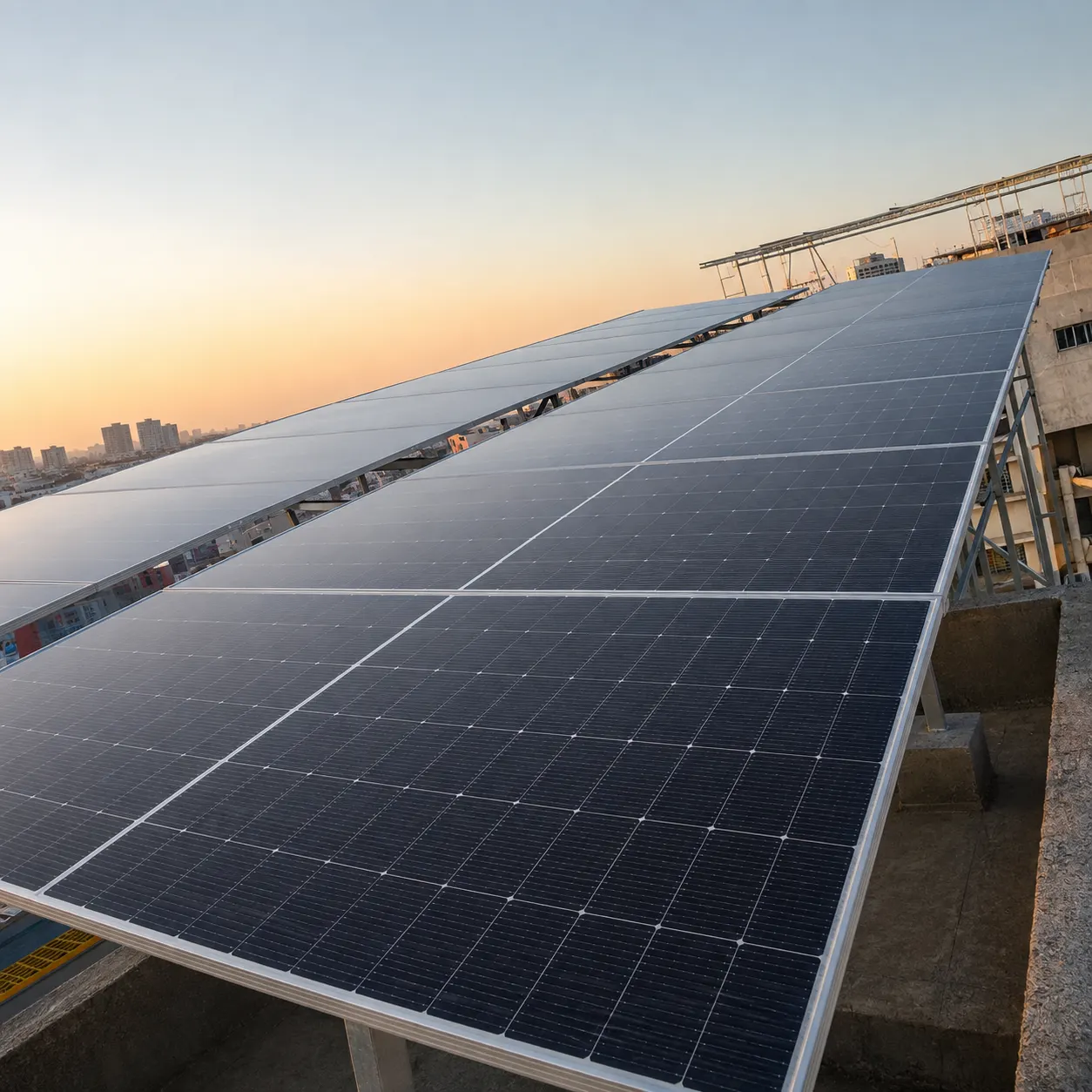
Textile markets, shopping complexes and office blocks often have a shared roof but many electricity accounts. A solar array must connect to an approved meter, and the owners must decide who funds, owns and maintains it. The most practical starting point is usually the building’s common-area account, followed by a separate review of tenant meters and any state-permitted sharing mechanism.
Direct answer. Solar for a commercial complex should start with a roof-rights and meter map. A common-area array can offset matching consumption on its approved account; it does not automatically credit every tenant. MPERC’s 2024 rooftop regulation permits group and virtual arrangements for eligible categories under stated conditions, while Maharashtra’s 2024 virtual provision is framed around residential consumers. A Gujarat commercial project needs the current GERC rule and utility approval before any shared-credit claim.
What is the difference between a common-area and tenant-meter plant?
For a Gujarat net-metering proposal, also check the DRES instrument signed 30 October 2026. Its published non-residential rule caps exported-energy set-off at 30% of grid imports in the billing cycle, with applicable banking charges and lapse of exports beyond the cap. This can change the value of low-load-day surplus. Gazette commencement and the terms governing the account must be confirmed with the DISCOM; direct on-site use is a separate quantity.
Most complexes have electricity for lifts, pumps, corridors, parking, central air conditioning or fire systems on one or more common accounts. Each shop or office may have its own utility meter. A solar plant tied to the common meter reduces that meter’s matching grid imports under its approved arrangement. The tenants may benefit indirectly if the association’s service charges fall, but their individual utility bills do not change automatically. The solar for shops guide covers the separate tenant-funded case.
Begin with a meter inventory. Record every consumer number, licensee, tariff category, sanctioned load or contract demand, physical location and person authorized to sign. Identify which roof zones belong to the association, a landlord or an individual unit. A common roof can be legally controlled by an association even if a tenant has an exclusive terrace licence. The EPC should not assume roof access from a building photograph or a property manager’s verbal approval.
The common-area account may have a good daytime baseload from lifts, water pumping and central cooling. It may also have mostly evening lighting. Use a year of bills and interval meter readings where available to find out. A tenant meter can have a stronger daytime load but limited rights to the roof. The commercial solar route is the proper proposal path for these business accounts; the housing-society solar guide describes a different residential common-meter context, which should not be copied as a commercial eligibility rule.
Decide which meter receives solar, who can authorise the roof and how the contributors receive the benefit. First decide which account would receive generation. Second confirm who can legally authorize the roof and interconnection. Third decide how the people paying for the plant receive the benefit. The utility settlement and the association’s internal sharing agreement are separate. A proposal should show both. Without that separation, a table of “savings per shop” can look precise while lacking any approved mechanism to put credits on tenant bills.
| Account | Possible solar effect | Governance question |
|---|---|---|
| Common-area meter | Directly offsets matching common services | How does the association allocate lower expenses? |
| Individual tenant meter | Offsets that tenant’s matching use | Does the tenant have roof and lease rights? |
| Multiple meters under proposed sharing | Depends on state rule and approval | Are category, ownership and meter conditions met? |
The table is a decision map, not a statement that every sharing option is available in every state.
Which state rules govern group or virtual crediting?
The terms group net metering and virtual net metering have legal meanings under state regulations. They are not a general right to divide generation among nearby meters. In Madhya Pradesh, the MPERC Grid Interactive Renewable Energy Systems and Related Matters Regulations, RG-39(II) of 2024, notified 15 March 2024 state that eligible consumers of all categories may install group and virtual arrangements below 100 kW, subject to the regulation’s remaining conditions. MPERC lists a first amendment dated 18 June 2026. A specific complex must check the amended text, meter relationships and utility approval before treating the route as available.
Maharashtra is different. MERC’s current rooftop regulation index lists the 2019 base regulation and 2024 Second Amendment. MERC’s explanatory memorandum for that amendment describes the virtual-net-metering addition for residential consumers, including multiple residential consumers and a housing-society common connection. A shopping complex should not cite that residential provision as authority to divide commercial rooftop credit among shops. MSEDCL’s official rooftop consumer page provides its net-metering and net-billing application documents for eligible consumers.
GERC published its final distributed renewable energy regulation dated 30 October 2026. Clause 8.5 requires group net metering accounts to have the same consumer name, tariff category and licensee. Clause 8.6 provides virtual net metering subject to its category and licensee conditions. Commencement depends on Gazette notification under clause 1.2. Confirm that effective date and the licensee’s application process before allocating generation between tenant accounts; a common roof alone does not establish eligibility. The business net-billing versus net-metering guide explains why export settlement can also differ by category.
| State | Official reference | Safe planning position for a commercial complex |
|---|---|---|
| Gujarat | GERC rooftop regulation and amendments | Confirm any multi-meter sharing in a final rule and DISCOM approval |
| Maharashtra | MERC 2019 regulation, 2024 amendment | Do not apply residential virtual provision to commercial tenants |
| Madhya Pradesh | MPERC RG-39(II) of 2024, amended 2026 | Test group or virtual eligibility and all conditions for the exact accounts |
This comparison is dated to the cited instruments as read on 30 October 2026. The approved connection agreement remains the project document.
The order dates should appear in any proposal that relies on a shared-credit mechanism.
How should an association choose a solar capacity?
Start with the proposed host meter’s interval load, not the sum of every tenant’s bill. If the array is tied to the common-area account, use the common-area consumption during solar hours. A complex with central AC, lifts and pumps can have a meaningful daytime baseline. Another may use most common electricity for night lighting and security. The roof can be large in both cases, but the value of direct solar use differs. The business bill-to-size guide explains the need to convert bill rupees into units and an operating profile.
Illustrative example, not a site forecast: suppose a complex’s common-area array produces 600 kWh on a representative day. The common meter uses 450 kWh during matching solar intervals, so up to 150 kWh could be surplus. The tenants together use another 1,000 kWh, but their demand is on separate utility meters. Without an approved sharing arrangement, those tenant units do not automatically absorb the common array’s surplus. A proposal that counts all 1,450 kWh as direct use would overstate the common-meter case.
Compare a smaller common-load array, a larger export-heavy array and a properly documented multi-meter option if state rules allow it. Each case should use the same weather and roof assumptions. Show monthly generation, direct use on the host meter, export, remaining imports and fixed or demand charges. A complex may have weekly market closures or seasonal vacancies that change load. Include those in the low-use case before accepting a capacity based on a busy trading day.
The physical ceiling matters too. Survey the roof for water tanks, HVAC equipment, skylights, fire routes, telecom leases, waterproofing and structure. A market building may have many additions over time, so a structural engineer should assess each bay. The roof-strength guide gives the checklist. The solar capacity and sanctioned-load guide covers connection caps and load extensions. Neither roof area nor sanctioned load alone is a recommended array size.
Sizing rule
Use the host meter's consumption for direct-use sizing. Tenant loads count only under a documented, approved sharing mechanism.
The association should ask for the exact meter list and unit split in the proposal. That one page can prevent a multi-tenant project from being sold on a benefit it cannot deliver.
Who pays, owns and receives the benefit?
An association can fund a common-area project through reserves, a special contribution or another approved arrangement. A landlord may fund it and adjust service charges. A third party may own and operate the array under a power agreement. Each route changes who holds the utility application, who pays maintenance and how lower electricity costs reach tenants. The OPEX versus CAPEX guide explains the broad models; a multi-tenant complex needs its governing documents applied to them.
Record the association’s authority to approve expenditure and roof use. Some buildings require a member vote or committee resolution. A single investor may not be able to occupy the common roof without consent. If tenants contribute, the agreement should state whether their contribution buys ownership, a service-charge reduction or another benefit. A promise of “equal savings” may be unfair when units have different areas or electricity use. The allocation formula belongs in the association’s contract, not in the utility’s meter settlement unless an approved scheme provides it.
Create an internal benefit schedule. It can show the common-area bill before and after solar, the maintenance reserve, any debt or power-purchase payment and the resulting service-charge treatment. The numbers should be based on actual bills and disclosed assumptions, not a guaranteed saving percentage. If a landlord owns the equipment, tenants should know whether the lower common cost is passed through and how that will be audited. If a tenant leaves, the building should not have to renegotiate the solar meter arrangement because one lease changed.
The contract should also cover roof repairs, future construction, insurance and end-of-term removal. A market roof may need new ducts or waterproofing. Who removes panels, pays for it and restores production? Who owns inverter credentials and generation data? The solar for tenants guide gives basic rights questions, but association bylaws and commercial leases determine the actual deal.
The owner’s accountant and legal adviser should review any tax or GST treatment for the chosen ownership structure. Do not insert a blanket accelerated-depreciation or input-credit benefit into a complex’s base energy case. A common association, landlord and tenant can have different tax positions even on the same building.
What approvals and roof checks should come before a vote?
The committee should commission a preliminary roof and meter study before voting on a final capacity or funding amount. The study should identify structurally usable zones, shading, access routes, drainage, fire equipment and the electrical path to the host meter. A structural review is especially important in older market buildings where roof additions and equipment may not match original drawings. The roof inspection guide helps the committee document the physical condition.
The approval pack should include a meter map, property or association documents, resolution or consent route, proposed layout, structural conclusion, single-line diagram and the current utility application form. The CEA Measures Relating to Safety and Electric Supply Regulations, 2023 are the national safety reference for electrical works. The local DISCOM and regulator set the interconnection process. A building permission or fire review may be needed for a new carport or major roof alteration; it should not be assumed for every ordinary module installation without checking the site.
During construction, plan material movement through shared areas and restrict access to work zones. A textile market may remain busy while rooftop work proceeds, and loading routes cannot simply be closed without a tenant plan. The final electrical tie-in may need an approved outage window for common services such as lifts, pumps or fire systems. The contract should state who notifies tenants and who maintains essential services during that window.
After approval, retain the DISCOM agreement, meter details, protection settings, drawings and inspection records in the association’s permanent files. Committee members and tenants change. A project dependent on one manager’s memory becomes difficult to maintain or alter. The handover should name the person authorized to call the utility and the person responsible for roof access and inverter alarms.
The association should also plan for future roof repairs. The solar layout should preserve service corridors and the contract should say how modules can be removed and reinstated. This is a practical cost driver that can matter more than a small difference in module specification.
How should the association compare EPC bids and O&M scope?
Give every bidder the same common-meter bills, interval data, roof plan, association rules and intended host connection. Require separate calculations for direct use, export and any proposed tenant credit. If a bidder proposes group or virtual metering, ask for the effective regulator clause and a written utility approval route. A proposal that merely lists “virtual net metering” without state eligibility is not a complete bid. The industrial EPC comparison checklist offers a broad normalisation method.
The equipment comparison should include module and inverter specifications, mounting, roof strengthening, cable route, metering, protection, monitoring and warranties. The scope comparison should include utility paperwork, structural sign-off, tenant notices, roof waterproofing, shutdown planning and handover. O&M should state cleaning access, inspection, inverter alarms, roof leak responsibility and replacement process. A lower headline price can simply exclude tasks the association will still have to purchase.
- ✓ Host meter and roof rights named
- ✓ Shared-credit rule cited if used
- ✓ Tenant notices and tie-in planned
- ✓ Maintenance and roof repair assigned
- ✗ Tenant bills counted as common-meter use
- ✗ Residential virtual rule used for shops
- ✗ Association vote assumed
- ✗ Roof repair omitted from contract
The final comparison should show the common-area bill effect and the association’s internal allocation method as separate tables. If a tenant-funded array is also proposed, keep its costs and credits separate. That makes the decision understandable to owners who do not work with electricity regulations every day.
The association should keep an assumptions register with the source and date for each tariff or rule. When a tenant mix or building load changes, the model can be updated without reconstructing the original bid. This is particularly important in market buildings where occupancy and operating hours can change quickly.
How can the building split a real common-area benefit?
The utility will bill the approved common-area account under its metering agreement. The association can then decide how any lower common electricity cost affects service charges, subject to its bylaws and leases. This is an accounting and governance step, not an additional utility credit. Each occupant should be able to see the common-area bill, solar production and maintenance costs used in the calculation. A single headline “saving per tenant” is too vague when units have different area, usage or service-charge terms.
Illustrative accounting example, not a forecast or actual building: suppose a common-area electricity bill is ₹100,000 for one month before considering a proposed solar plant. For a later comparable month, assume the common-area grid bill is ₹80,000 and the association spends ₹5,000 on solar operation and financing. The illustrative net difference is ₹15,000. Whether that amount reduces the following service charge, builds a maintenance reserve or is allocated another way depends on the building’s adopted rules. The individual shop’s utility bill is not reduced by this internal calculation. The example deliberately excludes a fixed savings percentage because real bills, occupancy and tariffs vary.
The comparison month should be comparable. A tenant vacancy, cooler weather, new central AC plant or changed lift use can lower the common bill independently of solar. The association should compare imported units, exported units and generated units, then adjust for building operation. The solar generation monitoring guide explains the records that help. A transparent log makes the allocation defensible to owners who joined after the original project vote.
If the project is funded by a special contribution, the committee should record who paid and whether future tenants or owners inherit a benefit or obligation. If a landlord funded it, the lease should state whether service charges pass through the reduction. If a third party owns it, any power-purchase payment must be deducted before presenting a net common-area benefit. These are contract terms, so the building’s adviser should review them with the proposed utility arrangement.
Benefit allocation
A lower common-meter bill can change service charges under building rules. It is not the same as a utility credit on each tenant's meter.
The committee should approve the formula before commissioning, then report actual results using the same method. That is clearer than promising a fixed rupee amount to every shop.
Request a multi-tenant proposal: Bring the common-meter bills, tenant-meter map, roof documents and association rules to the commercial solar enquiry. Ask for the exact credit and benefit-sharing routes.
How Heaven Green Energy helps scope a Complex
For a commercial-complex enquiry, assemble a year of bills for the proposed host meter, interval data if available, a tenant and common-meter map, roof plans, ownership or association documents, and the committee’s approval procedure. Heaven Green Energy files DISCOM paperwork for its customers. The association should identify the authorized applicant and provide accurate consumer and property records.
The relevant routes are:
- Commercial solar for the primary complex or market-building proposal.
- Industrial solar only where a separately operated factory has its own industrial account.
- Solar for housing societies for a distinct residential common-area comparison, not a commercial rule.
The first review should settle the host meter and roof rights. Next, compare the host account’s daytime load with roof generation and identify any quiet periods. Then the committee can review export treatment, internal allocation and funding. A group or virtual proposal should be advanced only with a current regulator clause and an approval plan for those exact meters. This keeps an attractive sharing diagram from outrunning the utility rules.
Use this buying sequence:
- Inventory meters. Separate common, landlord and tenant accounts.
- Map roof rights. Identify who can authorize structural and electrical work.
- Model direct use. Start with the proposed host meter’s interval load.
- Verify sharing. Cite an effective state rule for any multi-meter credit.
- Approve funding. Record contributions, ownership and allocation method.
- Plan operation. Assign maintenance, roof access and utility records.
After commissioning, compare generation, common-meter imports and exports with the original load model. The association can then account for the actual reduction in common costs under its bylaws. Tenant turnover and changed trading hours may alter the load, so the committee should retain the baseline and approval file. A later capacity change should be checked with the DISCOM before panels are added.
Use the commercial solar route for the primary enquiry. The useful outcome is a meter-specific project with a benefit allocation the building can govern.
Frequently asked questions
Can one array reduce every shop’s electricity bill?
Not automatically. A common-area array serves its approved host meter. Any group or virtual credit across tenant meters needs an applicable state rule, qualifying accounts and utility approval. A private service-charge reduction is a separate association decision.
Does MP allow group or virtual net metering for commercial users?
MPERC’s RG-39(II) of 2024 states eligible consumers of all categories can use group and virtual arrangements below 100 kW, subject to its conditions. The 2026 amendment and the specific utility application must be checked before a complex relies on that route.
Can a Maharashtra shopping complex use residential virtual net metering?
The MERC 2024 amendment’s virtual provision is framed around residential consumers. A commercial complex should not assume that wording covers shops. It should seek a current rule and MSEDCL confirmation for its exact account structure.
Is a committee resolution enough to connect solar?
No. The resolution can authorize spending and a signatory, but the DISCOM must approve the interconnection and metering. Structural, property and electrical-safety checks may also be needed for the proposed design.
Who maintains a donated or landlord-owned plant?
The ownership and service agreement should assign cleaning, monitoring, repair, roof access and utility contact. A funding source does not automatically provide long-term O&M. The association should hold the handover records permanently.
What should a market building send for a first proposal?
Send common-meter bills, interval readings if available, a tenant-meter list, roof plans, association or property documents and the approval process. A proposed shared-credit design also needs the relevant state-rule basis.
Ask the committee to identify who signs the utility application and who will keep the generation, import and export records after commissioning. Those roles matter when tenants or committee members change.