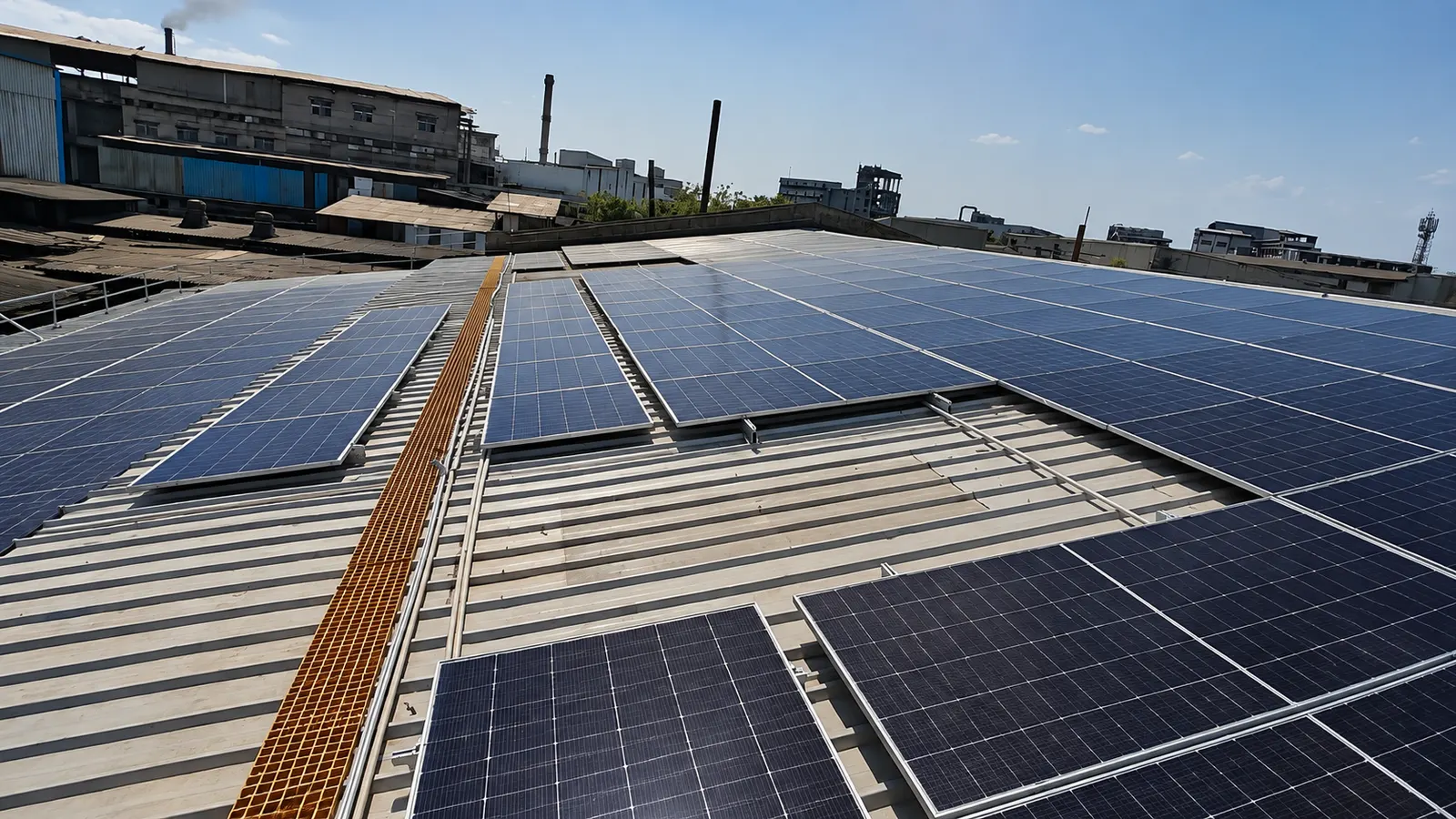
A cotton ginning mill can have strong power demand during its operating season and very little use in quieter months. An oil mill may run a different calendar. Rooftop solar produces whenever sunlight is available, so the owner’s first question is not “How much roof?” but “Where will the units go when production is low?”
Direct answer. Size a Saurashtra mill’s rooftop solar from month-by-month and interval consumption, not its busiest-season bill. GERC’s rooftop rules distinguish self-used energy from exported energy and the commercial settlement depends on the consumer’s approved arrangement. The PGVCL FY 2026-27 tariff is dated 25 March 2026. A viable project must also account for the roof, dust and cotton fire-safety controls.
Safety-law date check. The OSH Code became effective with the Labour Codes on 21 November 2025. The 2019 Model Factories Rules cited here are a historical model reference; they do not prove which current state rules, saved provisions or site permissions apply. Have the plant’s competent safety adviser confirm those requirements for the actual work.
Why does seasonal operation change solar economics?
Ginning load follows the arrival and processing of cotton, while solar generation follows sunlight. The two calendars do not necessarily align. A plant may use a large amount of power for gins, presses, air systems and lighting during busy months, then draw only security, office and maintenance load in quieter months. A yearly total hides that swing. If a rooftop array is sized to a peak-month bill, it may export a high share of its output during low-load months.
Ask for at least twelve months of complete PGVCL bills and, where available, interval data. Mark the weeks of operation, machine maintenance and any shutdown. Record the minimum daytime load on a working day and on an idle day. A machine list helps identify starting and running loads, but meter data shows what the utility actually billed. The industrial solar installation guide covers the general factory process; seasonal mills need an additional month-by-month use test.
Oil mills should be modelled separately. Their raw-material supply, extraction hours, heating and packaging load can differ from the ginning calendar. A site that houses both operations may have a more even daytime load than a standalone ginning plant, but that must be shown by data. Do not assume that one business name means one electricity profile. The owner should explain which plant runs under which consumer number and whether the two operations share a meter.
Use the checklist. First map monthly operating seasons. Then map 15-minute or hourly consumption against expected solar output. Finally test the usable roof and approved connection. The test distinguishes three values: solar used immediately by the mill, surplus exported under the rooftop agreement, and production that cannot be used because of a design or connection constraint. A good proposal makes all three visible.
| Month type | Typical mill question | Solar-model consequence |
|---|---|---|
| Busy production month | Which hours run the gins or presses? | Estimate direct use during solar hours |
| Partial-operation month | Does the mill run every day? | Test weekend and low-load export |
| Idle month | What minimum services remain on? | Value most potential surplus under the approved rule |
The table is a method, not a seasonal forecast for any named mill. The owner should supply its own production calendar.
Under clause 9.1.5 of the published 2026 DRES instrument, non-residential net-metering exports can offset only up to 30% of the billing cycle’s imported energy, with applicable banking charges; excess exports lapse. A seasonal mill must test idle months against that limit if the instrument applies. The rule’s Gazette commencement and the treatment of an existing agreement require written confirmation.
How are rooftop exports settled for a PGVCL business?
The governing evidence is the applicable regulation, commissioning approval and account agreement. The 2022 Third Amendment replaced the earlier accounting provisions: captive and third-party HT/EHV routes had daytime same-day set-off, LT demand-based routes had daytime billing-cycle set-off, and REC/RPO cases had their own interval rules. A simple industrial label did not establish 15-minute accounting. GERC’s DRES instrument signed 30 October 2026 publishes a further framework; confirm Gazette commencement and the clause governing the account before modelling seasonal surplus.
This matters for seasonal mills because exported units are not automatically a store of retail-value electricity for the next busy month. A commercial rooftop arrangement can settle surplus within a billing period or 15-minute accounting framework, with compensation for excess injection under the applicable clause. Open-access banking is a separate mechanism under Gujarat’s Green Energy Open Access Regulations. The banking-electricity glossary explains that distinction. The published 2026 DRES framework links business rooftop banking to the applicable green-open-access charge; residential exemptions should not be assumed for a mill. Confirm commencement, chargeable units and account terms.
The EPC should identify the consumer category, installation date, rooftop regulation clause, meter type, settlement period and export compensation source in the proposal. Ask for a worked bill showing a busy and an idle month. If the bidder says excess units “carry forward,” ask it to quote the exact agreement clause and expiry rule. If the bidder says every surplus unit is sold, ask for the rate-setting order and how the amount appears on the PGVCL statement.
Regulation note
A rooftop export credit and an open-access banked unit are different arrangements. Read the mill's approved agreement before valuing idle-month output.
The commercial net-billing versus net-metering guide gives the broader business comparison across states. For this mill, the exact PGVCL agreement is the final modelling input.
What size avoids excessive idle-month export?
Build the model around direct use in the lowest realistic operating period, then test the value of any extra production. A large roof does not require a large array. The mill may benefit from an array sized for its normal daytime processing load, while a larger design exports more during shutdowns. The right size is not necessarily the one that covers the highest month or the annual average.
Start with a proposed solar generation profile for each month, using a site and orientation-specific method. Subtract the mill’s interval consumption under its operating calendar. Show how many units are used on site and how many are surplus in each accounting period. Repeat for a conservative production scenario. The proposal should record roof shading, dust and expected cleaning access because they affect generation, but it should not use an invented site yield as a fact.
Illustrative example, not a PGVCL bill or project forecast: assume a candidate array produces 10,000 units in a busy month and the mill can use 8,000 of them during matching production intervals. Suppose the same array produces 10,000 units in an idle month but the mill uses only 1,000 in matching intervals. The first month has 2,000 possible surplus units and the second has 9,000. These assumed quantities show why the applicable export rate and settlement period can change the commercial case. They do not imply that every exported unit has the same value or that an actual array will produce 10,000 units in both months.
| Illustrative month | Solar generation | Matching mill use | Potential surplus |
|---|---|---|---|
| Busy month, hypothetical | 10,000 units | 8,000 units | 2,000 units |
| Idle month, hypothetical | 10,000 units | 1,000 units | 9,000 units |
Real metering may use 15-minute settlement and other adjustments under the approved category. The EPC should model those blocks and value surplus separately from self-consumption.
The sanctioned-load solar-capacity guide covers the connection cap, while the contract-demand glossary explains the HT or LT demand term. A mill can be limited by its approved connection or roof structure even if the busy-season bill seems to justify more panels. Size within all three constraints: load, roof and regulation.
Check both seasons before sizing. Send a full year of PGVCL bills and the production calendar through industrial solar so a proposal can compare busy and idle months.
Does an oil mill need a different solar design from a gin?
Yes, if its process and operating calendar differ. An oil mill can have motors, presses, filtration, heating and packaging loads that run at different hours from a cotton gin. Some units may share a site or electrical connection; others have a separate meter and roof. The proposal should establish the actual arrangement. A combined premises may have a useful year-round daytime base load, but a standalone seasonal mill may not. The decision still rests on measured energy rather than a sector label.
Ask for process stages and the times each runs. A high-capacity motor that operates briefly is a demand issue; a smaller motor that runs for many daylight hours is an energy-offset opportunity. Heating loads may use electricity or another fuel, so they should not automatically enter a solar electricity calculation. Record the source of each major energy use. The bill model should value only electricity that the rooftop plant can actually displace under the approved connection.
The roof may also differ. Oil-mill extraction and handling can create deposits near vents, while a gin can have cotton lint and dust. Both affect cleaning and equipment placement, but the hazards and maintenance method must be assessed site by site. Keep modules clear of exhausts, roof openings and service routes. A structural engineer should confirm the load path for the actual shed. The roof-strength guide applies to either business.
For a combined site, check whether one meter supplies both operations. If two meters exist, a single rooftop array cannot simply be credited to both without an approved regulatory arrangement. The owner should map the meter, roof rights, circuit boundaries and legal applicant. A scheme that looks attractive in a site-wide energy total may fail when the two bills are separated by connection.
The bid should therefore include two load profiles if the plant has both processes. Show the ginning-only period, oil-mill-only period and any overlap. This reveals whether a proposed array depends on one process operating to use its output. A buyer can then choose a capacity that remains sensible even when one production line is idle.
How do shed roofs, dust and cleaning change the scope?
An older ginning shed may have corrugated metal or cement sheets, rooflights, high vents and repair patches. Its gross area is not its usable solar area. Check the purlins, rafters, fixings, sheet condition and wind-load path before finalising capacity. The old-roof safety guide explains why a brittle covering cannot be treated as a working platform or structural support. If the roof is unsuitable, re-roofing or an alternative site may be safer than forcing a solar layout onto it.
Cotton lint and local dust can settle on modules, frames and electrical enclosures. Do not prescribe one cleaning interval for every mill. Establish a post-commissioning baseline, monitor generation and inspect safely when output or visible soiling warrants it. The solar cleaning guide covers general methods, but the mill needs a site-specific access plan and a method that does not move dust into live electrical equipment or production zones.
The array should preserve roof drainage and access to extraction equipment. A maintenance worker must reach inverters, isolators and module rows without crossing fragile sheets or blocked vents. The EPC should draw those routes and specify whether elevated platforms, fall protection or temporary isolation are needed. A densely packed design can raise service difficulty even if it fits in a CAD layout.
Material movement deserves its own plan. Lifting modules over stored cotton, presses or workers creates a risk separate from electrical installation. Define exclusion zones, weather limits, storage locations and daily housekeeping. The factory installation without shutdown guide explains phasing; the mill should adapt that sequence to its production and storage calendar. Roof work during a low-production period may reduce disruption, but it must still meet the approved safety method.
The proposal should separate solar scope from roof repairs, waterproofing, lint-control measures and ongoing cleaning. A low equipment price is not a complete project price if the roof must be reinforced or access platforms added. Ask for the exclusions and who owns each task after handover.
What fire and electrical controls matter around cotton?
Cotton and lint make housekeeping, hot-work control and electrical equipment placement central to the project. The solar array should not obstruct fire access, roof openings or the plant’s existing emergency plan. Cables, connectors and isolators need suitable routing and protection, and maintenance areas should be kept clear of accumulations. The solar fire-safety guide covers the general PV controls; the mill’s EHS team should apply its own fire-risk assessment to the actual stored material and process.
The CEA Measures Relating to Safety and Electric Supply Regulations, 2023 provide national electrical-safety requirements. The DG FASLI Model Factories Rules, 2019 provide model factory-safety provisions, but the applicable state rules and the plant’s own permits govern the site. Neither document is a substitute for an engineered solar layout and a cotton-specific fire plan.
The EPC should show DC and AC isolation, cable routes, earthing, protection, roof access and the location of each inverter and switchboard. Keep equipment away from known lint accumulation and water paths where the site design allows. If a hot-work activity is proposed for mounting or cable trays, the plant should approve it through its permit system and protect materials below. Do not treat a roof installation as separate from production fire risk just because the panels are outdoors.
Watch out
Keep lifting, hot work and electrical commissioning separate from cotton storage zones unless the plant has approved controls for each activity.
At commissioning, retain insulation, earthing, protection and meter-test records. At handover, train the plant electrician on isolation and emergency access. The O&M plan should include periodic visual checks for damaged cables, loose connectors, roof leaks and lint deposits. A cleaning plan that only lists panel washing misses these safety-critical items.
The site fire plan should tell the solar contractor where lint is handled or stored, which access paths must remain open and who authorises work that can create heat or sparks. It should also identify the solar isolation points for emergency responders and the plant maintenance team. Those controls need to appear on the final drawing and handover record, not just in a meeting note before installation.
What do PGVCL tariff and off-site options change?
The PGVCL tariff order for FY 2026-27, Case 2583/2025 dated 25 March 2026, and the common state-DISCOM tariff schedule effective 1 April 2026, should be read against the mill’s actual bill category. A seasonal business may still face fixed or demand charges during low-production periods. Solar can reduce imported energy while leaving those lines. The proposal should not claim that rooftop generation will eliminate the entire bill in an idle month.
If the rooftop is too small or an owner wants power from separate land, open access or a captive arrangement is a distinct route. It brings grid charges, losses, banking and contract terms. The Gujarat landed-cost guide separates those lines. An off-site plant does not use the ordinary rooftop export settlement simply because both projects produce solar electricity. A seasonal mill should model the timing of off-site generation and its own demand with the applicable banking and settlement rules.
- ✓ The mill uses much of the output during production.
- ✓ Roof and meter rights are clear.
- ✗ Idle months create large unvalued surplus.
- ✗ Roof or fire access is unsuitable.
The choice is not a generic ranking of rooftop and open access. A gin that shuts for part of the year may value exported or banked energy differently from a year-round oil mill. Demand charges and the plant’s seasonal classification also matter. Use the actual PGVCL bill, connection agreement and current GERC provisions. If the mill has more than one meter, model each separately before combining any site-wide figure.
Ask the EPC to show the base case without an assumed subsidy or tax benefit. Any policy incentive should be added only after eligibility is verified for the specific business. This keeps the solar decision tied to electricity and project facts rather than an uncertain external benefit.
How Heaven Green Energy helps scope a Seasonal Mill
For a factory proposal, collect the complete PGVCL bills for a full operating year, the production calendar, interval consumption where available, roof drawings, meter details and site fire plan. Heaven Green Energy files DISCOM paperwork for its customers. The owner should provide accurate connection and property documents and approve the mill-specific roof and fire work method.
The service routes are:
- Industrial solar for a ginning or oil-mill factory rooftop proposal.
- Commercial solar for a smaller business connection.
- Ground-mount solar park if a separate land-based route needs study.
Ask for a proposal that shows busy, partial and idle months. It should value directly used solar units and exported units separately under the applicable GERC arrangement. It should list the remaining fixed or demand charges from the PGVCL bill, not simply multiply all solar generation by the retail energy rate. The roof survey should state usable area, structural condition, lifting route and the work needed to preserve fire access.
The buying sequence is:
- Map the season. Mark production and idle periods from actual bills and records.
- Check the settlement. Identify the GERC clause and meter agreement for exports.
- Survey the roof. Confirm structural capacity, dust exposure and safe access.
- Review fire controls. Agree lifting, hot-work and electrical isolation plans.
- Compare sizes. Test a direct-use design against a larger export-heavy one.
Use the industrial solar route for the primary enquiry. The useful outcome is a size and approval plan that remains sensible when production is low. A project that only looks attractive in the busiest month has not answered the main seasonal question.
The owner should also request a handover pack showing the approved single-line diagram, protection settings, meter arrangement and cleaning access plan. These documents help the plant team compare expected output with actual seasonal performance and distinguish a solar fault from an ordinary drop in production load. Any later capacity change should be checked against the applicable DISCOM approval before equipment is ordered.
Keep the production calendar with the energy model after commissioning. When a season starts late or a mill runs fewer shifts, compare the changed load with the export ledger before judging the solar plant’s performance. The operations team should record dust cleaning, inverter alarms and any days when roof access is restricted by cotton handling. That record separates a generation problem from a change in mill activity and gives the next season’s sizing or maintenance decision a factual basis.
Frequently asked questions
Should a cotton ginning mill size solar from its busiest month?
No. That can create large exports in quieter months. Use a full year of bills and interval consumption, then value direct use and possible surplus separately under the mill’s approved rooftop arrangement.
Can unused rooftop solar units be saved until the next ginning season?
Do not assume so. GERC rooftop settlement depends on the consumer category, applicable amendment and connection agreement. Open-access banking is a separate mechanism. Ask the EPC to cite the exact clause for any claimed carry-forward.
Does an oil mill need the same solar size as a cotton gin?
Not necessarily. Its process and operating calendar may differ. Model each mill’s actual meter, shifts and roof. A combined site with two meters also needs a connection-specific design.
Will rooftop solar remove PGVCL demand charges in the off-season?
Not automatically. The mill’s tariff category can retain fixed or demand charges even when imports fall. Read the FY 2026-27 PGVCL order and the actual bill before estimating the remaining charge.
Is a dusty ginning shed suitable for solar?
It can be if the structure, covering, fire access and maintenance route pass a site survey. Dust and lint require a cleaning and inspection plan; there is no safe universal cleaning frequency for every mill.
What should a Saurashtra mill send for a proposal?
Send twelve months of complete PGVCL bills, the production calendar, interval data if available, roof drawings or safe photographs, meter details and the site’s fire-safety requirements. These inputs let the EPC test busy and idle periods.
Include the months when the gin is shut and any off-season activity that still uses the meter. If a separate oil-mill circuit or tenant account exists, identify it on a single-line drawing. A seasonal proposal should show how exports settle in each billing period.