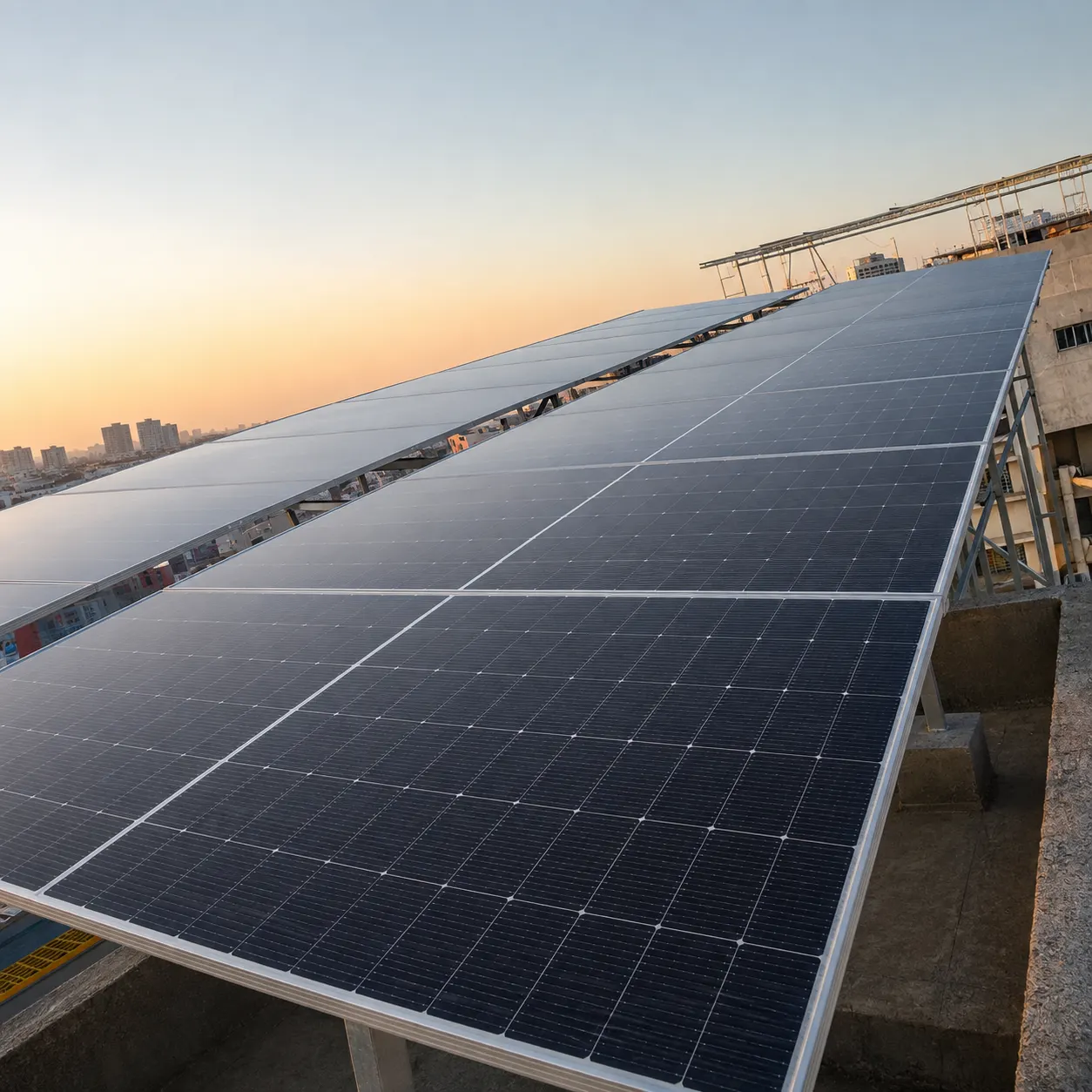
A diamond cutting or polishing unit may run its most valuable electrical loads during daylight, but it may occupy only one floor of a dense Surat building. The solar opportunity is therefore a meter-and-roof question before it is a panel question. A useful proposal starts with the actual bill, the working shift and the right to use the roof.
Direct answer. Rooftop solar can offset part of a diamond unit’s daytime grid use when the unit has a suitable roof and a clear connection route. Size it from interval consumption, usable roof area and the applicable export arrangement. Check whether the bill is from DGVCL or Torrent Power and whether the unit’s meter can legally use the proposed roof. Solar does not replace evening supply or make a shared roof automatically available.
Which diamond-unit loads are a good match for daytime solar?
For a Gujarat net-metering proposal, also check the DRES instrument signed 30 October 2026. Its published non-residential rule caps exported-energy set-off at 30% of grid imports in the billing cycle, with applicable banking charges and lapse of exports beyond the cap. This can change the value of low-load-day surplus. Gazette commencement and the terms governing the account must be confirmed with the DISCOM; direct on-site use is a separate quantity.
Start with the shift schedule rather than a guessed monthly bill saving. Cutting, polishing, laser work, CNC equipment, ventilation and air conditioning can each create a different hourly profile. A unit working mainly during daylight may consume a useful share of solar output on site. A unit with heavy evening or night shifts may have the same monthly units but lower direct use of daytime generation. This is a load-shape question, and two workshops of similar size can need different solar systems.
Ask the electrical team for twelve months of bills and, where available, interval meter data. Separate weekday, weekend and holiday operation. Note compressor cycling, air-conditioning set points, laser duty cycles and any planned machine addition. Record the minimum load during the middle of the day. That low point matters because a system sized to the busiest hour can export heavily on quieter days. The Surat solar guide gives broader local context, while this page focuses on diamond-unit load and building constraints.
An on-grid inverter reduces grid import when the machines are consuming power. It does not by itself run those machines during a power cut. A business that needs continuity for precision equipment should specify the critical load, acceptable transfer behaviour and backup source separately. Solar economics and power-quality requirements are different parts of the design. The EPC should confirm whether existing UPS, generator and protection systems will be affected by the solar interface.
Use a simple checklist. First, quantify the load during solar hours. Second, measure the roof that the business has the legal and physical right to use. Third, confirm the meter category and DISCOM connection rules. The smallest of those constraints usually sets the first practical rooftop size. A calculator based on annual units alone misses the short midday load, tenancy and approval constraints.
The solar for textile industry guide addresses a different Surat production profile. Diamond units can have denser equipment and less roof per occupied floor. This is why a factory-style kW-per-square-foot sales rule is unreliable in a multistorey commercial building. Collect the actual operating data first.
Does DGVCL or Torrent Power supply the unit?
Surat does not have one universal distribution licensee for every building. Check the name and consumer number on the bill. The GERC tariff orders list dated 25 March 2026 has separate FY 2026-27 orders for DGVCL, Case 2581/2025, and Torrent Power Distribution Surat, Case 2586/2025. The two schedules should not be mixed when estimating avoided grid charges or reading the meter category.
The DGVCL FY 2026-27 tariff order, Case 2581/2025 dated 25 March 2026 places non-residential LT premises up to and including 40 kW of aggregate load in Non-RGP unless another category applies, with LTMD available under its stated conditions. Larger LT loads use LTMD. The actual bill is decisive: its category, sanctioned load, demand and adjustment lines may differ from a shorthand description of “commercial tariff.”
The Torrent Power Surat FY 2026-27 tariff schedule, effective 1 April 2026, uses a separate Non-RGP and LTMD structure. Its published schedule places Non-RGP up to 15 kW of connected load and LTMD above that threshold or by the permitted option. These thresholds are dated to that order, not a rule for every Gujarat licensee. Confirm the currently billed category before modelling the plant.
For either licensee, do not convert the entire bill into a per-unit saving. Fixed or demand charges, fuel adjustments, electricity duty and other applicable lines can remain or vary independently. The solar valuation should identify which imported units are actually displaced in each time period and how exports are settled under the approved connection. Ask the EPC to show the bill line used for each assumption.
| Question from the bill | DGVCL route | Torrent Power Surat route |
|---|---|---|
| Licensee | DGVCL consumer number and 25 March 2026 Case 2581/2025 tariff | Torrent Surat consumer number and 25 March 2026 Case 2586/2025 tariff |
| LT category check | Non-RGP or LTMD under the DGVCL schedule | Non-RGP or LTMD under the Torrent Surat schedule |
| Rooftop application | GERC rooftop rules plus DGVCL process | GERC rooftop rules plus Torrent process |
| Proposal input | Actual category, load, demand and bill adjustments | Actual category, load, demand and bill adjustments |
If the meter is in a landlord’s name, resolve that before discussing equipment. The applicant, roof-rights holder and beneficiary of the bill must be aligned in the approval documents.
Regulation note
The DGVCL and Torrent thresholds come from different 2026 tariff schedules. Use the licensee named on the unit's bill.
How much roof can a dense Varachha or Katargam building really offer?
The building’s footprint is not the solar area. Subtract water tanks, lift rooms, ventilation plant, stair access, parapet shadows, skylights, fire routes and areas that need routine maintenance. Check whether nearby taller buildings shade the remaining roof, particularly in morning and afternoon. A dense neighbourhood can have a reasonable noon sun window yet poor shoulder-hour generation. The survey should include seasonal sun angles, not only a photograph taken at noon.
Structural capacity is another constraint. A terrace may contain old waterproofing, undocumented extensions or a slab that was never assessed for an elevated solar structure. The engineer should check the additional dead load, wind uplift, anchoring details and load path. Ballasted structures can avoid penetrations but add weight. Anchored structures can reduce ballast but require waterproofing details. Neither choice should be made from a standard brochure without a site survey.
In a multistorey building, the roof may serve several units. Even a physically empty roof may be common property, subject to a society, association, owner or lease agreement. A diamond unit renting one floor should obtain written roof rights, cable-route permission, inverter-space permission and access rights for maintenance. The agreement should explain what happens if the unit moves, the lease ends or the building is redeveloped. The sanctioned-load glossary explains the connection detail that will also constrain an application.
For a proposal, record three areas separately: gross terrace area, technically usable area and area legally allotted to the meter holder. The third can be smaller than the first two. The EPC should sketch the module layout over an annotated roof plan and show access clearances. Ask for a shade analysis that identifies neighbouring buildings and tanks. The final design should preserve drainage and access to existing plant, not simply maximize panel count.
If the roof is too small, a modest array sized to the accessible area may still be useful. It should be evaluated against the unit’s midday demand and the approved export treatment. A second option is a different eligible site or an off-site power procurement structure, but those bring separate land, grid and contract questions. The right comparison is a feasible small rooftop scheme against a properly priced alternative, not an imaginary full-roof system.
Watch out
An empty shared terrace is not a roof right. Obtain the owner's or association's written approval before treating it as usable area.
What happens when the roof is shared or the business is a tenant?
Begin with the legal relationship between the electricity meter and the roof. A tenant who pays a bill does not automatically own the right to place equipment above other occupants. A landlord who owns a roof does not automatically have a meter that matches the tenant’s consumption. Before buying panels, map the meter, roof title or lease, common-area rules, cable route and maintenance access. The solar for tenants and renters guide covers the broader tenancy problem.
The simplest arrangement is often one clearly authorised roof area connected to one eligible consumer meter, with the applicant and property owner documents aligned. Where multiple businesses share a building, do not assume that generation from one rooftop system can be divided informally among separate retail meters. Gujarat’s GERC rooftop net-metering regulation and amendments govern permitted connection and settlement arrangements. Any group or virtual arrangement must be checked against the current rule and the licensee’s approved process for that consumer category.
An agreement should cover more than installation permission. It should state the term, roof access hours, structural approval, repair responsibilities, ownership of equipment, electricity-bill beneficiary, insurance allocation, relocation, roof waterproofing and removal at lease end. If one unit pays for the system while another holds the meter, the parties need a written commercial arrangement and regulatory check. A shared-roof scheme can fail late if those questions are left until the DISCOM application.
Cable routing can become a practical bottleneck. A top-floor tenant may have a short route to its switchboard; a ground-floor unit may need permission through shafts and common areas. The EPC should check fire separation, accessible isolators, meter location and whether the building’s existing distribution board can accept the connection. An engineer should document the point of common coupling and protection arrangement.
Ask the building manager for an approved roof plan and a register of existing uses. If there are already solar arrays, water equipment or telecom installations, map them before promising capacity. The Surat location page is a route for a local site discussion, but the proposal should still start with the signed roof-rights position and the bill in the correct applicant’s name.
How should a diamond unit size solar without overvaluing exports?
Use hourly or interval demand where possible. Start with the minimum reliable daylight load on normal working days, then compare a candidate solar generation profile to that demand for each interval. Self-consumed units avoid the applicable variable import charges to the extent allowed by the billing arrangement. Exported units have their own valuation and settlement treatment under the approved GERC and licensee process. They should not automatically be valued at the same amount as avoided imports.
The GERC rooftop regulation listing contains the 2016 net-metering regulation and later amendments. A proposal should cite the amendment and connection route actually being used, rather than call every export “net metering” without checking category and capacity. The bill category, sanctioned load, point of connection and eligible roof all influence the design. The business net-billing versus net-metering guide explains why the distinction matters for a commercial consumer.
A useful sizing worksheet has four columns: time interval, grid use before solar, expected solar generation and residual import or export. Prepare it for a typical working day and a low-load day. Then test the monsoon months and holiday periods. A unit that closes for several weeks may export far more than a simple annual-average model suggests. If the unit plans to add machines or change shifts, model the future case separately rather than hide it inside one number.
Illustrative example, not a forecast: suppose a workshop uses 20 kWh in one midday hour and a proposed array produces 15 kWh during that hour. Ignoring losses and any other site generation, all 15 kWh can offset contemporaneous demand and grid import falls to 5 kWh. If the unit closes and load falls to 3 kWh in that hour while production remains 15 kWh, 12 kWh is surplus to be handled under the applicable export arrangement. This arithmetic explains why the work calendar matters. It does not state a tariff, saving or annual yield.
Request a proposal with the assumed generation profile, interval load data source, shading assessment, export cap, degradation assumption and applicable tariff order. Ask the EPC to show an alternative smaller array if the large option exports heavily. This is a better buying decision than a single capacity chosen from the monthly bill amount.
| Operating hour, illustrative | Unit load | Solar generation | Grid result before losses |
|---|---|---|---|
| Working midday hour | 20 kWh | 15 kWh | 5 kWh imported |
| Closed midday hour | 3 kWh | 15 kWh | 12 kWh surplus |
The two hypothetical hours use the same array. They show why export valuation needs its own line in a proposal.
Need a roof-and-meter assessment? Send the bill, roof rights and shift pattern through commercial solar so a proposal can compare direct use with possible export.
For a site-specific proposal, use the commercial solar route. A larger industrial unit can use the industrial solar route. Send the actual bill, shift pattern, roof plan and ownership information so the proposal can test the real constraints.
What if the roof cannot cover the unit’s annual consumption?
A small roof can still justify a small system if the daytime load uses most of its production. The first option is to maximize safe, lawful self-consumption on the available roof, not to force a larger array into shaded or inaccessible space. An elevated structure, carport or separate nearby building may create more area, but each needs structural, ownership and connection checks. Do not describe a neighbouring roof as part of the project until the owner and meter arrangement have been verified.
If the unit has a high consumption and little roof, off-site renewable procurement may be worth investigating. That is a different commercial route from rooftop net metering. It can involve open access, group captive, wheeling, banking, cross-subsidy surcharge and contract terms. Those charges and eligibility rules must be assessed using the current GERC orders and the buyer’s connection. The captive solar versus third-party PPA guide introduces the commercial choices. A small LT unit should not be told that it can simply buy off-site power under any proposed structure without an eligibility check.
For a tenant, an owner-funded rooftop system or a negotiated lease adjustment may be commercially possible if the roof owner, meter holder and benefits are clearly allocated. The agreement should state who owns the equipment, who receives the electricity benefit, who handles outages or roof repairs and what happens at lease end. A multi-tenant building may prefer to offset a common-area meter first, but that does not automatically lower each tenant’s separate bill. The arrangement must match the actual metering and regulatory route.
Some buyers consider storage because roof area is limited. A battery shifts or backs up energy; it does not create more solar generation. If the main constraint is roof area, storage alone does not solve the annual energy gap. It may have a role where the unit has an identified evening load, tariff difference or continuity requirement, but those uses need separate hourly modelling, safety design and a clear scope. Do not add a battery as a generic solution to a small roof.
- ✓ Roof rights and access are clear.
- ✓ Daytime load uses most output.
- ✗ The roof is too small or shaded.
- ✗ Meter and roof ownership cannot align.
The decision should be recorded in a short alternatives table. State the roof area, expected direct-use share, export mechanism, ownership path and approvals for each option. A clear “no suitable roof” conclusion can be useful: it prevents a business from purchasing an unbuildable system and directs attention to an off-site or building-ownership discussion.
How Heaven Green Energy helps Surat diamond units
Send twelve months of electricity bills, including pages that show the licensee, consumer category, sanctioned load, demand and adjustments. A single front page can omit the lines that decide the proposal. If interval data is available from the meter or utility, include it. A list of machine ratings is useful, but observed meter data is better for estimating the load during solar hours. Note planned expansion, changed shifts and seasonal closures.
Send an annotated roof plan, or at least dimensions and safe-position photographs. Mark tanks, lift rooms, skylights, parapets, shade from adjacent buildings, existing equipment and the location of the electrical room. State whether the building is owned or rented, who holds title to the roof and whether an association must approve work. Include any structural drawings or recent waterproofing report. The EPC can then define what site inspection is needed before finalising an array layout.
- Send the complete bill. Include the category, sanctioned load and adjustment pages.
- Mark the roof right. Identify the owner, allotted area and cable route.
- Share operating hours. Include a normal shift and a low-load day.
- Request two sizes. Compare a high direct-use option with a larger export-heavy option.
Ask the EPC to return a decision record, not just a panel quote. It should state the DISCOM and tariff category from the bill, the approved rooftop route to be checked, the usable roof area, the structural assumption, the proposed point of connection, expected self-consumption versus export and the unresolved approvals. The industrial EPC bid checklist gives additional comparison questions for larger projects. For smaller shops, the same principle applies in a shorter scope.
The final contract should say who prepares and files the DISCOM paperwork. Heaven Green Energy files DISCOM paperwork for its customers, but the owner still needs to supply accurate property and connection documents. A landlord’s consent, association resolution or revised load sanction cannot be assumed. Ask for a document list with a named owner for each item and a clear sequence from roof approval through meter commissioning.
The relevant site routes are:
- Commercial solar for a diamond workshop or multistorey business unit.
- Industrial solar for a larger factory with an industrial connection.
- Surat location guide for local service context before a site survey.
Before accepting a quote, verify the daytime load, roof rights and approved meter route in a site survey. If the unit has a good daylight load but no legal roof right, solve the right first. If the roof is available but shaded, revise the expected generation. If the roof and load fit but the meter category is uncertain, check the current GERC and licensee process. The commercial solar page is the proposal route for a diamond unit; the industrial solar page suits larger factory premises.
How should the solar design protect sensitive equipment?
Diamond-unit owners often ask whether solar will change the supply seen by lasers, CNC controls and polishing equipment. The question deserves an electrical design answer, not a general reassurance. The EPC should identify the connection point, existing transformer or LT panel, protection settings, inverter specification, earthing arrangement and any UPS or generator interface. The current electricity bill and a single-line diagram are more useful than a verbal statement that the equipment is “sensitive.”
An on-grid inverter synchronises with the utility supply. Its output can reduce net import while the grid remains present, but it is not a substitute for a UPS that maintains a defined voltage and transfer time for a critical machine. A proposal should separate the energy-saving function from the continuity function. If the factory already has a UPS or generator, map the electrical boundary so the solar inverter does not energise an isolated circuit unexpectedly. The CEA safety regulations notified in 2023 are the national electrical-safety baseline; the actual connection must also satisfy the licensee’s approved protection requirements.
Power factor and harmonics also need attention where the site has many drives, compressors or electronic power supplies. Solar can change the active power drawn at the utility meter while the facility’s reactive load remains. This can change the grid-side power factor shown on a bill. Ask for a measurement before and after installation and a review of any APFC panel and inverter reactive-power settings. The power-factor penalty after solar guide explains the mechanism and checks in detail. The EPC should identify who will set and test those controls at commissioning.
The bid should include a commissioning test plan. It can list insulation and earthing tests, anti-islanding verification, inverter settings, meter import and export checks, and observation under representative machine operation. These tests do not promise that every future power-quality issue has one cause. They create a baseline so the owner can distinguish a pre-existing machine or UPS fault from a solar-interface problem. Keep the test report with the approved drawings and train the site electrician on the isolation points.
Finally, ask how the solar system will be monitored. A generation graph alone does not show whether a laser has stable power. The unit should retain its usual equipment and power-quality logs where required by its own process. Solar monitoring, grid meter data and machine events should be reviewed together if a problem appears after commissioning. That is a more useful acceptance criterion than a blanket statement that solar is compatible with every machine.
Frequently asked questions
Is solar suitable for a diamond polishing unit in Surat?
It can be when the unit has substantial daytime grid use, a structurally suitable roof, a clear roof right and an eligible meter arrangement. A bill, interval load data and roof survey are needed to size it responsibly.
Does DGVCL or Torrent Power supply every diamond unit in Surat?
No single licensee supplies every premises. Read the bill. GERC issued separate FY 2026-27 orders on 25 March 2026 for DGVCL and Torrent Power Surat, so the tariff category and application route must follow the actual connection.
Can a tenant install solar on a shared building roof?
Only after obtaining the necessary owner or association permissions and checking the meter connection route. The agreement should cover roof area, cable access, equipment ownership, maintenance and what happens when the lease ends.
Will solar run lasers and polishing machines during a power cut?
A standard on-grid solar inverter does not by itself provide outage backup. Continuity needs a separately designed backup arrangement matched to the critical machines and power-quality requirements.
Should a diamond unit size solar from its monthly bill amount?
The bill is a starting point, but interval daytime consumption, roof area, shade and export treatment determine a useful size. Ask for a model of a normal workday and a low-load or holiday day.
What if a unit has too little roof for its electricity use?
Consider a smaller self-consumption array first. Other buildings or off-site procurement may be options only after roof rights, connection eligibility, charges and contracts have been checked. A battery does not create additional solar generation.
For a shared commercial building, confirm whether the owner will allow a separate cable route and metering arrangement before counting any neighbouring roof. If the unit rents its premises, record who owns and maintains the equipment when the lease ends. The answer is site-specific.