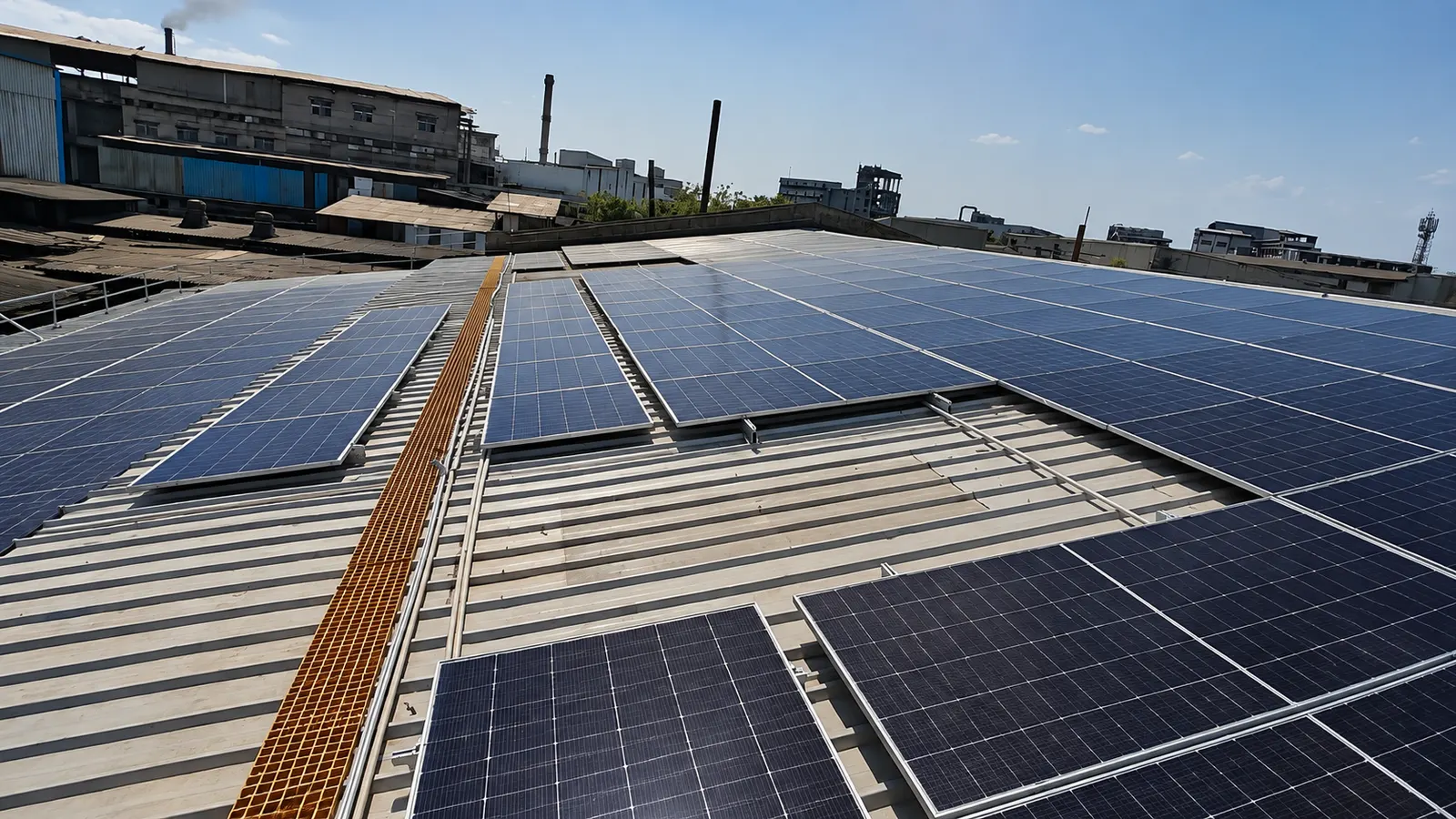
If you need to compare solar EPC quotes for a factory in India, check what each Engineering, Procurement and Construction (EPC) bidder will build, what it expects the plant to generate, and what it will do if the plant underperforms. In 2026, a factory can receive two quotes for the same rooftop capacity that use different module models, structures, production assumptions and maintenance terms. The lower quoted price may therefore buy a different plant.
Direct answer. Compare factory solar EPC quotes across ten items: site and yield assumptions, performance ratio, module and inverter models, structure, electrical protection, approvals, monitoring, operations and maintenance, warranties, and payment milestones. Ask every bidder to fill the same comparison sheet. A price per kW is only a starting point; compare the expected units and the obligations behind them.
This guide is for plant owners and procurement teams evaluating rooftop bids. For the sequence from survey to commissioning, see the industrial solar installation guide. The ten checks below focus on the contract you are about to sign.
What must you know to compare solar EPC quotes for a factory?
You cannot compare bids fairly until the bidders use the same site boundaries. Give each EPC the same electricity bills, roof drawings, operating hours, planned expansion and access restrictions. Ask for a site survey before treating any yield or structure claim as firm. A quote based only on satellite roof area may miss skylights, fragile sheets, ventilation equipment, parapets or future maintenance paths.
The checklist is a ten-row table in which each bidder records one assumption, one deliverable and one contract reference for every check in this article. A blank cell is a question, not a reason to guess. The sheet makes differences visible before procurement decides which bidder is cheaper.
Start by confirming the point of connection and the proposed DC and AC capacities. State whether the bidder assumes an LT or HT connection. Record the sanctioned load or contract demand shown on the current bill. If a quote assumes a load increase, transformer change or export approval, the bidder should name that dependency and show where its cost sits.
| Common input | Put in the bid pack | Why it changes the answer |
|---|---|---|
| Electricity | Recent bills and interval data, if available | Shows daytime demand, tariff and export exposure |
| Roof | Drawings, sheet type, access and known repairs | Sets usable area and structure work |
| Connection | Meter category, voltage and approved load | Sets the interconnection route |
| Operations | Shifts, shutdown windows and future equipment | Changes consumption match and work plan |
This input pack also helps you separate a firm proposal from a budget estimate. If one bidder has surveyed the roof and another has not, ask the second bidder to price the same survey and revision step. A missing survey should not become an assumed saving.
Watch out
If a bidder will not identify the roof, electrical and operating assumptions behind its price, ask for a revised scope before comparing totals.
Checks 1 and 2: yield model and performance ratio
Check 1 is the yield model. Ask each EPC for its monthly generation estimate, weather data source, roof orientation, shade treatment, DC to AC ratio, temperature loss, soiling loss and outage assumption. A single annual units figure is hard to test. Monthly values show whether the model accounts for monsoon months and seasonal operating changes. Ask for the underlying simulation report, not just a slide with a large annual number.
Check 2 is the performance ratio (PR) basis. PR compares actual energy output with the output implied by measured solar irradiation and installed DC capacity. It is a performance diagnostic, not a universal promise that a factory will receive the same units each year. Ask which losses are included in the quoted PR, where irradiation will be measured, and whether the proposed monitoring system can calculate PR after commissioning. The performance ratio glossary explains the term before you evaluate a guarantee.
The EPC should show both the modelled energy and the conditions under which a contractual shortfall is measured. If the bid commits to an output number, read the exclusions: grid outages, restricted roof access, force majeure, curtailment, cleaning failure, meter failure and any owner controlled load. Do not compare an unqualified number from one bidder with a heavily qualified number from another.
| Yield question | Strong bid evidence | Red flag |
|---|---|---|
| Annual and monthly units | Simulation with visible assumptions | One annual number without inputs |
| Shade and obstruction | Survey drawing or shade study | Full roof counted as usable |
| PR and losses | Defined loss table and measurement method | PR stated without measurement point |
| Generation obligation | Baseline, exclusions and remedy in contract | Sales slide used as the only commitment |
These questions matter because the factory pays for energy produced and consumed, not simply for nameplate capacity. Ask the bidder to show how expected solar output overlaps your working hours. A plant that exports much of its midday output can have a different bill effect from a plant sized for self-consumption, even if both have the same annual generation.
Checks 3 and 4: equipment schedule and structure
Check 3 is the bill of materials. Every bid should name the module manufacturer and model, module rating, inverter manufacturer and model, quantity, cable specification, protection equipment, meters, monitoring hardware and mounting material. A brand family is not a model number. Ask whether substitutions require written approval and how an equivalent product will be judged. The schedule should state direct current (DC) module capacity and alternating current (AC) inverter capacity separately. Otherwise, a price per kW can refer to two different denominators.
The Bureau of Indian Standards (BIS) lists IS 14286 and IS/IEC 61730 for PV modules. Its list also identifies IS 16221 for inverter safety. These references tell you which certificates to request for the exact models offered. They do not prove that an unnamed module or inverter will be acceptable. Check current programme and procurement requirements against the Ministry of New and Renewable Energy (MNRE) notices when the bid depends on an Approved List of Models and Manufacturers entry.
Check 4 is the structure. Ask for a structural assessment of the existing roof and a drawing of the proposed mounting system. The bidder should explain wind loads, attachment points, purlin condition, corrosion protection, drainage, waterproofing and access for future roof repairs. The roof strength checklist helps owners prepare records for an engineer. A low structure allowance can become a costly variation after work begins. If the roof needs reinforcement or replacement, separate that work from the solar EPC price. Record who designs it, who signs the structural note, and whether the solar work can start before the repair is complete.
For each major component, request the manufacturer’s data sheet and warranty document with the bid. Check that the inverter’s operating voltage range suits the proposed strings and that the module layout matches the roof drawing. These are engineering review questions for the bidder’s designer; a purchase manager should not have to infer them from brand names.
Checks 5 and 6: protection, approvals and meter location
Check 5 is electrical design and protection. Ask for a single line diagram that shows the inverter output, AC and DC isolators, surge protection, earthing, grid interface, transformer and metering point. The Central Electricity Authority (CEA) publishes distributed generation connectivity standards and electric safety regulations dated 2023. Ask the design engineer to identify the applicable clauses and the distribution company’s (DISCOM’s) current requirements. A generic residential diagram is not a substitute for a factory design.
Check 6 is the approval matrix. The bid should name who prepares and submits drawings, who pays official fees, who attends inspection, and what happens if the DISCOM asks for a revision. Name the actual licensee, such as DGVCL in south Gujarat or MSEDCL in much of Maharashtra. For an HT consumer, confirm whether the inverter connects to an LT bus and where the import/export meter sits. These details affect transformer losses, protection settings and the bill calculation. The solar permit guide for Gujarat and commissioning guide explain the broader sequence.
Do not accept “all approvals included” without a list. Include the DISCOM application, connectivity agreement, electrical inspector requirements where applicable, meter installation and permission to synchronise. The exact route depends on state, licensee, voltage and system capacity. A bidder who has not checked your consumer category may price a route you cannot use.
Have a factory proposal compared against your bill and connection. Share the competing scopes, roof details and recent electricity bills through industrial solar. Ask for a written explanation of the design and approval assumptions before choosing a bidder.
The owner should also know which works are outside the EPC boundary. Transformer upgrades, additional switchgear, roof repairs, network strengthening and meter changes can sit with different parties. Record each exclusion in the comparison sheet and request a price or a clear process for resolving it. Ask for the name of the engineer who will sign the design and the person who will coordinate the inspection. A responsibility matrix is easier to use during commissioning than a general promise that the EPC will “handle approvals.”
- ✓ Bid includes roof, grid and O&M assumptions.
- ✗ One bid omits structural or commissioning work.
Checks 7 and 8: monitoring, service and warranty boundaries
Check 7 is monitoring and operations. Ask what the dashboard measures, how often data is recorded, who owns the data and what happens when the internet link fails. A monitoring package may show inverter generation but omit irradiation, string faults or meter imports. That changes which performance problems you can diagnose. Ask for the alert list and access rights in writing.
Operations and maintenance (O&M) scope needs the same precision. Who cleans modules, checks connectors, tests protection devices, inspects corrosion and maintains the structure? Who supplies consumables? Who pays for a crane or safe access platform? If a bidder includes O&M for a period, require its schedule and exclusions. If O&M is optional, add its scope to the bid comparison so the first year is not priced on a different basis.
Check 8 is the warranty map. Separate module product warranty, module output warranty, inverter warranty, structure warranty, workmanship remedy and monitoring support. Ask who makes a claim and pays for removal, transport and reinstallation. A manufacturer’s warranty may cover a failed product while leaving site labour to another party. Read the warranty types guide before accepting a single “plant warranty” line.
| Service item | Bidder A | Bidder B | Contract reference |
|---|---|---|---|
| Monitoring data and alerts | Fill in | Fill in | Fill in |
| Cleaning and inspections | Fill in | Fill in | Fill in |
| Inverter replacement labour | Fill in | Fill in | Fill in |
| Fault response process | Fill in | Fill in | Fill in |
| Annual performance review | Fill in | Fill in | Fill in |
This is a template, not a sample claim about either bidder. Ask procurement to complete it with the signed bid schedules. A service promise in a brochure should be copied into the agreement if you expect to enforce it.
For a factory with several shifts, ask who reviews an alert outside normal office hours and how the alert reaches the plant team. The contract should name the data owner, the monitoring platform and the export format. This lets the buyer compare service scope without treating a dashboard screenshot as a maintenance plan.
Checks 9 and 10: commercial terms and cost per expected unit
Check 9 is payment milestones. Match each milestone to a deliverable you can verify: approved design, equipment delivery with model records, mechanical completion, electrical test records, DISCOM permission and handover documents. Avoid paying a large final portion merely because panels are on the roof if the plant cannot yet operate. Define how approved variations are priced and who can authorise them.
Check 10 is the comparison denominator. Price per installed kW is useful only after equipment and scope are aligned. For a deeper comparison, divide the total owner cost over a stated evaluation period by the expected delivered units in that same period. Include O&M, expected inverter replacement and any owner paid interconnection work. Use the same evaluation period and generation method for every bidder. This is a comparison calculation, not a return promise.
The denominator must reflect what you can use or credit. If the plant exports energy at a different value from self-consumed energy, show those streams separately. Do not silently treat every generated unit as a full tariff offset. The solar ROI calculation guide explains the bill inputs. For a factory bid, request a monthly import, self-consumption and export model.
| Normalised item | Bidder A | Bidder B |
|---|---|---|
| EPC price, including tax | Fill in | Fill in |
| Excluded civil and electrical work | Fill in | Fill in |
| O&M across common evaluation period | Fill in | Fill in |
| Equipment replacement allowance | Fill in | Fill in |
| Expected usable or credited units | Fill in | Fill in |
| Total owner cost divided by those units | Calculate | Calculate |
Record which values are contractual and which are estimates. If one bidder refuses to disclose a critical input, the comparison should show “unknown”. Replacing that blank with an optimistic assumption makes the worksheet look complete while hiding a real procurement risk.
Practical check
Ask the shortlisted bidders to return the same filled worksheet with page references to their proposal and contract.
How should you compare solar EPC quotes for a factory?
Shortlist bids that pass the engineering and contract checks. Then compare price, expected usable energy and operational fit. A higher price can be justified by a stronger structure, better access plan or clearer service obligation. A lower price can be justified when it achieves the same outcomes with a simpler design. The comparison sheet should let you explain either choice without relying on a sales claim.
Use this review order:
- Confirm the site facts. Resolve roof condition, connection details and the operating profile before accepting firm numbers.
- Compare design evidence. Read the yield model, layout, structural note and electrical diagram together.
- Check named equipment. Verify exact module and inverter models, certificates and substitution rules.
- Map approvals. Put every application, fee and inspection beside the party responsible for it.
- Review service and remedies. Read the monitoring, O&M, warranty and underperformance clauses.
- Normalise the commercial offer. Add exclusions and compare cost against expected usable or credited units.
There is no universal winner between the least expensive and most expensive bid. The decision depends on the roof, factory load, connection and contractual risk. The industrial EPC selection guide covers team and project management questions after you have checked the technical offer.
- ✓ Named equipment and quantities
- ✓ Yield inputs and monthly output
- ✓ Drawings and responsibility matrix
- ✓ Contract terms tied to deliverables
- ✗ Equipment described only by brand
- ✗ Annual output without inputs
- ✗ Unpriced roof or grid works
- ✗ Service promises outside the contract
Keep the final filled sheet with the signed agreement. It becomes a useful handover reference when the plant is commissioned and a baseline for future performance conversations. Before signing, ask each bidder to identify every proposed deviation from the common input pack. Put the answers in an appendix. That appendix makes later variations easier to evaluate, especially if roof repairs or a DISCOM requirement changes the design.
How Heaven Green Energy helps with a factory proposal
For a factory proposal, ask Heaven Green Energy to review the connection, roof constraints, operating hours and intended commercial scope. The response should be a written scope you can compare with other EPC bids. Keep each assumption visible, especially the generation model, approval route and exclusions. You can use the ten checks above to question our proposal as well as any competitor’s.
Send the same source pack to every bidder: recent bills, available interval data, roof drawings, photographs, transformer information and your production calendar. Tell bidders which areas must remain accessible and which electrical work requires a planned outage. This makes the proposed scope more useful than a capacity quote alone. If drawings or bills are missing, ask the bidder to mark the related item as provisional and to state how it will be confirmed.
At the review meeting, walk through the checklist row by row. Ask for page references, then keep the completed version with the signed proposal. A buyer should be able to find the module model, the yield assumptions, the single line diagram and the O&M schedule without asking the sales representative to reconstruct them. If the scope changes after survey, request a revised sheet alongside the revised commercial offer.
- Industrial solar: Start a factory rooftop or larger project enquiry and share the bid documents.
- Commercial solar: Route a smaller business premises to the business solar service page.
If you need to compare engineering drawings, the Heaven Designs rooftop engineering service describes the design documents that can sit behind a proposal. If you are reviewing inverter specifications, Qbits Energy’s inverter engineering guide is a separate technical reference. These are sister-site resources, not evidence that a particular equipment model is included in a Heaven Green bid.
Request a factory solar proposal. Send your recent bills, roof drawings, connection details and any competing scopes through industrial solar. Ask for a bid you can compare line by line.
Use the same worksheet to compare solar EPC quotes for a factory before signing any proposal.
Frequently Asked Questions
Is the lowest solar EPC price per kW the best bid?
No single price per kW can describe the whole plant. Compare the named equipment, usable roof area, yield model, structure, electrical protection and approval work first. Then add excluded owner costs to each bid. Use the ten checks in this guide to put each bid on the same basis. A low price may still be the right choice when the engineering and service scope are equivalent.
What should an industrial solar generation estimate include?
Ask for monthly units and the assumptions behind them: weather data, tilt, orientation, shade, temperature, soiling, inverter losses and outages. The estimate should also show how production overlaps factory demand. A bidder should identify the measurement method if it offers a generation commitment. Annual output alone cannot reveal whether a model ignores monsoon months or produces surplus units your tariff values differently.
Which module certificates should I request with a factory quote?
Request certificates for the exact module model, then verify the applicable standards and programme conditions. BIS lists IS 14286 for design qualification and IS/IEC 61730 for module safety. The certificate should match the model and manufacturer named in the bill of materials. If an EPC proposes a substitution later, require written approval and equivalent evidence before accepting it. Record the certificate number in the bid sheet.
Should an HT factory ask where the solar meter will sit?
Yes. The single line diagram should show the inverter connection, transformer and meter location. Meter placement affects how generation and imports are measured, and it can affect the bill model. The correct arrangement depends on the state regulator and DISCOM approval. Ask the EPC to show the approved drawing and explain any transformer loss treatment before signing the bid. Do not infer it from a brochure.
What should the EPC contract say about underperformance?
It should define the baseline, measurement equipment, review period, exclusions and remedy. Check who maintains the meter and irradiation data. A performance ratio or annual units figure on a sales slide is not enough. Ask for the exact clause and for a clear division of owner and EPC duties, including cleaning, access, outages and equipment repairs. Keep the accepted model as a contract schedule.
How do I compare O&M if one bidder includes it and another does not?
Use the same evaluation period for both offers. Price the missing operations and maintenance scope separately, then list cleaning, inspection, monitoring, labour, consumables and replacement exclusions. Keep estimates distinct from signed prices. If a bidder includes O&M, confirm its schedule and service boundary in the contract. The comparison can then show the real owner cost alongside expected usable or credited units.