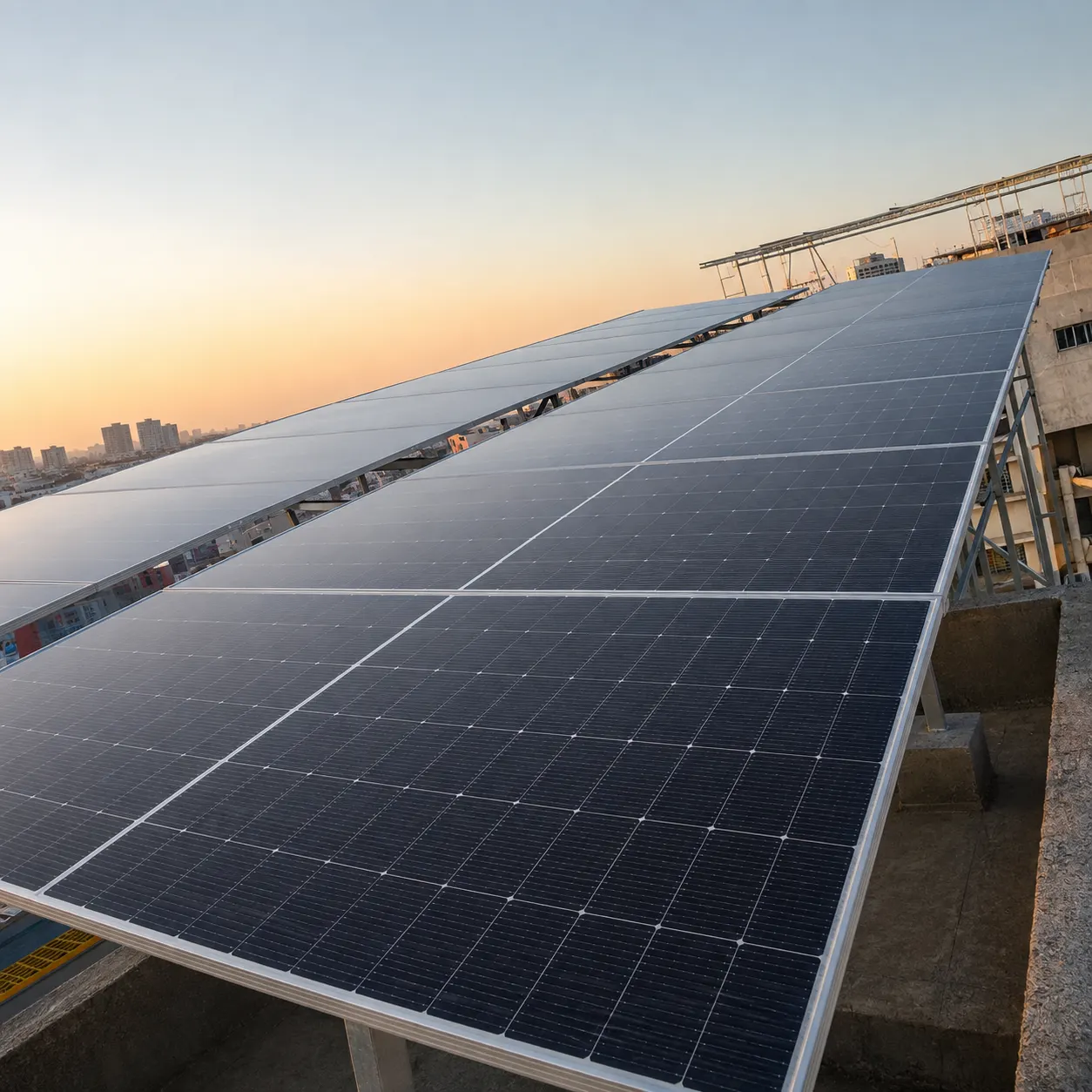
A shop or showroom can have a strong daytime load from air conditioning, lighting, displays and refrigeration. Yet many small businesses rent their premises or share a building roof, so the electrical and property arrangements matter as much as the bill. The best solar size comes from the shop’s meter and operating hours, not its floor area alone.
Direct answer. Solar for a shop should match the business meter’s daylight imports, with roof consent and the applicable LT commercial rooftop rule checked before equipment is ordered. Gujarat’s state DISCOM tariff schedule is effective 1 April 2026; a Maharashtra or MP shop needs its own current utility order. A landlord’s roof and a tenant’s electricity account require a written rights and benefit arrangement.
What part of a shop or showroom bill can daytime solar offset?
For a Gujarat net-metering proposal, also check the DRES instrument signed 30 October 2026. Its published non-residential rule caps exported-energy set-off at 30% of grid imports in the billing cycle, with applicable banking charges and lapse of exports beyond the cap. This can change the value of low-load-day surplus. Gazette commencement and the terms governing the account must be confirmed with the DISCOM; direct on-site use is a separate quantity.
Retail premises often use air conditioners, fans, lights, display equipment, computers and payment systems while customers are present. A food shop may also run refrigeration day and night. A showroom may have high weekend occupancy and a weekday lull. A garment shop can close for a weekly market holiday, while a medical store might operate late into the evening. These patterns affect how much rooftop generation the business can use at the same meter when the sun is out.
Collect twelve months of electricity bills and record opening hours, weekly closures and seasonal AC use. If the meter offers interval data, use it. Otherwise ask the EPC to state how it estimated daytime consumption and test a conservative case. A business may have high annual units because of evening cooling or refrigeration; a solar array cannot directly offset those dark-hour imports without a separately designed storage or credit arrangement. The solar bill-slabs guide explains why a unit’s value follows the applicable bill component.
Check the shop’s opening hours, electricity account and legal roof access before sizing solar. First map the shop’s actual opening and equipment schedule. Second identify the consumer number and tariff category. Third find the roof or carport the business can legally and safely use. A large electricity bill without roof rights is not a ready rooftop project. A large roof with little matching daytime load can create exports whose value depends on the approved mechanism. This test helps a small business avoid buying a system based only on a generic per-kW rule.
The equipment schedule also helps separate essential and discretionary loads. A refrigeration circuit may need grid or backup power when solar is unavailable. Air conditioning can track business hours more closely. An inverter-powered rooftop plant connected to the grid will not keep the shop running in a power cut by itself. If outage continuity is important for cold storage or payments, that needs a separate system design and operating plan.
| Business load | Typical timing question | Solar implication |
|---|---|---|
| AC and display lighting | Open hours and seasonal use | Possible daytime direct consumption |
| Refrigeration | Does it run overnight? | Daytime offset, night grid import remains |
| Weekend trade | Is the shop busiest on weekends? | Changes self-use pattern |
| Weekly closure | What load stays on? | Possible export or curtailment |
The table is a survey prompt. The proposal should replace it with the shop’s own meter and operating records.
Which LT tariff and capacity rule should a shop use?
The tariff category appears on the utility bill. In Gujarat’s state DISCOM areas, a shop can fall under a non-residential category such as Non-RGP or, at a higher aggregate load or by option under the schedule, LTMD. The GERC tariff schedule effective 1 April 2026 sets the specific conditions. It states that LTMD applies to qualifying premises with aggregate load above 40 kW and can also be opted into by certain Non-RGP consumers. This dated rule is not a claim that every showroom is LTMD. Torrent-supplied locations need their own tariff schedule.
For Madhya Pradesh, the MPERC FY 2026-27 retail order, Petition 140/2025 dated 26 March 2026 lists shops and showrooms under its LV-2 non-domestic applicability. Maharashtra’s commercial accounts require the current MSEDCL schedule, accessible from MERC’s distribution tariff orders. The HT versus LT guide explains why larger business connections may need a different design and billing model.
Read the actual account’s energy, fixed or demand, fuel adjustment, duty and tax lines. Directly used solar can reduce matching imported energy. Fixed or demand charges may remain. A showroom with a short peak under heavy AC can still have a demand component even after solar. Do not multiply every forecast solar unit by the total blended bill rate; that can include charges the array does not avoid. The EPC should show each rate, effective order and consumer category in the model.
The rooftop capacity ceiling depends on the state’s current regulation and the shop’s sanctioned load or contract demand, plus network feasibility. The solar capacity and sanctioned-load guide explains the cross-state framework. If the shop needs a load extension, clarify that utility process and its cost drivers before ordering a larger plant. A possible future AC addition is not the same as today’s sanctioned load.
The actual consumer category and licensee, not the shop’s business name, decide which schedule applies.
How do tenancy and shared roofs affect a small-business plant?
The shop may pay the electricity bill but not own the roof. A tenant should obtain written consent from the building owner and identify the legal right to install, access, maintain and remove the equipment. The agreement should state whether the solar plant belongs to the tenant, landlord or a third-party owner, and who receives the utility credit. The solar for tenants guide covers the broader ownership issue. A simple verbal permission may not survive a lease renewal or building sale.
Check the remaining lease term and renewal rights. Solar is a fixed asset with mounting, cables and a meter application tied to the premises. If the tenant leaves, who buys the plant, who can remove it, and who pays to restore the roof? If the landlord retains it, how is the value handled? If the business moves to a larger showroom, the old array may not move easily or remain approved at a new connection. These questions should be written into the commercial arrangement before the EPC files documents.
In a market building, several shops may share one roof but have separate utility meters. Roof area allocation and structural capacity need the building owner’s or association’s approval. A tenant’s array typically needs a defined electrical connection and meter arrangement. It cannot be assumed to credit every shop simply because all occupy the same complex. If a group or virtual metering option is proposed, require the exact state rule and utility approval for those accounts. The housing-society solar guide shows a different shared-roof governance model that can help frame the questions, although commercial eligibility must be checked separately.
The landlord may also need roof access for waterproofing, water tanks, HVAC equipment or building expansion. Put access corridors and removal responsibilities in the agreement. The structural review should cover the entire shared roof’s existing equipment and future loads. If the roof is unsuitable, an off-site procurement route may be possible for larger eligible consumers, but it is a separate contract and network process, not a substitute for roof consent on a small shop.
Tenant check
Put roof ownership, access, bill credit and end-of-lease treatment in writing before a tenant-funded system is ordered.
The utility application, roof consent and lease agreement should describe the same owner and connection. A mismatch can delay approval or later create a dispute over who benefits.
How should a showroom with AC-heavy load size its system?
Air conditioning can create a strong sunlit demand, especially in warm months. It can also continue after sunset, and the load may be much lower during a closed day or cooler season. A month-by-month model should show predicted solar output, direct use and exports under the actual operating calendar. The business bill-to-size guide explains why rupees should first be converted into the appropriate bill units and load profile, rather than directly into kW.
Illustrative example, not a site forecast: assume a proposed array produces 100 kWh on a representative clear day. A showroom’s AC, lights and display equipment use 85 kWh in the same solar intervals on an open day, leaving 15 kWh of potential surplus. On a weekly closure, suppose the matching load falls to 20 kWh, leaving 80 kWh of potential surplus. The physical array is unchanged. The commercial case depends on how many days of each type occur and how the applicable rooftop approval values exports.
Compare a smaller array that matches regular open-day use with a larger roof-fill design. The latter may generate more total units but also more low-value or limited export. Show the break-even assumptions without a promised payback or savings percentage. The business should also consider roof shade from neighbouring buildings, signage, water tanks and AC outdoor units. An array that is theoretically large but heavily shaded is not a sound design.
The EPC should state the predicted generation method and its assumptions: usable roof, orientation, shade, equipment losses and maintenance access. It should use the shop’s actual tariff order and approved metering mechanism for the bill model. Do not treat a home PM Surya Ghar subsidy as a business benefit. The proposal should state which grid imports remain in the evening, along with fixed or demand charges and taxes.
| Array choice | Direct-use strength | Question before approval |
|---|---|---|
| Smaller open-day match | Less closure-day surplus | Does it cover enough regular use? |
| Larger roof-fill design | More output in high-AC months | How are closure exports settled? |
| Deferred addition | Responds to future AC or expansion | Will the utility approve later capacity? |
The table is a comparison method. The right choice depends on the shop’s load, roof and approved export rule.
The owner should ask the EPC to show the calculations in units as well as rupees. A proposal that can be recalculated when opening hours change is more useful than a single headline saving claim.
Can a proprietor use depreciation or GST input tax credit?
Tax treatment is not automatic because the shop is a business. The solar asset must be owned and used in a way that fits the proprietor’s or company’s tax position. The Income Tax Department’s published depreciation schedule, subject to the applicable tax-year regime lists solar power generating systems under a renewable-energy-device depreciation block. Whether a particular proprietor can claim depreciation, at what timing and under which accounting method, is a matter for the tax adviser using the business’s current income and asset records. A rented roof or third-party-owned OPEX plant can change who owns the depreciable asset.
GST input tax credit also needs a fact-specific review. The CBIC CGST Act, Chapter V sets input-credit conditions and Section 17(5) restrictions for certain immovable-property construction, with distinctions for plant and machinery. A solar installation can involve modules, inverters, mounting and construction work; the invoicing and legal character of each supply matter. A GST-registered proprietor cannot safely assume that all project GST is recoverable simply because the shop makes taxable sales. The tax adviser should review the current Act, contract and invoices before any ITC appears in a purchase decision.
Keep tax benefits in a separate sensitivity case. The base commercial model should show energy and export effects using the current utility tariff without a guessed tax credit. If the accountant confirms a treatment, add it with the source and owner of the asset stated. This makes a CAPEX bid comparable with an OPEX proposal where a third-party owner may handle depreciation and GST differently. The accelerated-depreciation solar guide explains the general concept, but it does not decide a particular shop’s tax return.
The same discipline applies to financing. A low monthly payment may be attractive to a shop, but the agreement should show ownership, energy purchase terms, escalation, roof access and what happens when the lease ends. The OPEX versus CAPEX guide sets out those choices. A business should compare total obligations and operational control, not a tax benefit asserted by a salesperson.
Tax model
Treat depreciation and GST credit as adviser-confirmed inputs. Keep the electricity case understandable without either assumption.
The practical next step is to send the EPC’s proposed ownership and invoice structure to the shop’s tax adviser before signing.
What roof, meter and contract checks belong in the quote?
An EPC should inspect roof structure, shade, waterproofing, access, nearby AC units and the cable route to the shop’s distribution board. If the roof is part of a multi-storey building, confirm who controls it and how the electrical route crosses common areas. The roof inspection guide helps the owner ask the right questions. A small shop roof can have significant shade from parapets or neighbouring buildings even when its area looks adequate from the ground.
The quote should name the proposed DC and AC capacity, equipment, mounting method, meter arrangement, interconnection point, utility application, required inspections and any roof work. It should state who obtains landlord or association consent. Exclusions such as roof repair, cable shaft work, switchboard change or meter charges should be explicit. A “complete” price without those boundaries can leave a tenant with a bill for work it did not authorize.
Ask for a yearly generation estimate with monthly detail and a bill bridge. It should show self-used units, exported units, imports after solar, remaining fixed or demand charges, and the current tariff source. If the shop closes on one day each week, that assumption must be visible. If a restaurant operates through the evening, the model should not treat all its monthly kWh as daytime use. The how to read a solar quote guide gives a broader checklist for comparing equipment and scope.
The contract should address maintenance and transfer. Who cleans the array, monitors the inverter, holds the utility agreement and pays for roof repairs? What happens if the shop sells, the lease ends or the landlord needs waterproofing work? The owner should retain as-built drawings, protection settings, meter agreement and equipment records. A future tenant or property buyer should be able to understand the system without relying on the original installer being present.
- ✓ Actual LT category and bill used
- ✓ Roof consent and access written
- ✓ Closure-day export case shown
- ✓ Lease-end equipment treatment stated
- ✗ Residential subsidy assumed
- ✗ All units valued at retail rate
- ✗ Landlord consent verbal only
- ✗ GST credit promised without review
The owner should compare bids on the same roof, load and utility assumptions. A smaller but better-documented proposal can be easier to operate and defend than a larger estimate based on unverified credits.
When is a shared building project better than a shop-only array?
In a row of small shops, one tenant may have a narrow roof allocation while the building has a large common-area bill for lifts, corridor lighting, pumps or central cooling. The building owner or association may be able to consider a common-meter solar project separately from any tenant-funded array. The two options serve different electricity accounts. A shop-only design should not assume it can use the common roof or credit the common meter without a written arrangement; a common-area design should not promise a credit on each tenant’s bill without an approved mechanism.
Map the electricity accounts and roof rights first. Record who owns the roof, which meter pays for common services, how many tenant meters exist, and whether the owner or association can authorize construction. Then compare the daytime use on the common account with the shop’s own daytime use. A building with lifts, pumps and a central AC plant may have a steadier base load than one small retail unit. A building with only evening corridor lighting may have the opposite result. Interval readings decide which connection can use more solar directly.
The committee must decide who funds the plant and who receives the benefit. A common-area project could reduce a charge that all occupants share through service fees, but the allocation depends on the building’s own agreement. A shop-only project may be paid by one proprietor and tied to that proprietor’s lease. Avoid mixing the two commercial cases in one savings estimate. If virtual or group crediting is proposed, require the exact current state rule and a utility approval path for the meter configuration.
Structural and maintenance responsibilities also differ. A building-wide array may occupy a roof needed for water tanks or HVAC service. The association should reserve access and define who can isolate the system. A shop-only array might be easier to manage electrically but harder to justify if its tenant lease is short. Compare the two routes on roof availability, direct use, legal rights, export settlement and long-term maintenance, not on panel count alone.
The result may be to start with a common-meter project, a tenant project, or neither until the roof rights are resolved. A proposal should state which account it serves. That simple line prevents a shared building from buying equipment for a benefit it cannot lawfully allocate.
Request a business-specific proposal: Send the shop’s bills, opening hours and roof-consent documents through the commercial solar enquiry. Ask for the LT tariff, export rule and tenancy terms to be shown explicitly.
How Heaven Green Energy helps scope a Shop Proposal
For a commercial enquiry, gather a year of bills, opening hours, weekly closures, roof photos and plans, sanctioned-load details, and the property or lease papers. Heaven Green Energy files DISCOM paperwork for its customers. The business owner should provide accurate consumer and roof-rights documents before the utility application is prepared.
The relevant routes are:
- Commercial solar for the primary shop or showroom proposal.
- Industrial solar only if a separate factory operation has its own industrial connection.
- Solar calculator for an initial size exploration before a site-specific review.
The first review should confirm the utility and tariff category, then map daytime use and roof rights. A roof survey should identify safe mounting and shade. The proposal can then compare a direct-use size with a larger design under the correct export rule. A rented shop needs the lease and owner consent addressed before the EPC treats the roof as available. This sequence keeps property and billing assumptions aligned.
Use this buying sequence:
- Read the bill. Confirm licensee, category, load and fixed charges.
- Map the hours. Include AC seasons and weekly closures.
- Secure the roof. Obtain written owner or association consent.
- Compare capacities. Show self-use and export separately.
- Review tax. Ask an adviser about depreciation and GST credit.
- Keep records. Retain approvals, drawings and lease-end terms.
After commissioning, compare monthly generation, imported units and exported units with the shop’s opening calendar. A business that changes hours or adds refrigeration can change its direct-use share. The owner should keep the original assumptions and request an updated capacity review if the premises or connection changes. The system should remain understandable to the landlord and any future operator.
Use the commercial solar route for the primary enquiry. The useful outcome is a size and contract that fit both the electricity account and the property right.
Frequently asked questions
Can a rented shop install rooftop solar?
It may be possible with written roof consent, a valid utility arrangement and a contract covering access, ownership, bill credit and lease-end treatment. A verbal landlord approval is a weak basis for a fixed asset. Review the lease before ordering equipment.
Is a shop eligible for the PM Surya Ghar home subsidy?
Do not assume so. The proposal should use the business meter’s consumer category and official scheme eligibility. A residential household subsidy must not be treated as an automatic commercial benefit.
Does solar remove a showroom’s AC bill at night?
Standard rooftop solar produces in daylight. Evening AC and refrigeration still draw from the grid or another supply arrangement. A credited export is different from direct use and follows the approved state mechanism.
Is GST credit guaranteed for a proprietor’s solar plant?
No. CBIC’s input-tax-credit conditions and immovable-property restrictions make contract, ownership and invoice details important. The proprietor’s GST adviser should review the specific purchase before any credit enters the model.
Should a shop use every square metre of its roof?
Only after structure, shade, access and export-value checks. A larger array can produce substantial surplus on weekly closure days. Compare a direct-use design with a larger design under the same tariff assumptions.
What should a showroom send for a first proposal?
Send twelve months of bills, opening hours, weekly closure pattern, roof documents, sanctioned load and any planned AC or refrigeration additions. A tenant should also send the lease and written roof-consent terms.
If the building has a common-area account, include that bill only as a separate case. The EPC should identify which consumer number each proposed array would serve and who would sign its application and maintain the system.