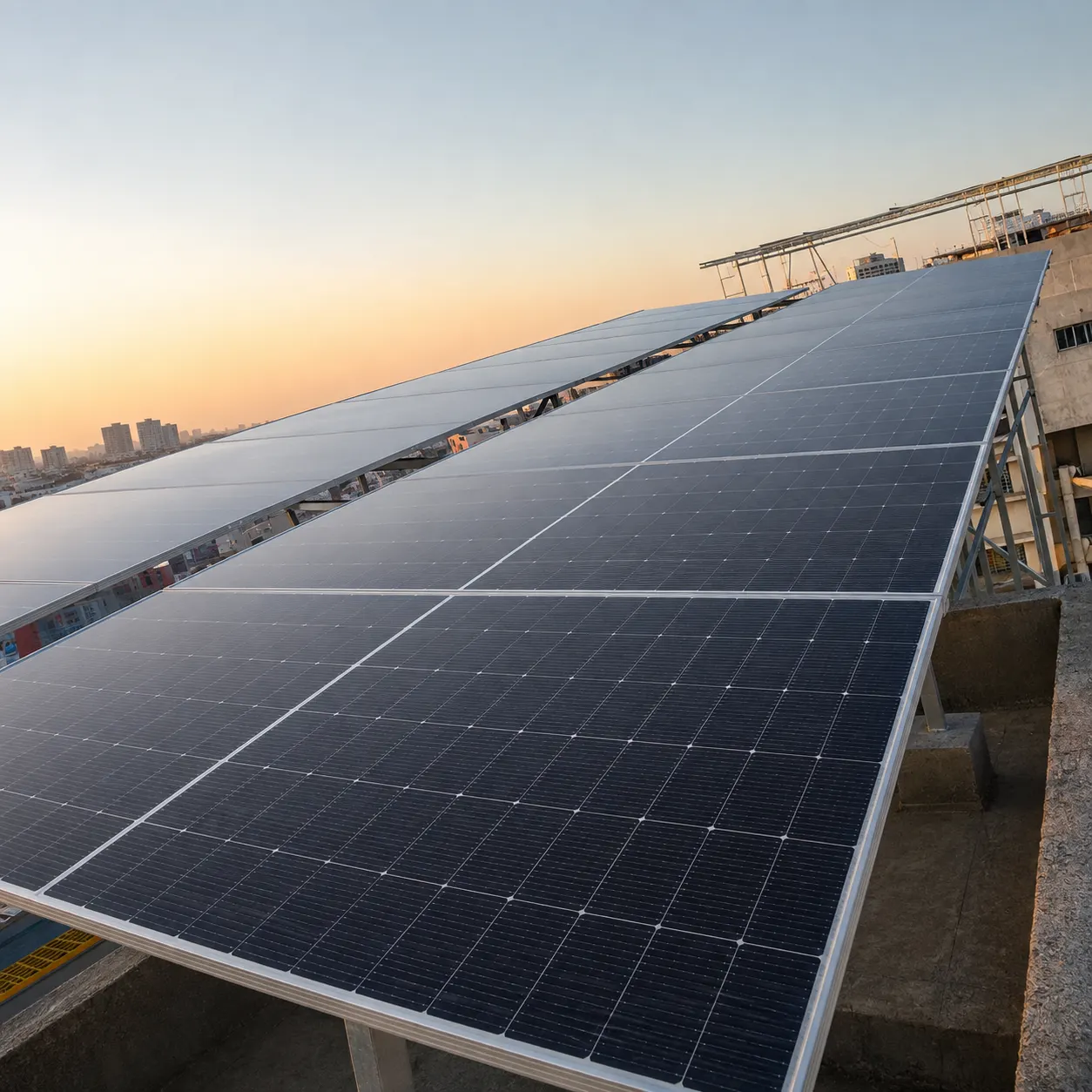
A loom shed and an embroidery workshop can have similar roof area and very different electricity use. The useful solar size depends on running hours, machines, air systems, roof condition and the connection shown on the bill. For Surat units in Sachin, Palsana or Pandesara, a proposal should begin with those facts before it chooses panels.
Direct answer. Day-shift weaving and embroidery loads can use rooftop solar directly, while evening and night production remains dependent on grid or a separately designed backup arrangement. Measure the unit’s lowest daytime load, check the LT or HT bill category, then survey the shed and the approved rooftop connection. A system that fits the roof can still be too large for the business’s low-load days if exports are poorly valued.
What does the powerloom or embroidery load actually look like?
For a Gujarat net-metering proposal, also check the DRES instrument signed 30 October 2026. Its published non-residential rule caps exported-energy set-off at 30% of grid imports in the billing cycle, with applicable banking charges and lapse of exports beyond the cap. This can change the value of low-load-day surplus. Gazette commencement and the terms governing the account must be confirmed with the DISCOM; direct on-site use is a separate quantity.
The first design input is the production calendar. Powerlooms, embroidery machines, compressors, ventilation, humidification, lighting and office loads do not all run together in every unit. Some premises work one long daytime shift; others run two shifts or nearly continuously. A monthly electricity bill totals all those patterns and cannot show how much load overlaps the solar generation window. Ask for interval data where the meter provides it, and record a typical weekday, a lighter day and a shutdown day.
Machine nameplate ratings are useful for an equipment inventory, but they are not the same as measured demand. A motor may cycle or run below its rated power. A cluster of machines can start together and create a peak even if its hourly energy use is moderate. The proposal should distinguish kW demand, kWh consumption and kVA or kVAh billing where applicable. The industrial solar installation guide explains the larger factory workflow; a loom unit needs the same discipline at its actual scale.
The work area can affect the profile. Ventilation or humidification may remain on when looms pause. Embroidery workshops may have lighting and cooling loads that extend beyond machine hours. A plant owner should record the machines expected to be added or removed, and the months of peak orders. If production is expected to move to a night shift, the current daytime solar match will change. Model the present and proposed schedules separately rather than averaging them into one annual figure.
Use a Shift Overlap Map. For each hour, list grid consumption before solar, expected solar production and the difference. The positive difference is still grid import; a negative difference is possible export. Build the map for a normal shift and a low-production day. This shows why a plant with strong daytime work may be a better rooftop candidate than a similar monthly-bill plant that mainly works after sunset.
The Surat textile industry guide covers a broad sector. This article focuses on weaving and embroidery, where machine cycles, shed roofs and shift timing can differ from processing or dyeing operations. A roof or tariff assumption copied from a processing plant should be checked against this unit’s actual meter and production floor.
Which LT or HT tariff applies to the Surat unit?
Read the licensee, category, sanctioned load, contract demand and billed demand from the most recent electricity bill. The GERC DGVCL tariff order for FY 2026-27, Case 2581/2025 dated 25 March 2026 and its tariff schedule effective 1 April 2026 set the applicable categories. The schedule states Non-RGP for premises not in another category with aggregate load up to and including 40 kW, with an option to elect LTMD. LTMD applies above 40 kW. An HT connected plant has a different tariff and demand framework.
This classification is based on the approved connection, not simply the business name. A loom unit and an embroidery unit may both be on LTMD, or one may be on an HT supply. Do not use a residential slab or a generic “industrial unit rate” for the proposal. Fixed or demand charges, electricity duty, fuel adjustments and time-of-use lines may remain even when solar reduces grid energy imported. The HT versus LT connection guide explains what that connection choice changes for a solar project.
Demand should be reviewed separately from energy. A plant can reduce daytime kWh while a brief machine-start or evening peak still sets maximum demand. A tariff with a billing-demand floor may continue to charge for part of the contracted demand. If the owner expects solar to remove a demand charge, ask the EPC to demonstrate that result from interval demand data and the actual order. The maximum-demand guide explains why ordinary rooftop generation is an unreliable peak-shaving guarantee.
Some units may be supplied by Torrent Power rather than DGVCL, depending on the site. The bill identifies the licensee. The GERC tariff-order list includes a separate Torrent Power Surat order, Case 2586/2025 dated 25 March 2026. A Sachin or Pandesara address alone should not be used to infer a tariff. Use the exact consumer category from the bill and the corresponding licensee order.
| Bill field | Why it matters for solar |
|---|---|
| Licensee and consumer number | Determines application route and tariff order |
| Non-RGP, LTMD or HT category | Determines variable and demand-charge model |
| Sanctioned load or contract demand | Constrains the approved connection and rooftop application |
| Interval demand and time slots | Reveals solar overlap, peak risk and export |
| Fuel and statutory lines | Prevents treating the entire bill as avoidable energy cost |
How should a shed roof be checked before panels are laid out?
Weaving and embroidery units often occupy long-span sheds where a large gross roof area looks attractive. The useful area is smaller after rooflights, vents, gutters, access routes, parapets, shade and structural exclusions are mapped. The roof’s age and sheet type matter too. An old metal sheet can have corroded fasteners; a cement sheet can be fragile. The roof-strength checklist is a starting point, and the old-roof safety guide addresses asbestos and brittle coverings specifically.
Ask a structural engineer to check purlins, rafters, columns, connections and any previous extensions. The solar mounting design must show where gravity and wind-uplift loads travel through the frame. A bidder should not count every square metre of roof before checking the structure. The answer can be a smaller array, local reinforcement or roof replacement. Each changes the project scope and schedule.
The roof layout should protect production. A crane or material-lifting route must avoid people and moving machinery below. Work above a running shopfloor needs controlled zones and a plant-approved permit-to-work plan. The electrical tie-in may need a planned interruption even if most roof work is phased around operations. The factory installation without shutdown guide describes the distinction. “No shutdown” should not be used as a promise before the tie-in method is approved.
Shed details affect yield and maintenance. Rooflights, north-light profiles and vents can cast complex shade. Roof pitch and orientation may divide the array into several electrical strings with different output. The inverter layout should account for that, and the monitoring plan should let the owner detect a shaded or failed string. Maintenance access must remain safe after panels are installed. A design that fills every bay may be difficult to clean or repair.
The EPC should submit an annotated roof drawing with gross and usable area, exclusions, structural assumptions, module layout, cable routes and access paths. The drawing makes capacity review possible. It also reveals whether a roof replacement or reinforcement cost has been silently omitted from a low-priced proposal.
What solar size fits a one-shift unit compared with a multi-shift unit?
Watch out
A large monthly bill does not prove that a large array will be used during solar hours. Check low-production days and export.
For a one-shift unit, the direct-use opportunity is governed by how much power the plant draws during the solar window. If machines start late, stop early or close on some days, the array may export more than the monthly bill suggests. For a multi-shift unit, annual consumption can be high while rooftop generation remains concentrated in daylight. The owner may want a larger annual offset, but the roof and approved export treatment can still cap the useful size.
Build a sizing worksheet from measured data. Divide the day into the meter’s intervals. For each interval, subtract expected solar production from the plant’s load. Sum the remaining import and possible export separately. Repeat for working days, lighter days and holidays. Apply shading and equipment losses in the production model. Then check the maximum rooftop size permitted by the current GERC net-metering regulation and amendments and the approved sanctioned load or contract demand. The sanctioned-load capacity guide explains this regulatory cap.
Illustrative example, not a site forecast: if a weaving unit draws 30 kWh in a sunny midday hour and its proposed array produces 18 kWh, grid import during that hour could fall to about 12 kWh before other losses or metering details. If the same unit stops production and draws 5 kWh while the array still produces 18 kWh, roughly 13 kWh is surplus during that hour. The two hours have the same array but very different commercial value. The current export and settlement mechanism must be checked before assigning a rupee value.
Consider future shift changes in the purchase decision. Adding a second shift increases the monthly bill but may do little for daytime self-consumption if the added load is mostly at night. Adding daytime looms may improve the match. The EPC should show a base case and a reasonable planned-expansion case, each labelled with its assumptions. A single “recommended kW” number without those profiles is hard to audit.
Where the roof is too small for the desired offset, the buyer can investigate another eligible roof or off-site procurement. That is a different approval and commercial structure. Do not treat a large annual bill as permission to oversize the rooftop plant or assume all surplus is credited at the retail tariff.
| Shift pattern, illustrative | Solar overlap | Main sizing check |
|---|---|---|
| Daytime weaving | Potentially high | Minimum working-day load and roof area |
| Late embroidery shift | Lower direct overlap | Evening import and export treatment |
| Mixed shifts | Varies by day | Interval load across both schedules |
The table describes load logic, not a forecast for any Surat unit.
Size around the shift. Send the bill and a normal and low-load workday through commercial solar to test a roof layout against actual production.
Do Sachin, Palsana and Pandesara change the project checklist?
The electrical and roof questions are the same in principle, but the site conditions differ. Sachin, Palsana and Pandesara can contain different building ages, lease arrangements, roof types and electrical connection categories. A proposal should name the actual industrial estate, building and licensee rather than apply a cluster-wide template. The Sachin cluster guide and Pandesara cluster guide provide local context; their processing and dyeing examples should not substitute for a weaving unit’s interval data.
Check the building’s ownership and any GIDC, estate association, landlord or common-area permission that applies. A rented shed may have a long useful roof but a short lease. The agreement should identify who owns the array, who benefits from the meter, who repairs the roof and what happens if the tenancy changes. A connection cannot be modelled correctly if the roof and bill belong to different parties without an approved arrangement.
Material movement is another site-specific constraint. A narrow internal road, shared yard or densely packed production floor can change how modules and structures are delivered. Ask for a lifting plan, roof access route and exclusion zones. Dust and lint also affect cleaning and inspection access. The bid should define an operation and maintenance method based on the site, not assume the roof can be approached like a vacant warehouse.
Check the fire and electrical interfaces. Textile materials and electrical equipment require clear access to isolators and emergency routes. The solar fire-safety guide covers general design questions. Site EHS staff should approve cable routes, switchgear position, roof penetrations and emergency shutdown access. Those checks are more useful than a generic claim that a cluster has “ideal roofs.”
The current GERC rooftop rules apply across Gujarat, while the DISCOM application depends on the actual licensee and consumer category. A local EPC should show the specific application path and drawing set for this meter. If an estate or building authority has additional requirements, put them in the approvals matrix and assign who obtains each permission before ordering equipment.
Are Gujarat textile-policy power incentives relevant?
Regulation note
A textile-policy benefit needs unit-specific eligibility. Keep it out of the base solar case until an official approval supports it.
The Gujarat textile policy may matter to some businesses, but it should not be placed in a solar proposal as an automatic discount. The GIDC page describing Gujarat Textile Policy 2024 mentions a power tariff subsidy for eligible textile activity, including specified renewable power routes. Eligibility, project timing, unit classification and the application conditions determine whether a particular weaving or embroidery unit can use it. A general cluster address or textile business label is not enough.
Ask the finance team whether the unit has already applied for any textile-policy assistance and what was approved. Keep the government incentive model separate from the rooftop solar model. A tariff subsidy can change the value of an avoided grid unit, and an off-site renewable arrangement may be treated differently from self-consumed rooftop generation. The owner should use its own eligibility letter or written departmental guidance, not a generic percentage or amount copied from another unit.
The solar proposal should therefore show the underlying tariff cost before any assumed incentive and a separate scenario if eligibility is verified. If a policy term has a duration or start date, identify the official document and approval that fixes it. Do not assume the benefit will continue for the full life of a solar plant. This keeps the investment decision understandable even if a policy application is delayed or denied.
The DGVCL FY 2026-27 schedule effective 1 April 2026 still determines the retail bill category. A policy benefit is a separate layer, not a replacement for checking Non-RGP, LTMD or HT charges. The same applies to the export mechanism under GERC rooftop rules. Three documents can affect the commercial case: tariff, solar settlement and any individually approved policy incentive.
If the unit cannot verify policy eligibility before signing, the EPC should present a viable base case without it. The buyer can then treat a later approved benefit as an additional scenario. This avoids turning an uncertain incentive into a sales promise or using it to justify an array that exports heavily on non-production days.
How Heaven Green Energy helps Surat weaving units
- ✓ Verified daytime machine load.
- ✓ Sound shed and safe access.
- ✗ Weak or undocumented roof structure.
- ✗ Export-heavy size without settlement check.
The proposal should state the production schedule used for sizing, the source of meter data, the current bill category, the roof area and structural survey status. It should distinguish direct self-consumption from export and identify the GERC connection arrangement assumed. If the roof is old, the bid should say whether reinforcement, sheet replacement or waterproofing is included. The industrial EPC bid checklist gives a fuller equipment and performance comparison.
Ask for a single-line diagram and a clear protection plan. It should show the point of connection, inverter, isolators, meter, earthing and any existing APFC panel, UPS or generator. On a weaving floor with motors and drives, power factor should be measured and reviewed after solar. The power-factor penalty guide explains why the grid-side reading can change even when the machines are unchanged. The contract should assign responsibility for settings, tests and handover measurements.
The scope should name who prepares the DISCOM application, structural drawings and electrical-inspector submissions if applicable. Heaven Green Energy files DISCOM paperwork for its customers. The owner still needs to provide accurate property, connection and business documents. The work plan should identify safe roof access, material lifting, plant exclusion zones and the planned electrical tie-in. A claim that installation never interrupts production should not replace a tie-in schedule.
For a proposal, send the recent bill, twelve-month consumption, shift calendar, interval data if available, roof drawings or safe-position photographs, and details of landlord or estate permissions. The commercial solar page is the primary route for a weaving or embroidery business. A larger HT factory can use the industrial solar page. The result should be a site-specific size and approval plan, with every unverified assumption visible.
The final comparison should show what the unit buys and what it must do next. Confirm the roof, load and meter before treating generation or bill effects as final. That sequence protects both the factory and the value of the solar investment.
- Send the complete electricity bill. Include demand, category and adjustment lines.
- Share shift hours. Provide a normal day and a low-production day.
- Document the shed. Include roof drawings, condition and ownership.
- Review two sizes. Compare direct use, export and structural scope.
The service routes are:
- Commercial solar for a powerloom or embroidery business proposal.
- Industrial solar for a larger HT-connected factory.
- Solar mounting structures for the roof-system design discussion.
How should a loom unit plan cleaning and maintenance?
Dust, lint and industrial deposits make maintenance a design issue, not an afterthought. The actual soiling rate depends on nearby processes, traffic, wind and rainfall. A fixed cleaning interval copied from another plant may waste water or leave modules dirty. Set a baseline after commissioning, watch the generation trend and inspect the roof safely when output departs from the expected pattern. The solar cleaning guide explains general methods; a factory needs its own access and isolation plan.
Ask the EPC to show how a worker reaches each row and whether any rooflight or fragile bay sits along that route. Leave enough clearance for cleaning tools, inspection and replacement. The structural design should consider maintenance loading and any temporary access equipment. A densely packed array may look attractive on a layout drawing, but it can be difficult to service safely on a long-span shed. The owner should receive a marked access drawing with fall-protection points and no-go roof areas.
Water choice and drainage also matter. The plant should check whether its available water leaves deposits and whether wash water can drain without entering electrical equipment or production areas. Cleaning should follow module and inverter manufacturer instructions and the site’s electrical isolation procedure. Do not spray into connectors, cable entries or switchgear. The CEA safety regulations, 2023 provide the electrical safety framework; the plant’s permit-to-work process should govern who can isolate and release the array for service.
Monitoring should separate weather changes from faults. A daily generation value can fall because of clouds, a tripped inverter, a failed string, shading from a new roof object or heavy soiling. Compare output with irradiance or a suitable weather reference, and check inverter and string alarms before concluding the panels need washing. Keep a log of cleaning dates, weather, alarms and any production changes that affect self-consumption. This gives the operator evidence to investigate a persistent decline.
Finally, specify maintenance responsibility in the EPC contract. State who inspects modules, structures, fasteners, cables, earthing, isolators and roof seals; how faults are reported; and what documentation is handed over. Avoid an undefined promise that the system will “maintain itself.” A rooftop plant is an electrical asset on a working factory. The unit needs a safe, repeatable method for keeping it in service without interfering with production.
Frequently asked questions
Can a powerloom run directly on rooftop solar?
An on-grid system can offset part of the electricity the looms use while the grid is present. Its contribution changes with sunlight and machine load. A standard on-grid inverter is not an outage backup for the looms.
Is a one-shift loom unit better for solar than a night-shift unit?
A daytime shift usually gives more direct overlap with solar generation. Compare measured interval use, low-production days and roof area before choosing a size. The monthly bill alone cannot show the overlap.
Which Gujarat tariff category applies to a weaving unit?
Read the actual bill. The DGVCL FY 2026-27 schedule uses Non-RGP up to 40 kW of aggregate load, with an LTMD option, and LTMD above that threshold. An HT or Torrent Power connection follows its own applicable schedule.
Can an old tin or cement-sheet shed carry solar?
Only after a structural and safe-access survey. Check purlins, corrosion, fixings, sheet condition, wind uplift and maintenance routes. Fragile or asbestos-containing sheets need a specific work method.
Does Gujarat’s textile policy automatically reduce a solar project’s cost?
No. Eligibility and approval depend on the particular unit and policy terms. Model the solar project using the actual tariff first, then add a separate incentive scenario only when it is verified for that unit.
What documents should a Surat unit send for a proposal?
Send the electricity bill, consumption and demand history, shift calendar, roof drawings or safe photographs, roof ownership details and any planned machine expansion. Interval meter data helps distinguish self-consumption from likely export.
Also identify which meter serves the looms, compressors, lighting and office. If several rented sheds share one roof, include the landlord’s consent and the planned cable route. These details prevent a proposal from assigning solar output to the wrong electricity account.