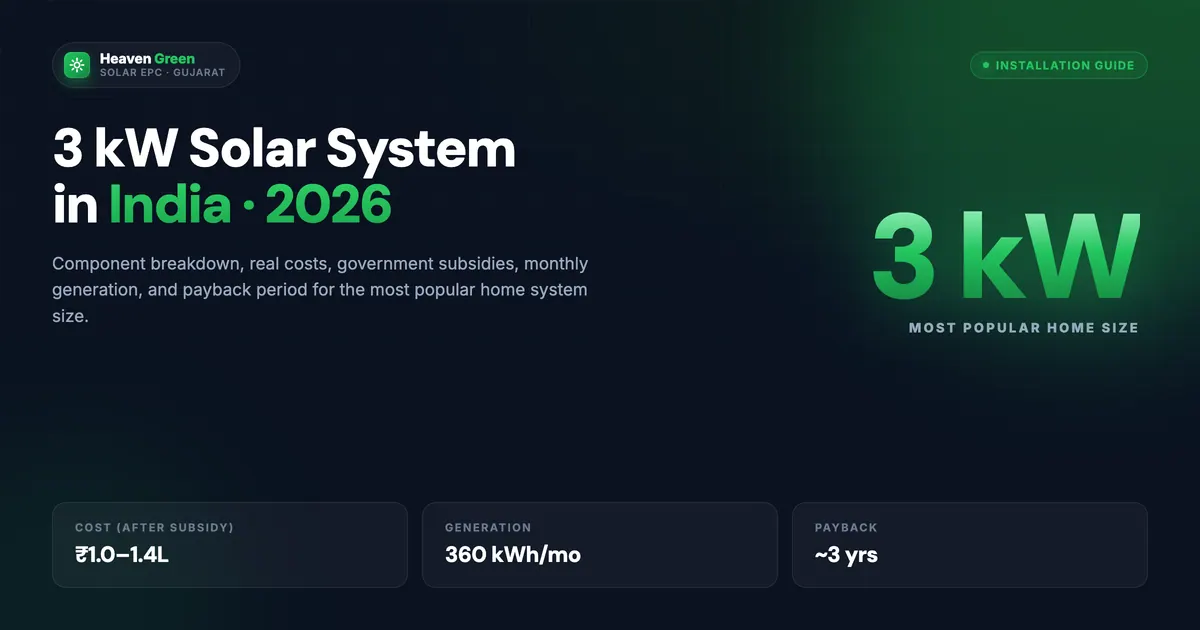
Solar cost in Ahmedabad changes sharply with system size, and the three sizes that cover almost every home in the city are 3 kW, 5 kW, and 10 kW. In 2026, a 3 kW rooftop system from a UGVCL-empanelled installer costs ₹1,57,000 to ₹1,72,000 gross and ₹79,000 to ₹94,000 after the ₹78,000 PM Suryaghar subsidy. A 5 kW system nets ₹1,84,000 to ₹2,09,000. A 10 kW system nets ₹4,47,000 to ₹4,96,000. This guide is the size-by-size companion to our full solar panel cost in Ahmedabad guide: price tables per size, what each size generates at Ahmedabad’s 5.5 to 6.0 kWh/m²/day irradiation, what it saves at UGVCL’s ₹4.65 to ₹6.55 per kWh tariff, and how to pick the right one for your bill.
Direct answer. In Ahmedabad in 2026, a 3 kW solar system costs ₹79,000 to ₹94,000 after the ₹78,000 PM Suryaghar subsidy, a 5 kW costs ₹1,84,000 to ₹2,09,000, and a 10 kW costs ₹4,47,000 to ₹4,96,000. Generation runs 480 to 540, 800 to 900, and 1,600 to 1,800 kWh per month respectively. Payback at UGVCL tariffs is 3.5 to 4 years for 3 kW and roughly 3 to 4.5 years for the larger sizes. Heaven Green Energy is MNRE-approved and UGVCL-empanelled.
One thing before the tables: the ₹78,000 subsidy is capped at 3 kW for individual homes. Going from 3 kW to 5 kW or 10 kW adds zero extra subsidy from MNRE (Ministry of New and Renewable Energy). That single fact drives most of the sizing math below.
3kW Solar System Cost in Ahmedabad
The 3 kW system is Ahmedabad’s volume seller, and for good reason: it captures the full ₹78,000 PM Suryaghar subsidy, fits the default 3 kW sanctioned load on most residential connections, and covers 60 to 80 percent of a typical 2 to 3 BHK bill. The subsidy math is ₹30,000 for the first kW, ₹30,000 for the second, and ₹18,000 for the third, totalling ₹78,000 as per the MNRE 2026 schedule on pmsuryaghar.gov.in.
| Cost item | Amount (Ahmedabad, 2026) |
|---|---|
| Gross turnkey price | ₹1,57,000 to ₹1,72,000 |
| PM Suryaghar subsidy | ₹78,000 |
| Net cost after subsidy | ₹79,000 to ₹94,000 |
| Monthly generation | 480 to 540 kWh |
| Annual saving (₹5.75 avg tariff) | ₹33,120 to ₹37,260 |
| Roof area needed | 200 to 280 sqft shadow-free |
| Typical payback | 3.5 to 4 years (2.2 to 2.6 in upper slabs) |
That gross price buys a complete on-grid system: 6 to 8 ALMM-listed mono PERC panels of 450 to 545 Wp, a BIS (Bureau of Indian Standards) certified string inverter, galvanised mounting structure, DC and AC cabling, DCDB and ACDB protection boxes, earthing, and the net metering application. For the item-by-item split, see our solar panel cost breakdown.
Best fit: a monthly UGVCL bill of ₹3,000 to ₹5,000, one or two 1.5-ton air conditioners used sensibly, and a family of 3 to 5. If that describes you, 3 kW is almost always the right answer and the densest subsidy-per-rupee option available anywhere in India.
Loan route: under PM Suryaghar’s collateral-free window, public sector banks finance up to ₹2 lakh at about 6.75 percent. The post-subsidy ₹86,500 midpoint financed over 5 years works out to roughly ₹1,900 per month EMI, which is close to the bill saving itself. The full EMI math per size is in our solar loan EMI guide for 3kW, 5kW and 10kW.
💰 Real numbers
A homeowner in Bopal with a ₹4,200 average bill installed a 3 kW system through us in early 2026 at ₹1,64,000 gross. Subsidy of ₹78,000 hit his bank account 24 days after net meter commissioning. His last two UGVCL bills came to under ₹300 each, mostly fixed charges.
5kW Solar System Cost in Ahmedabad
The 5 kW system is the standard upgrade for homes that outgrow the 3 kW ceiling. The subsidy stays capped at ₹78,000, so the extra 2 kW is full retail price, but the generation jump to 800 to 900 kWh per month comfortably handles two air conditioners running 6 to 8 hours daily, a geyser, and a work-from-home setup.
| Cost item | Amount (Ahmedabad, 2026) |
|---|---|
| Gross turnkey price | ₹2,62,000 to ₹2,87,000 |
| PM Suryaghar subsidy | ₹78,000 |
| Net cost after subsidy | ₹1,84,000 to ₹2,09,000 |
| Monthly generation | 800 to 900 kWh |
| Annual saving (₹5.75 avg tariff) | ₹55,200 to ₹62,100 |
| Roof area needed | 400 to 500 sqft shadow-free |
| Typical payback | 2.8 to 3.6 years |
Notice the per-kW cost drops: 5 kW works out to roughly ₹52,400 to ₹57,400 per kW gross versus ₹52,300 to ₹57,300 for 3 kW at the low end, and lower still at the efficient end, because the inverter, structure, and labour scale sub-linearly. The per-kW saving is real but modest, roughly ₹2,000 to ₹4,000 per kW.
Best fit: a monthly bill of ₹5,000 to ₹8,000, a 3 to 4 BHK in areas like SG Highway, Gota, Chandkheda, or Satellite, and consumption of 650 to 800 units per month. At that usage you sit in UGVCL’s ₹6.00 to ₹6.55 slabs, where every solar unit saves the most. This is why 5 kW payback (2.8 to 3.6 years) often beats 3 kW payback (3.5 to 4 years) despite the lower subsidy density: the savings are priced at upper-slab rates.
One honest caveat: if your bill is ₹4,500 or below, a 5 kW system will over-generate. Surplus units exported to UGVCL are credited near the APPC (Average Power Purchase Cost) of about ₹3.35 per kWh instead of saving you ₹6 or more, and that stretches payback by a year or more. Size to your bill, not to your roof.
Curious what a 5 kW would save on your exact bill? Our free solar calculator takes your bill amount, pin code, and roof type and returns size, subsidy, savings, and payback in 60 seconds.
10kW Solar System Cost in Ahmedabad
The 10 kW system is the residential net metering cap in Gujarat and the choice of bungalows, villas, and farmhouses on the city edges, think Sanand, Bavla, and the SP Ring Road belt. It is also where buyers most often overspend, because a 10 kW quote looks impressive and the subsidy framing gets murky.
| Cost item | Amount (Ahmedabad, 2026) |
|---|---|
| Gross turnkey price | ₹5,25,000 to ₹5,74,000 |
| PM Suryaghar subsidy | ₹78,000 |
| Net cost after subsidy | ₹4,47,000 to ₹4,96,000 |
| Monthly generation | 1,600 to 1,800 kWh |
| Annual saving (₹5.75 avg tariff) | ₹1,10,400 to ₹1,24,200 |
| Roof area needed | 800 to 1,000 sqft shadow-free |
| Typical payback | 3.6 to 4.5 years |
The ₹78,000 subsidy is the same as a 3 kW system gets. It does not scale. That means only about 15 to 17 percent of a 10 kW gross cost is subsidised, versus 45 to 50 percent for a 3 kW. The system still pays back well because upper-slab UGVCL tariffs are high and per-kW hardware cost falls at this size, but the subsidy story vendors tell at 10 kW is often inflated.
Best fit: monthly bills above ₹8,000, consumption of 1,200 to 1,600 units, three or more air conditioners, possibly an EV charger or a pool pump, and a sanctioned load that supports 10 kW. Check the sanctioned load on your UGVCL bill first. If it says 5 kW, you need a load enhancement application (15 to 25 days, separate workflow) before the DISCOM will approve a 10 kW system.
⚠️ Watch out
Homeowners on X regularly report being told the subsidy scales with system size, so they upsize from 3 kW to 5 kW or 10 kW expecting proportionally more money back. It does not. The cap is ₹78,000 for any individual residential system of 3 kW or above, per MNRE 2026. Only housing society common-area systems use a different slab of ₹18,000 per kW.
Which Size Should You Pick? The Size-Lock Method
Our proprietary framework for this decision is the Heaven Green Size-Lock Method, developed across our Ahmedabad installations. Definition: the right system size is the smallest size that passes all three locks. If a size fails any lock, drop down or fix the constraint first.
- Bill lock. Divide your average monthly bill by ₹1,800. That is your bill-implied kW. A ₹4,200 bill gives 2.3, so round up to 3 kW. A ₹6,800 bill gives 3.8, so 4 kW or 5 kW for headroom.
- Roof lock. Measure your shadow-free terrace area in sqft and divide by 100. A 450 sqft clear roof caps you at about 4.5 kW regardless of what your bill says. Water tanks, staircase rooms, and parapet shadows all subtract.
- Sanctioned-load lock. Your UGVCL sanctioned load, printed on your bill, caps the system size the DISCOM will approve for net metering. Most urban homes carry 3 to 5 kW. Enhancement is possible but adds 15 to 25 days.
The smallest passing size wins. Here is the decision table we use on site visits:
| Monthly bill | Bill-implied size | Roof needed | Recommended size | Net cost after subsidy |
|---|---|---|---|---|
| ₹2,500 to ₹4,500 | 1.5 to 2.5 kW | 200 to 280 sqft | 3 kW (full subsidy) | ₹79,000 to ₹94,000 |
| ₹4,500 to ₹8,000 | 2.5 to 4.5 kW | 400 to 500 sqft | 5 kW | ₹1,84,000 to ₹2,09,000 |
| Above ₹8,000 | 4.5 kW and up | 800 to 1,000 sqft | 10 kW | ₹4,47,000 to ₹4,96,000 |
The tradeoff between right-sizing and oversizing, in plain terms:
- ✓ Fastest payback, 3.5 to 4 years at Ahmedabad tariffs
- ✓ Full subsidy density at 3 kW, up to 50 percent of gross cost
- ✓ No sanctioned-load enhancement delays at 3 kW
- ✓ Lower EMI fits the PM Suryaghar ₹2 lakh loan window
- ✗ Surplus exports earn APPC of about ₹3.35 per kWh, not ₹6
- ✗ Zero extra subsidy above 3 kW, extra capacity is full retail
- ✗ Load enhancement adds 15 to 25 days before approval
- ✗ Payback stretches by 0.5 to 1.5 years on wasted export
For the national version of this comparison with city-by-city generation, read 3kW vs 5kW vs 10kW home solar. For the broader sizing methodology, the home solar system size guide covers edge cases like low-tariff states and daytime-empty houses.
UGVCL Tariffs, Savings and Payback by Size
Your savings depend on which UGVCL slab your consumption touches, because solar offsets your most expensive units first under net metering. UGVCL (Uttar Gujarat Vij Company Limited) 2026 residential slabs: ₹4.65 per kWh up to 100 units, ₹5.50 for 101 to 200, ₹6.00 for 201 to 400, and ₹6.55 above 400 units, per the UGVCL tariff order on ugvcl.com.
| System size | Units offset per month | Slab where savings land | Monthly saving | Annual saving | Payback (net cost) |
|---|---|---|---|---|---|
| 3 kW | 480 to 540 kWh | ₹5.50 to ₹6.55 | ₹2,800 to ₹3,400 | ₹33,120 to ₹37,260 | 3.5 to 4 years |
| 5 kW | 800 to 900 kWh | ₹6.00 to ₹6.55 | ₹4,600 to ₹5,200 | ₹55,200 to ₹62,100 | 2.8 to 3.6 years |
| 10 kW | 1,600 to 1,800 kWh | ₹6.00 to ₹6.55 | ₹9,200 to ₹10,400 | ₹1,10,400 to ₹1,24,200 | 3.6 to 4.5 years |
Two nuances the table hides. First, the 5 kW row assumes your consumption is high enough to absorb 800-plus units; if it is not, the excess exports at APPC of about ₹3.35 per kWh and payback stretches. Second, these figures assume 80 percent self-consumption. Daytime-empty homes self-consume less, and the solar payback period explained guide shows the export-credit adjustment in detail.
📘 One more check: parts of Ahmedabad city core are served by Torrent Power rather than UGVCL. The DISCOM name is printed on your bill. The subsidy amount, portal process, and sizing logic in this guide are identical either way; only the slab numbers shift slightly. GEDA (Gujarat Energy Development Agency) publishes the state policy context at geda.gujarat.gov.in.
What Changes the Price Within Each Size
Every size band above has a ₹15,000 to ₹50,000 range inside it. Four variables drive that range, and none of them are arbitrary.
Panel technology. ALMM-listed mono PERC panels from Waaree or Goldi Solar run ₹22 to ₹25 per Wp. Premium TOPCon panels from Adani Solar or REC run ₹28 to ₹34 per Wp. On a 10 kW system that gap alone is ₹60,000 to ₹1,00,000. For Ahmedabad’s brutal summers, TOPCon’s lower temperature coefficient buys 3 to 5 percent more generation from March to June, per module test data tracked by MNRE’s ALMM program.
Inverter class. A standard string inverter (Growatt, Solis, Sofar) adds ₹12,000 to ₹18,000 at 3 kW and ₹35,000 to ₹50,000 at 10 kW. Hybrid inverters that accept batteries later cost ₹25,000 to ₹45,000 more. Microinverters add the most and rarely make sense on unshaded Ahmedabad terraces.
Structure and roof work. Ballasted structures for flat RCC roofs cost less than anchor-drilled ones for sloped or older roofs. Pre-galvanised structures cost ₹3,000 to ₹5,000 more per system but outlast standard GI by years.
Cable runs and switchgear. Panels above the second floor, long runs to the meter room, or a tired MCB panel can add ₹5,000 to ₹12,000. A legitimate itemised quote shows all of this; our how to read a solar quote guide shows what each line should look like.
Any quote below ₹52,000 per kW gross in Ahmedabad should trigger questions about panel provenance, inverter certification, or missing protection equipment. Cross-check the installer against our vetted best solar companies in Ahmedabad list before signing.
Mistakes Ahmedabad Buyers Make, by Size
The failures we see on re-surveys cluster by size. The red-flag list below is ordered by how much money each mistake wastes.
-
1
Upsizing for subsidy that does not exist, moving from 3 kW to 5 kW expecting ₹1,30,000 back. The cap is ₹78,000. The extra 2 kW is full retail.
-
2
Installing 10 kW on a 5 kW sanctioned load, which gets the net metering application rejected and strands the hardware while the load enhancement crawls through UGVCL.
-
3
Accepting a below-market 3 kW quote under ₹1,55,000 gross, which almost always means non-ALMM panels (subsidy ineligible) or a missing DCDB, surge protection, or workmanship warranty.
-
4
Ignoring shading at 3 kW, where one water-tank shadow can cut a small array's output by 15 to 25 percent because there is no surplus capacity to absorb the loss.
-
5
Skipping the site survey at any size, trusting a WhatsApp quote over a measured roof assessment. Every accurate quote starts with a physical visit.
The thread connecting all five: sizing and pricing decisions made without your actual bill, your actual roof, and your actual sanctioned load. Run the Size-Lock Method first and three of these five mistakes disappear.
How to Buy: PM Suryaghar Steps for Each Size
The process is the same across sizes; only the sanctioned-load check and loan amount change. Register on the PM Suryaghar national portal and follow this sequence:
- Register with your consumer number and Aadhaar-linked mobile. Select Gujarat, then your DISCOM as printed on your bill.
- Upload documents: last 3 months of bills, Aadhaar, bank passbook, and property proof.
- Get feasibility approval from the DISCOM, typically 7 to 15 working days. For 5 kW and 10 kW, confirm sanctioned load here.
- Choose an empanelled vendor from the portal list. Heaven Green Energy is empanelled across UGVCL, DGVCL, MGVCL, and PGVCL.
- Install in 3 to 5 days for 3 kW and 5 kW, 5 to 7 days for 10 kW.
- Net meter installation within 15 to 30 days of commissioning. The UGVCL net-metering guide from Heaven Designs documents this DISCOM workflow step by step.
- Subsidy via DBT (Direct Benefit Transfer) into your bank account within 30 days of meter commissioning.
For the Ahmedabad-specific document checklist and timeline detail, our PM Suryaghar UGVCL guide covers it end to end, and the PM Surya Ghar Yojana guide from Qbits Energy explains the scheme mechanics nationally. Grid data on rooftop additions is tracked by the Central Electricity Authority at cea.nic.in.
How Heaven Green Energy Helps
Heaven Green Energy is an MNRE-approved channel partner and UGVCL-empanelled installer with 10,000-plus installations across Gujarat. In Ahmedabad we have sized and installed systems from 1 kW apartments in Naranpura to 10 kW bungalows on SP Ring Road, and every quote starts with the Size-Lock Method applied on a free physical site survey: shadow analysis, roof measurement, and a sanctioned-load check against your actual UGVCL bill. Subsidy filing, net metering coordination, and after-sales support are included in every turnkey price quoted in this guide.
- Residential Solar: 1 to 10 kW rooftop systems with PM Suryaghar subsidy handled end to end, the exact service behind every price in this guide.
- Commercial Solar: 10 to 500 kW for shops, offices, and societies with custom ROI modelling.
- Solar Calculator: your size, subsidy, and payback in 60 seconds.
- Contact Us: free site visit within 24 hours, itemised proposal within 48 hours.
Ready to lock your size with real numbers? Get a free site assessment and our engineer will run all three locks on your roof and bill, then send a fixed quote in 48 hours.
Frequently Asked Questions
How much does a 3kW solar system cost in Ahmedabad after subsidy?
A 3 kW system costs ₹1,57,000 to ₹1,72,000 gross from a UGVCL-empanelled installer with ALMM-listed panels and a BIS-certified inverter. After the ₹78,000 PM Suryaghar subsidy, net cost is ₹79,000 to ₹94,000. It generates 480 to 540 kWh per month and pays back in 3.5 to 4 years at mid-slab UGVCL tariffs, faster for upper-slab consumers.
How much does a 5kW solar system cost in Ahmedabad after subsidy?
A 5 kW system costs ₹2,62,000 to ₹2,87,000 gross and ₹1,84,000 to ₹2,09,000 after the ₹78,000 subsidy. It generates 800 to 900 kWh per month. At UGVCL’s ₹6.00 to ₹6.55 upper slabs, annual savings are ₹55,200 to ₹62,100 and payback runs 2.8 to 3.6 years, provided your monthly bill is above ₹5,000 so the generation is actually consumed.
Is a 10kW solar system worth it in Ahmedabad?
Only if your monthly bill exceeds ₹8,000 and you have 800 to 1,000 sqft of shadow-free roof. Net cost is ₹4,47,000 to ₹4,96,000 after the same ₹78,000 subsidy a 3 kW gets. Generation of 1,600 to 1,800 kWh per month saves ₹9,200 to ₹10,400 monthly at upper slabs, paying back in 3.6 to 4.5 years. Below that consumption, exports at APPC of about ₹3.35 per kWh erode the returns.
Does the PM Suryaghar subsidy increase for 5kW or 10kW systems?
No. The subsidy caps at ₹78,000 for any individual residential system of 3 kW or above, per the MNRE 2026 schedule: ₹30,000 for the first kW, ₹30,000 for the second, and ₹18,000 for the third. A 5 kW and a 10 kW system receive the same ₹78,000 as a 3 kW. Housing society common-area systems use a separate ₹18,000 per kW slab.
Which is better for a 3 BHK in Ahmedabad, 3kW or 5kW?
For a 3 BHK with one or two ACs and a bill of ₹3,000 to ₹5,000, 3 kW is the better buy: full ₹78,000 subsidy, ₹79,000 to ₹94,000 net, and 60 to 80 percent bill coverage. Choose 5 kW only if your bill consistently exceeds ₹5,000 or you run two ACs heavily in summer. Oversizing a low-consumption home stretches payback because surplus units export at about ₹3.35 per kWh instead of saving ₹6 or more.
How much roof space do I need for 3kW, 5kW, and 10kW?
Plan for roughly 100 sqft of shadow-free roof per kW in standard flat mounting: 200 to 280 sqft for 3 kW, 400 to 500 sqft for 5 kW, and 800 to 1,000 sqft for 10 kW. Water tanks, staircase rooms, parapet shadows, and dish antennas all subtract from usable area. Higher-wattage panels of 545 Wp reduce panel count but not the area requirement by much.
How long does the whole process take in Ahmedabad?
From portal registration to subsidy in your bank account, expect 60 to 90 days with clean documents: 7 to 15 working days for feasibility approval, 3 to 7 days for installation depending on size, 15 to 30 days for net meter commissioning, and up to 30 days for the DBT credit. Load enhancement for 5 kW or 10 kW systems adds 15 to 25 days before the feasibility step.
Can I get a loan for a 3kW or 5kW system in Ahmedabad?
Yes. PM Suryaghar’s collateral-free loan window lets public sector banks finance up to ₹2 lakh at roughly 6.75 percent for residential rooftop systems. A post-subsidy 3 kW at ₹86,500 financed over 5 years costs about ₹1,900 per month EMI, close to the monthly bill saving, so cash flow is near neutral from month one. A 5 kW nets ₹1,84,000 to ₹2,09,000, which also fits inside the ₹2 lakh window.