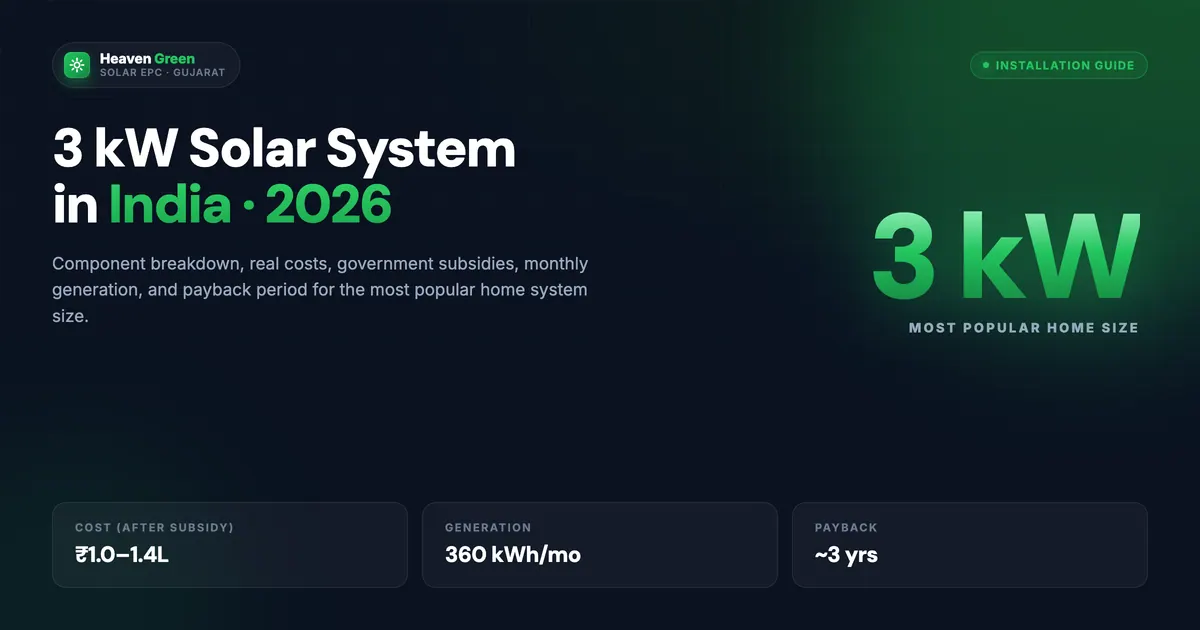
Solar cost in Surat changes completely depending on whether you install a 3 kW, 5 kW, or 10 kW system, and most quotes hide that difference behind a single lump-sum figure. In 2026, a complete on-grid rooftop system from a DGVCL (Dakshin Gujarat Vij Company Limited) empanelled installer costs ₹1,80,000-₹2,25,000 for 3 kW, ₹3,00,000-₹3,75,000 for 5 kW, and ₹6,00,000-₹7,50,000 for 10 kW, before the PM Suryaghar subsidy from MNRE (Ministry of New and Renewable Energy). After subsidy, Surat homeowners pay ₹1,02,000-₹1,47,000, ₹2,22,000-₹2,97,000, and ₹5,22,000-₹6,72,000 respectively. This post breaks each size down line by line: gross price, subsidy, net cost, monthly generation, savings against DGVCL tariff slabs, and payback. Our parent guide on solar installation cost in Surat covers the full 1-10 kW spectrum; this post goes deeper on the three sizes Surat homeowners actually shortlist.
Direct answer. In Surat in 2026, a 3 kW rooftop solar system costs ₹1,02,000-₹1,47,000 after the ₹78,000 PM Suryaghar subsidy, a 5 kW system costs ₹2,22,000-₹2,97,000, and a 10 kW system costs ₹5,22,000-₹6,72,000. Payback runs 2.5-4 years for 3 kW and 5 kW systems, and 4-5 years for 10 kW, at DGVCL tariffs of ₹4.65-₹6.55 per kWh, according to Heaven Green Energy’s Surat install data and MNRE 2026 benchmarks.
One rule before the tables: every price here is a complete turnkey price. That means ALMM (Approved List of Models and Manufacturers) listed panels, a BIS (Bureau of Indian Standards) certified inverter, mounting structure, DC and AC cabling, protection boxes, the PM Suryaghar application on pmsuryaghar.gov.in, DGVCL net metering filing, and a 5-year workmanship warranty. If a quote you hold does not list these, it is not comparable.
3 kW Solar System Cost in Surat: The Subsidy Sweet Spot
A 3 kW system is the most installed residential size in Surat because it captures the entire ₹78,000 central subsidy. The subsidy structure is ₹30,000 for the first kW, ₹30,000 for the second, and ₹18,000 for the third, so 3 kW is the exact point where the cap hits. Every kW you add beyond 3 kW is full price.
The cost breakdown for a typical 3 kW Surat installation in 2026:
| Component | Cost Range | Share of Total |
|---|---|---|
| Solar panels (mono PERC or TOPCon, ALMM-listed) | ₹66,000-₹1,02,000 | 37-45% |
| String inverter (BIS-certified) | ₹15,000-₹30,000 | 8-13% |
| Mounting structure (hot-dip galvanized) | ₹8,000-₹15,000 | 4-7% |
| Wiring, DCDB, ACDB, earthing, protection | ₹10,000-₹20,000 | 6-9% |
| Labour, commissioning, DGVCL application fees | ₹25,000-₹45,000 | 14-20% |
| Gross total | ₹1,80,000-₹2,25,000 | 100% |
| PM Suryaghar subsidy | -₹78,000 | |
| Net cost to you | ₹1,02,000-₹1,47,000 |
A 3 kW system in Surat generates 430-520 kWh per month at the city’s 5.4-5.8 kWh/m²/day irradiation (MNRE Solar Atlas, 2026) with a performance ratio of 0.80. That covers roughly 80-90% of a typical 2-3 BHK Surat household running one AC. Homeowners on X (formerly Twitter) report Gujarat 3 kW installs closing near ₹1.6 lakh gross with Adani panels, landing around ₹82,000 net after subsidy, which sits at the efficient end of our range.
Financing softens the outflow further. Under PM Suryaghar’s collateral-free loan window, public sector banks finance up to ₹2 lakh at roughly 6.75% interest. A ₹1,20,000 net cost financed over 5 years is an EMI of about ₹2,360 per month, very close to the ₹2,500-₹3,400 monthly bill saving a 3 kW system produces in Surat. For the full subsidy mechanics, see the PM Suryaghar complete guide.
5 kW Solar System Cost in Surat: The Two-AC Home Size
A 5 kW system in Surat costs ₹3,00,000-₹3,75,000 gross and ₹2,22,000-₹2,97,000 after the same ₹78,000 subsidy. It is the right size for a 3-4 BHK home running two inverter ACs, a geyser, and a washing machine, which describes a large share of households in Vesu, Adajan, Pal, and Piplod.
The per-kW economics actually improve at 5 kW. Gross cost per kW drops from ₹60,000-₹75,000 (at 3 kW) to ₹60,000-₹75,000 at the low end but clusters near ₹60,000-₹70,000 because the inverter, structure, and labour costs scale slower than capacity. What does not scale is the subsidy: it stays frozen at ₹78,000, so the extra 2 kW from 3 to 5 kW is entirely unsubsidized at roughly ₹1,20,000-₹1,50,000.
| Item | 3 kW | 5 kW | What Changes |
|---|---|---|---|
| Gross cost | ₹1,80,000-₹2,25,000 | ₹3,00,000-₹3,75,000 | Panels + inverter scale up |
| Subsidy | ₹78,000 | ₹78,000 | Capped, no increase |
| Net cost | ₹1,02,000-₹1,47,000 | ₹2,22,000-₹2,97,000 | Extra 2 kW at full price |
| Monthly generation | 430-520 kWh | 720-870 kWh | Scales with capacity |
| Annual saving (₹5.50 avg) | ₹28,380-₹34,320 | ₹47,520-₹57,420 | Roughly 1.7x |
| Roof area needed | ~300 sqft | ~500 sqft | Shadow-free, south-facing preferred |
| Payback | 2.5-4 years | 3-4 years | Slightly longer, similar band |
Homeowners on X report 5 kW Gujarat and pan-India installs closing at ₹3.3-₹3.6 lakh gross, landing near ₹2.5-₹2.8 lakh net, squarely inside the range above. Generation of 720-870 kWh per month covers a ₹4,500-₹7,500 monthly DGVCL bill almost fully. One field note from our Surat installs: 5 kW systems on RCC flat roofs in coastal Surat benefit most from TOPCon panels, because the lower temperature coefficient preserves output through the humid pre-monsoon months when cheaper PERC panels sag 4-6%.
If your bill sits between 3 kW and 5 kW territory, the 3kW vs 5kW vs 10kW comparison walks through the sizing tradeoff nationally, and the Surat-specific numbers above localize it.
10 kW Solar System Cost in Surat: Villas, Bungalows, and Joint Families
A 10 kW system costs ₹6,00,000-₹7,50,000 gross and ₹5,22,000-₹6,72,000 after subsidy. This size fits Surat’s bungalows in Athwalines and Vesu, joint-family homes with 3-4 ACs, and homes adding EV (Electric Vehicle) charging. Monthly generation runs 1,440-1,740 kWh, enough to zero out a ₹9,000-₹12,000 DGVCL bill.
Two structural facts change the 10 kW decision. First, the subsidy share of total cost shrinks: ₹78,000 covers about 43-53% of a 3 kW system’s net cost but only 10-13% of a 10 kW gross cost. You are buying mostly at market price. Second, 10 kW sits at the residential net metering cap most Gujarat DISCOMs apply, and it usually requires a sanctioned load enhancement before DGVCL approves the application, a separate workflow that adds 15-25 days. The PM Suryaghar DGVCL process guide covers the load-enhancement paperwork.
| Item | 5 kW | 10 kW | What Changes |
|---|---|---|---|
| Gross cost | ₹3,00,000-₹3,75,000 | ₹6,00,000-₹7,50,000 | Roughly doubles |
| Subsidy | ₹78,000 | ₹78,000 | Still capped |
| Net cost | ₹2,22,000-₹2,97,000 | ₹5,22,000-₹6,72,000 | Subsidy dilutes to 10-13% |
| Monthly generation | 720-870 kWh | 1,440-1,740 kWh | Doubles |
| Annual saving (₹5.50 avg) | ₹47,520-₹57,420 | ₹95,040-₹1,14,840 | Depends on self-consumption |
| Sanctioned load | Usually sufficient | Enhancement often needed | 15-25 extra days |
| Payback | 3-4 years | 4-5 years | Export dilutes returns |
The payback dilution at 10 kW comes from exports. A household that cannot consume 1,500 kWh a month pushes surplus units to DGVCL at the export credit rate of roughly ₹2.25-₹3.00 per kWh instead of saving the retail ₹6.00-₹6.55. That is why we push back on oversizing: across our Surat installs, a 10 kW system on a ₹6,000 monthly bill exports 40-50% of its output and stretches payback past 5 years. Oversizing is the single most common expensive mistake we correct during site surveys.
💰 Real numbers
If your monthly bill is under ₹8,000, a 10 kW system is almost always the wrong size. Size to your bill, not your roof. The money you do not spend on excess panels earns more than the export credits those panels would.
Which Size Fits Your Home? The Surat Size-Lock Matrix
The Surat Size-Lock Matrix is Heaven Green Energy’s sizing framework: your correct system size is the smallest of three numbers, your bill-implied kW, your roof kW, and your sanctioned-load kW. We apply it on every Surat site survey, and it prevents both oversizing and subsidy waste.
- Bill kW: Average your last three DGVCL bills and divide by ₹1,800. A ₹4,000 bill implies 2.2, round up to 3 kW. A ₹6,500 bill implies 3.6, step to 4 or 5 kW. A ₹12,000 bill implies 6.7, consider 7-10 kW. The divisor works because Surat’s upper-slab tariff of ₹6.00-₹6.55 and 1,700-1,900 kWh annual yield per kW back-solve to roughly ₹1,800 of monthly bill per kW.
- Roof kW: Measure your shadow-free roof area in square feet and divide by 100. A 450 sqft clear terrace supports 4.5 kW. Watch for water tanks, stairwell bulkheads, and parapet shadows after 3 pm.
- Sanctioned-load kW: Check the sanctioned load printed on your DGVCL bill. DGVCL generally approves rooftop systems up to your sanctioned load. A 3 kW sanctioned load caps you at 3 kW unless you file for enhancement first.
- Lock the smallest: If bill kW says 5 but roof kW says 3, install 3 kW. If both say 5 but sanctioned load says 3, either install 3 kW or file the enhancement and wait.
Two boundary cases deserve honesty. If your bill is small but you plan an EV within two years, sizing one step up is rational because retrofitting capacity later costs more per kW. And if your roof is heavily shaded, no matrix output matters until shading is resolved; trim the obstruction or accept the lower number. For a deeper walkthrough, the home solar system size guide covers consumption-based sizing, and our glossary explains what a kWp rating actually means on a panel datasheet.
Curious what your exact size and savings look like? Run your bill through our free solar calculator, subsidy, sizing, and payback in 60 seconds.
DGVCL Tariffs: What Each kWh of Solar Is Worth to You
Your savings per size depend on which DGVCL slab your solar generation displaces. DGVCL residential slabs in 2026 (per DGVCL’s published tariff schedule):
- 0-50 units/month: ₹4.65 per kWh
- 51-200 units/month: ₹5.50 per kWh
- 201-400 units/month: ₹6.00 per kWh
- Above 400 units/month: ₹6.55 per kWh
Solar always displaces your most expensive units first, because net metering nets your consumption down from the top of the bill. A household using 500 units a month that generates 450 from solar now buys only 50 units, paying ₹4.65 on those instead of ₹6.55 on the top 100. The value of each solar kWh is therefore ₹6.00-₹6.55 for upper-slab homes, not the ₹4.65-₹5.50 average a naive calculation assumes.
| Household Profile | Monthly Bill | Effective Solar kWh Value | Best Size |
|---|---|---|---|
| 2 BHK, 1 AC, 300-400 units | ₹2,200-₹3,200 | ₹5.50-₹6.00 | 3 kW |
| 3 BHK, 2 ACs, 600-750 units | ₹4,500-₹6,000 | ₹6.00-₹6.55 | 5 kW |
| Bungalow, 3-4 ACs, 1,200+ units | ₹9,000-₹12,000 | ₹6.55 | 7-10 kW |
Exported units, whatever your panels generate beyond your consumption, earn only ₹2.25-₹3.00 per kWh as DGVCL credit. Homeowners on X have flagged confusion over how DGVCL shows surplus credits on bills, and DGVCL has publicly responded to such complaints by walking consumers through the surplus calculation. Keep your generation meter readings photographed monthly; it makes any credit dispute a 10-minute conversation instead of a months-long one. For state-level policy context, GEDA (Gujarat Energy Development Agency) publishes Gujarat’s rooftop solar policy updates.
Payback and 25-Year Savings for Each Size
Payback is where the three sizes genuinely separate. Using Surat irradiation, DGVCL upper-slab tariffs, 70-80% self-consumption, and the export credit for the remainder:
| Metric | 3 kW | 5 kW | 10 kW |
|---|---|---|---|
| Net cost after subsidy | ₹1,24,500 (mid) | ₹2,59,500 (mid) | ₹5,97,000 (mid) |
| Monthly generation | ~475 kWh | ~795 kWh | ~1,590 kWh |
| Monthly value (70% self-use) | ~₹2,350 | ~₹4,000 | ~₹7,200 |
| Simple payback | 4.4 yrs worst case, 2.5-3 upper slab | 3-4 years | 4-5 years |
| 25-year net savings | ₹7-9 lakh | ₹13-16 lakh | ₹22-28 lakh |
Verdict. For most Surat homes, 3 kW is the best financial decision and 5 kW is the best lifestyle decision. The 10 kW size only wins when your bill genuinely crosses ₹8,000-₹9,000 a month or an EV is in the driveway plan. Buy the size your bill supports, not the size your terrace allows.
The 25-year savings column assumes a 0.5% annual panel degradation and flat tariffs, which is conservative since DGVCL tariffs have risen roughly 3-5% per year over the past decade. Rising tariffs accelerate realized payback. The full methodology, including degradation and export-adjusted calculations, is in our solar payback period explainer and the solar ROI calculation guide.
Subsidy Rules That Apply Differently by Size
The PM Suryaghar subsidy looks simple but behaves differently at each size. Three rules matter for Surat buyers, per MNRE’s 2026 scheme guidelines:
- The cap binds at 3 kW. ₹30,000 + ₹30,000 + ₹18,000 = ₹78,000. Systems of 3 kW and above all receive the same ₹78,000, so subsidy per installed kW falls from ₹26,000 (3 kW) to ₹15,600 (5 kW) to ₹7,800 (10 kW).
- The vendor must be DGVCL-empanelled. Subsidy is released only when your installer is registered on the national portal for DGVCL territory. Heaven Green Energy is empanelled across all DGVCL circles.
- Subsidy arrives after commissioning. DBT (Direct Benefit Transfer) lands in your bank account within about 30 days of net meter installation. You fund the gross amount upfront or through the PM Suryaghar loan window, and homeowners in Surat have reported bank-side delays on JanSamarth loan disbursals, so start the loan file early.
📘 Regulation note
PM Suryaghar subsidy requires ALMM-listed modules. From 2026, DCR (Domestic Content Requirement) cell rules have pushed 3 kW compliant system prices up by roughly ₹20,000-₹30,000 nationally, a cost trend installers report is hitting Gujarat and Maharashtra hardest. Lock your quote validity in writing.
The DCR price pressure is a real 2026 development: posts from installers and buyers on X through June-July 2026 describe 3 kW DCR-compliant quotes moving to the ₹1.8-₹2.1 lakh band. That is the top half of our Surat range, and it is why quotes below ₹1.6 lakh for a “subsidy-compliant” 3 kW system deserve scrutiny. The mechanics of the scheme are also covered in this PM Surya Ghar Yojana guide from Qbits Energy, our group’s inverter and engineering arm.
Red Flags in Surat Solar Quotes (Any Size)
Surat’s competitive market attracts both excellent EPCs and operators who win on headline price and recover margin in the fine print. Five red flags, whatever size you buy:
-
1
Panel price quoted as system price, a ₹66,000 "3 kW" quote is panels only. A complete system has seven cost lines; ask for all of them.
-
2
No ALMM model numbers on the quote, without listed module model numbers, your subsidy claim can be rejected at inspection.
-
3
Subsidy pre-deducted but vendor not DGVCL-empanelled, if the installer cannot file on the portal, the ₹78,000 "discount" is a loan you repay.
-
4
Standard GI structure in coastal Surat, non-galvanized structures rust in 8-12 years here; hot-dip galvanized costs ₹3,000-₹6,000 more and lasts twice as long.
-
5
Generation promises above 550 kWh/month for 3 kW, physically implausible at Surat irradiation; it signals the payback figure is inflated too.
⚠️ Watch out
Vendor ads on social media promote "3 kW from ₹66,999" in Gujarat. That figure is either panel-only pricing, a net-of-subsidy number presented as gross, or an EMI teaser. Always ask: is this gross or net, and does it include inverter, structure, installation, and DGVCL filing?
Is a Bigger System Worth It? Pros and Cons
The oversizing question deserves a straight answer rather than a sales answer.
- ✓ Your bill already crosses ₹7,500-₹8,000 monthly
- ✓ You plan an EV or second floor within 2 years
- ✓ Daytime occupancy keeps self-consumption above 70%
- ✓ Your sanctioned load and roof both support it
- ✗ The house is empty 9 am-5 pm (exports earn ₹2.25-₹3.00)
- ✗ The extra kWs carry no subsidy above 3 kW
- ✗ Sanctioned-load enhancement delays the project a month
- ✗ Payback stretches past 5 years on the extra capacity
The exception worth naming: commercial establishments. If part of your “home” load is actually a shop, clinic, or tuition setup on a commercial connection, the economics flip because commercial DGVCL tariffs run ₹5.30-₹7.20 per kWh and accelerated depreciation adds 14-18% effective cost recovery. That is a different calculation, and our commercial solar team models it separately. Cross-state net metering rules differ too; our group’s engineering arm maintains a state-by-state DISCOM net metering reference if you own property outside Gujarat.
How Heaven Green Energy Helps
Heaven Green Energy is MNRE-approved and DGVCL-empanelled, with 10,000+ installations across 25+ cities and a dedicated Surat field team covering Vesu, Adajan, Althan, Pal, Piplod, Bhatar, and City Light. Every Surat project starts with a free physical site survey where we apply the Size-Lock Matrix to your actual bills, roof, and sanctioned load, so the quote you receive is sized to save, not sized to sell. Our proposals itemize all seven cost lines, list exact ALMM model numbers, and state gross and net prices separately. We also file the PM Suryaghar application, coordinate DGVCL feasibility and net meter installation, and track your subsidy DBT until it lands. If you are comparing installers, our Surat solar company page explains how we work, and the Surat installation guide maps the full local process. You can also read how to claim the ₹78,000 subsidy in Surat before you sign with anyone.
- Residential Solar, 1-10 kW rooftop systems with PM Suryaghar subsidy handled from application to DBT.
- Commercial Solar, 10-500 kW for Surat’s textile and diamond units with accelerated depreciation planning.
- Solar Calculator, your size, subsidy, and payback in 60 seconds.
- Contact Us, free site visit within 24 hours, itemized proposal within 48 hours.
Ready for your exact number? Our engineer applies the Surat Size-Lock Matrix to your DGVCL bill and roof, and sends an itemized proposal in 48 hours, no cost, no obligation. Get your free site assessment →
Frequently Asked Questions
What is the cost of a 3 kW solar system in Surat after subsidy?
A complete 3 kW on-grid system in Surat costs ₹1,80,000-₹2,25,000 gross from a DGVCL-empanelled installer in 2026. After the ₹78,000 PM Suryaghar subsidy, the net cost is ₹1,02,000-₹1,47,000. That price includes ALMM-listed panels, a BIS-certified inverter, mounting structure, wiring, protection equipment, installation labour, the subsidy application, and DGVCL net metering filing. Quotes significantly below ₹1.6 lakh gross usually exclude major cost lines.
How much does a 5 kW solar system cost in Surat in 2026?
A 5 kW system costs ₹3,00,000-₹3,75,000 gross and ₹2,22,000-₹2,97,000 after the ₹78,000 subsidy, which stays capped from 3 kW upward. It generates 720-870 kWh per month in Surat conditions, enough for a 3-4 BHK home with two ACs. Payback runs 3-4 years at DGVCL upper-slab tariffs of ₹6.00-₹6.55 per kWh with reasonable daytime self-consumption.
Is a 10 kW solar system worth it for a Surat home?
Only if your monthly DGVCL bill crosses ₹8,000-₹9,000 or you plan EV charging. A 10 kW system costs ₹5,22,000-₹6,72,000 after subsidy and generates 1,440-1,740 kWh monthly. If your home cannot consume most of that during the day, the surplus exports at ₹2.25-₹3.00 per kWh, pushing payback past 5 years. Size to your bill using the bill ÷ ₹1,800 rule, not to your roof area.
How many units does a 3 kW solar system generate per month in Surat?
A well-installed 3 kW system generates 430-520 kWh per month in Surat, based on the city’s 5.4-5.8 kWh/m²/day irradiation (MNRE Solar Atlas, 2026) and a 0.80 performance ratio. Output peaks from October to May and drops 30-40% during the monsoon months of July and August. Any quote promising above 550 kWh monthly for 3 kW in Surat is inflated.
Does the PM Suryaghar subsidy increase for 5 kW or 10 kW systems?
No. The subsidy caps at ₹78,000 for all residential systems of 3 kW and above: ₹30,000 for the first kW, ₹30,000 for the second, and ₹18,000 for the third. Every kW beyond 3 kW is unsubsidized. This makes 3 kW the densest subsidy-per-rupee size, while 5 kW and 10 kW purchases are mostly at market price.
Can I install 5 kW or 10 kW on my existing DGVCL connection?
DGVCL generally approves rooftop systems up to your sanctioned load, which is printed on your bill. Most urban residential connections carry a 3 kW sanctioned load, so 5 kW and 10 kW systems usually need a sanctioned-load enhancement filed with DGVCL first. That workflow adds 15-25 days. Your empanelled installer can file it alongside the PM Suryaghar application.
What is the payback period for solar in Surat by system size?
At current DGVCL tariffs and Surat irradiation: 3 kW pays back in 2.5-4 years, 5 kW in 3-4 years, and 10 kW in 4-5 years. Upper-slab households with high daytime self-consumption land at the fast end. Homes that are empty during the day export more units at the lower credit rate and land at the slow end.
What roof area do I need for 3 kW, 5 kW, or 10 kW in Surat?
Plan roughly 100 square feet of shadow-free roof per kW: about 300 sqft for 3 kW, 500 sqft for 5 kW, and 1,000 sqft for 10 kW. Account for water tanks, stairwell bulkheads, and parapet shadows, especially after 3 pm. In coastal Surat, also budget for hot-dip galvanized structures, which cost ₹3,000-₹6,000 more but outlast standard GI in the humid climate.