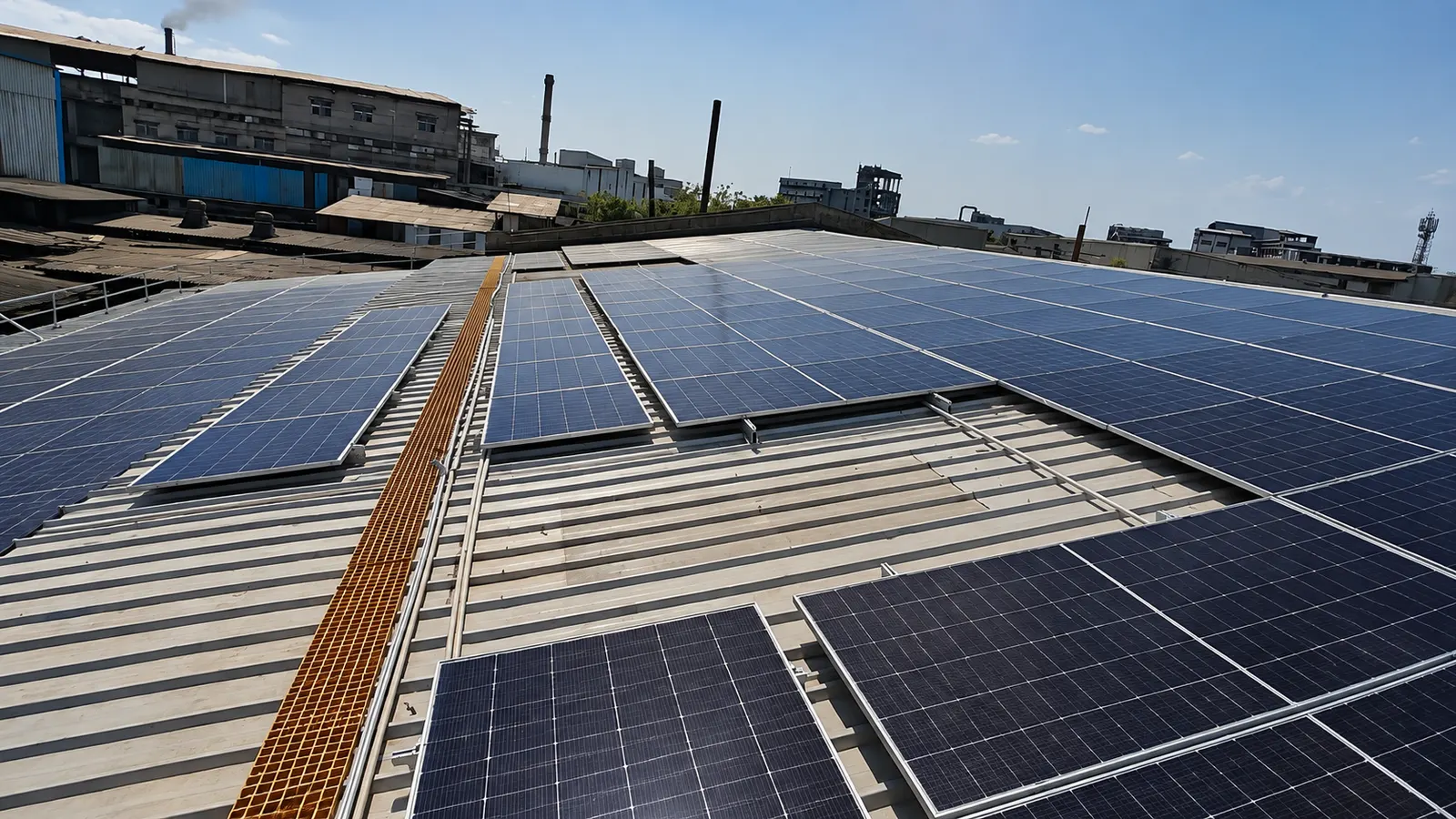
Effluent and water-treatment plants often run pumps, blowers and monitoring equipment for long hours. Rooftop or on-site ground solar can offset part of their daytime electricity use, but treatment continuity and site corrosion make the design different from an ordinary warehouse. The proposed meter, land rights and process controls must be mapped before capacity is chosen.
Direct answer. Solar for an ETP should be sized from interval demand for pumps, aeration and treatment auxiliaries, with off-hours grid supply and process continuity kept visible. GIDC’s 2025 infrastructure list identifies common treatment facilities in several estates, but a CETP and an in-house ETP can have different owners and electricity meters. The applicable GERC tariff and rooftop rule must be selected from the actual account.
Which treatment loads can use solar directly?
For a Gujarat net-metering proposal, also check the DRES instrument signed 30 October 2026. Its published non-residential rule caps exported-energy set-off at 30% of grid imports in the billing cycle, with applicable banking charges and lapse of exports beyond the cap. This can change the value of low-load-day surplus. Gazette commencement and the terms governing the account must be confirmed with the DISCOM; direct on-site use is a separate quantity.
An ETP can draw power for equalisation pumps, aeration blowers, mixers, dosing, sludge handling, filtration, monitoring and control systems. The exact equipment depends on the treatment process. A water-treatment plant may have raw-water pumping, filtration, disinfection and distribution loads. Some duties are continuous; others run with incoming flow or scheduled backwash. Solar output follows sunlight, so its direct-use opportunity depends on whether those duties run during the same intervals.
Start with twelve months of electricity bills and interval import data where available. Add a process flow diagram, motor list, pump operating log and the plant’s flow schedule. The CPCB action plan’s ETP O&M guidance explicitly calls for maintenance of electric motors, pumps and blowers and discusses blower-speed optimisation. Those operational measures should be understood before solar sizing. A plant that improves control or changes treatment capacity may have a different future electrical baseline.
Map flow by hour and season, identify the motors that follow it and compare their load with solar output on the host meter. First map influent or water demand by hour and season. Second identify which motors follow flow and which form a continuous base. Third compare the measured import with forecast solar generation in matching intervals. This gives direct-use, potential export and remaining grid-import quantities. The industrial solar installation guide covers the wider factory process; a treatment plant needs the process duty cycle added to the usual roof and bill survey.
Continuity is essential. An ETP cannot simply stop a biological process because a cloud lowers solar output. Standard grid-connected solar offsets imported power while the grid is available; the grid or a separately designed backup remains responsible for non-solar hours and outages. The solar and power-cuts guide explains that distinction. Any proposal that implies the array alone can run a 24-hour treatment plant needs a specific, separately engineered supply design.
| Treatment load | Operating question | Solar effect to model |
|---|---|---|
| Transfer and equalisation pumps | Continuous or level-controlled? | Daytime direct use and short peaks |
| Aeration blowers | Fixed or variable-speed duty? | Stable load or changing baseline |
| Sludge and filtration equipment | Scheduled hours? | Load shifting opportunity, subject to process limits |
| Monitoring and controls | Critical through outages? | Grid or backup requirement remains |
The table is a survey framework. Process engineers must confirm which duties can move in time without affecting treatment compliance.
How do a CETP and an in-house ETP differ for solar?
A common effluent treatment plant serves multiple industrial members and often has a separate operating entity, land parcel and utility connection. An in-house ETP belongs to one factory and may share its electricity meter, roof and contract demand with production. These differences determine who can authorize the solar plant and where the electricity benefit appears. A factory cannot assume solar on its own roof will directly credit a separately metered CETP simply because it sends effluent there.
GIDC’s infrastructure-services list published in 2025 identifies CETP facilities in estates including Sachin, Pandesara, Vapi, Sarigam, Nandesari and Ankleshwar or Panoli. This is location context, not proof of the operator, available roof or tariff at any specific site. GIDC also notes that approvals for an ETP on an individual plot are considered during building-plan approval. The GIDC infrastructure page describes estate facilities and varied remaining approvals. A solar project should be checked against the actual plant’s property and consent documents.
For a CETP, obtain the operator’s authorization, electricity bills, land records, roof or ground-space rights, process expansion plan and any member agreement affecting capital expenditure. For an in-house ETP, determine whether the solar array will serve the whole factory meter or a dedicated treatment meter. If it shares a factory meter, the model should use the entire account’s interval load and allocate savings internally only for management reporting. The commercial-complex shared-meter guide explains a different multi-party benefit issue; the same principle applies that private cost allocation is separate from utility settlement.
The owner should also identify environmental permit conditions that affect construction. A solar foundation or cable trench must not obstruct drains, treatment tanks, sampling points, emergency access or future expansion. The EPC does not replace the plant’s GPCB compliance adviser. It should obtain the site restrictions from that adviser before fixing the layout. A plant with a hazardous chemical area may need a different equipment location and work permit than a simple water-treatment site.
The result should be a one-page entity and meter map: owner, operator, landholder, utility consumer, signatory and intended host connection. It prevents a proposal from assuming that an estate association and a factory member are the same buyer.
The official documents identify the facility context and tariff year. The specific operator and bill decide the project.
How should the utility bill and rooftop approval be modelled?
Read the utility licensee, consumer category, contract demand or sanctioned load and voltage from the actual bill. A GIDC estate can have a state DISCOM, Torrent or another distribution licensee depending on location. For a state DISCOM account, the GERC tariff schedule effective 1 April 2026 is an official rate source; the selected category must match the bill. The DGVCL FY 2026-27 tariff order, Case 2581/2025 dated 25 March 2026 supports a DGVCL site. The HT versus LT connection guide explains why voltage and contract demand affect the route.
Split the bill into energy, demand or fixed charge, time-of-day items, power-factor adjustment, fuel adjustment, duties and taxes. Directly used rooftop solar can lower matching grid energy imports. It does not automatically remove the peak-demand charge because an aeration blower or pump can still set demand under clouds or at night. The maximum-demand guide and power-factor penalty guide explain those separate bill risks.
The GERC rooftop regulation and amendments index is the starting point for capacity, metering and export settlement. An EPC should cite the current clause and the plant’s consumer category. Exported units should not be valued as if they were always directly consumed, and the applicable rooftop instrument must be checked for any banking charge or cross-reference to open-access charges. The business net-billing versus net-metering guide describes the mechanisms. Any proposed load extension or capacity increase should be cleared before equipment is ordered.
An in-house ETP’s load can change when the factory changes production or treatment technology. A CETP’s load can change when member units join or effluent volumes shift. Model a current operating case and a documented expansion case. Use the same weather and tariff assumptions in both so the owner can see whether extra capacity depends on an uncertain future process load.
The proposal should retain tariff order number, date, assumed export value and measured interval data in an assumptions register. A low price per generated kWh is not enough if the model ignores demand charges, network constraints or treatment downtime.
Bill model
Separate energy used during treatment from exported output and surviving demand charges. A 24-hour process does not turn every solar unit into a night-time unit.
The finance team should be able to trace each claimed bill effect to the plant’s meter and effective tariff clause.
Is spare ETP land a better solar site than the roof?
Treatment plants may have tanks, pipelines and narrow roofs rather than large safe sheds. Spare land can be considered for a ground-mounted array if the land rights, future process expansion and utility connection allow it. The owner should first check whether the land is truly spare. A treatment plant may need room for another aeration tank, sludge handling, vehicle access or flood drainage. Solar foundations should not occupy a reserved process corridor simply because it looks empty today.
Survey the site for underground pipes and cables, tank setbacks, chemical storage, flood levels, drainage, shadow from structures and safe maintenance access. A ground array may be easier to clean than modules above a wet process tank, but it can also be exposed to corrosive mist, vehicle impact or flooding. The ground-mount solar park route gives the wider land-based enquiry path, while the roof-strength guide frames the roof alternative.
Illustrative example, not a project yield or price: assume the usable roof supports an array expected to produce 700 kWh on a representative day, while a surveyed ground parcel could support another 300 kWh. If the host meter has 900 kWh of matching daytime use, the roof-only case could use all 700 kWh directly in matching intervals. The combined 1,000 kWh case may create surplus unless the timing of generation and load permits use. The example shows why more physical area does not automatically produce more avoided grid energy. Actual results require an interval model and approved export rule.
The EPC should compare roof and ground cases with the same load, weather, tariff and connection assumptions. It should list foundations, cable route, site fencing, drainage, corrosion protection, cleaning access and any GIDC or plot approval. A roof option may need structural strengthening; a ground option may need civil works and a longer cable. These are cost drivers, not a reason to assign a universal price range.
| Site option | Main benefit | Main constraint |
|---|---|---|
| Treatment-building roof | Uses built area | Structure, chemicals, tanks and access |
| Open plot within premises | Easier physical access | Process expansion, utilities and land rights |
| Separate off-site land | More potential capacity | Open-access approvals and network charges |
The table is a screen for a site survey. A separate off-site plant is not the same as an on-premises captive array connected behind the meter.
The process engineer should approve any land or roof plan before the EPC finalises the layout, so future treatment capacity remains possible.
How should corrosion and chemical exposure affect the design?
An ETP can contain corrosive vapours, moisture, splash and cleaning chemicals. The exposure varies by process, tank location, wind and enclosure. A module over a benign water-treatment roof may face a different environment from equipment beside chemical dosing or a high-salinity effluent channel. The EPC should map exposure zones with the plant’s EHS and maintenance teams, then specify materials and locations accordingly. Do not assign a generic corrosion class to every GIDC ETP without a site survey.
Place inverters, combiner boxes and switchgear away from splash, flooding and high-corrosion areas where possible. Choose mounting, fasteners, cable supports and enclosures for the actual exposure and maintenance regime. The solar in coastal salt-mist guide covers a related environmental stress, but chemical mist and water-treatment conditions can require different evidence. Ask equipment suppliers for relevant test and warranty conditions rather than assuming a normal rooftop specification covers every ETP atmosphere.
Electrical isolation and safe access matter near water and tanks. The CEA Measures Relating to Safety and Electric Supply Regulations, 2023 provide the national safety requirements, including solar-specific protection and testing. The site’s electrical design should show earthing, isolators, cable routes, protection coordination and any applicable inspector approval. The plant team should know how to isolate PV before cleaning or maintenance near tanks and switchgear.
Construction should follow the ETP’s permit-to-work system. Lifting above live tanks, trenching near buried utilities and hot work near chemicals require site-specific review. The solar crew should not interrupt sampling points, emergency showers, spill-control routes or operator access. The factory installation without shutdown guide gives a phasing framework, but treatment compliance takes precedence over construction convenience.
O&M should include corrosion inspection and cleaning method, not just inverter monitoring. The owner should retain photos of installed equipment locations, coatings, earthing tests and any warranty conditions. A later replacement should use the same environmental design basis or an updated one if the treatment process changes.
Exposure map
Have the process and EHS teams identify splash, vapour, flood and vehicle zones before placing inverters, cable routes or ground structures.
A corrosion-aware design is an equipment-location and maintenance decision, not a blanket claim that solar cannot work at treatment plants.
How can construction protect treatment continuity?
The ETP’s operating process should set the solar construction boundaries. A treatment plant can have sampling, dosing, sludge removal and emergency access that cannot be obstructed. Before work starts, the operator should mark no-go areas and identify which tanks or rooms require uninterrupted access. The EPC should route deliveries, cranes, scaffolds and cable work around those areas. A construction schedule based only on roof availability can conflict with process obligations.
Break the project into work packages: survey and structural work, mounting, module installation, cable routing, switchgear work, utility metering and commissioning. Roof work can often be planned while treatment runs, subject to safe access and isolation. The final electrical tie-in may require a planned power window. The process engineer should specify which pumps and controls can stop, for how long, and what alternative supply or operating procedure applies. Those limits should be written into the permit-to-work plan.
If a ground array is proposed, locate buried process pipes, drains, cables and sampling lines before excavation. A foundation that damages an effluent line can create a compliance and clean-up problem far beyond the solar project. The civil designer should use verified as-built drawings and site detection where appropriate. Temporary stockpiles should not block flood drainage or operator access. A CETP with multiple member industries may need its operator and association to approve the work window together.
Commissioning should also be staged. Test protection and metering under controlled conditions, verify the interconnection agreement and then observe operation during normal treatment load. A short test when pumps are idle may not reveal the same power-factor or demand behaviour as a full process day. The owner should retain the baseline readings and agree a post-commissioning review after normal operating conditions resume. A problem in the utility bill should be diagnosable without interrupting treatment.
Finally, hand over an isolation map and emergency contacts to the shift operators, not only the project manager. The people running the plant overnight need to know which equipment belongs to PV and which remains essential to treatment. This is a practical safety and continuity requirement, independent of the generation estimate.
What should a CETP or factory ask the EPC before signing?
The EPC should receive the host meter’s bills, interval readings, process flow diagram, motor list, operating calendar, plot plan, roof or land documents, single-line diagram and EHS restrictions. It should identify whether the buyer is a CETP operator or an individual factory with an in-house ETP. A generic industrial roof quote may omit the entity, process and site constraints that decide the project. The industrial EPC bid checklist helps normalize generation, equipment and scope assumptions.
Ask for at least two capacity cases under the same treatment and weather assumptions. Each should show direct-use units, exports, remaining grid imports, demand-charge treatment and any PF effect. A continuous process may use much of daytime generation, but the proposal should prove it with interval data. If treatment volume is expected to grow, show a separate expansion case. The EPC should not count an unapproved capacity increase as current demand.
The physical scope should list roof structure or civil foundation, drainage, buried services, chemical exposure, equipment location, cleaning access, fencing if needed and the electrical tie-in. Approval scope should list DISCOM interconnection, property or GIDC permissions where applicable, electrical inspection and coordination with the plant’s environmental compliance team. The solar contract should not claim to replace GPCB consent or treatment compliance obligations.
- ✓ Operator and host meter identified
- ✓ Process load and export separated
- ✓ Roof or land restrictions mapped
- ✓ Corrosion and continuity addressed
- ✗ CETP and factory meter conflated
- ✗ Spare land assumed buildable
- ✗ Chemical exposure ignored
- ✗ Solar described as process backup
The final proposal should include a commissioning and handover plan. It should state who verifies inverter operation, utility metering, protection, earthing and generation data, and who keeps those records. The treatment operator must know how to respond to a PV alarm without disrupting the process. A project can be judged over time only if the plant retains the initial load and generation assumptions.
The buyer should compare bids on delivered usable energy and a complete site scope, not simply the largest module capacity or lowest generation cost. Treatment compliance and access are essential operating requirements.
Request a treatment-plant proposal: Bring the bills, process load, plot plan and roof or land records to the industrial solar enquiry. Ask for separate roof, on-site ground and export cases where relevant.
How Heaven Green Energy helps scope ETP Solar
For an industrial enquiry, assemble twelve months of bills, interval data if available, process and motor schedules, the operator’s entity documents, roof or land plan, electrical single-line diagram and EHS restrictions. Heaven Green Energy files DISCOM paperwork for its customers. The buyer should provide accurate consumer and property documents and have the process team approve equipment locations and work permits.
The relevant routes are:
- Industrial solar for the primary in-house ETP or CETP proposal.
- Commercial solar for a smaller separately metered service facility.
- Ground-mount solar park if a land-based route needs its own review.
The first review should identify the host meter and tariff category, then map process duty by interval. A site survey should compare safe roof and land areas without blocking treatment expansion or access. The commercial model should separate direct use, export and remaining charges under the current GERC rule. Any continuity or backup requirement should be scoped independently from the normal grid-connected energy-offset case.
Use this sequence:
- Identify the operator. Record the CETP or factory entity, meter and signatory.
- Map treatment load. Separate continuous, flow-driven and scheduled motors.
- Survey surfaces. Check roof, land, pipes, tanks and expansion space.
- Map exposure. Locate splash, vapour, flood and maintenance zones.
- Model energy. Compare direct use, export and remaining demand charges.
- Plan handover. Retain approvals, protection settings and O&M records.
After commissioning, compare generated energy and grid imports with flow and treatment logs. A change in influent volume can alter direct solar use without indicating a solar fault. Keep the original load baseline so the operator can distinguish process changes from generation problems. If the treatment plant expands, review both electrical load and utility solar approval before adding modules.
Use the industrial solar route for the main enquiry. The useful outcome is a site-specific plan that supports treatment operations while making the electricity case auditable.
Frequently asked questions
Can rooftop solar run an ETP continuously?
Solar can offset matching daytime grid imports, but a standard grid-connected system does not supply nights or grid outages by itself. The ETP needs grid or separately designed backup for continuous treatment duties. The proposal should keep energy offset and process continuity separate.
Is a GIDC CETP the same buyer as a factory ETP?
Not necessarily. A CETP can have a separate operator, property and electricity account. An in-house ETP may share its factory’s meter. Identify the host consumer and signatory before choosing a rooftop or ground site.
Can an ETP use spare land for ground-mounted solar?
Possibly, after checking land rights, buried utilities, drainage, tanks, process expansion and electrical routing. Land that looks empty may be reserved for future treatment equipment or access. Compare ground and roof cases under the same meter and tariff assumptions.
Does solar reduce ETP maximum-demand charges?
Not automatically. A pump or blower peak after sunset or during clouds can still set recorded demand. Use interval data and the applicable tariff clause before claiming any demand-charge effect.
What equipment needs corrosion review?
Review mounting, fasteners, cable supports, junction boxes, inverters and switchgear against actual moisture, chemical mist, splash and flood exposure. Site conditions vary, so location and specification should follow a surveyed exposure map.
What should a CETP send for a first proposal?
Send bills, interval data if available, process flow and motor schedules, site and roof plans, land documents, electrical diagram, operator authorization and EHS restrictions. These inputs establish the meter, load and safe surface before capacity is quoted.
Include the plant’s permit-to-work procedure and process shutdown limits. The EPC can then plan electrical tie-in and material movement around the treatment duties that must continue during construction.