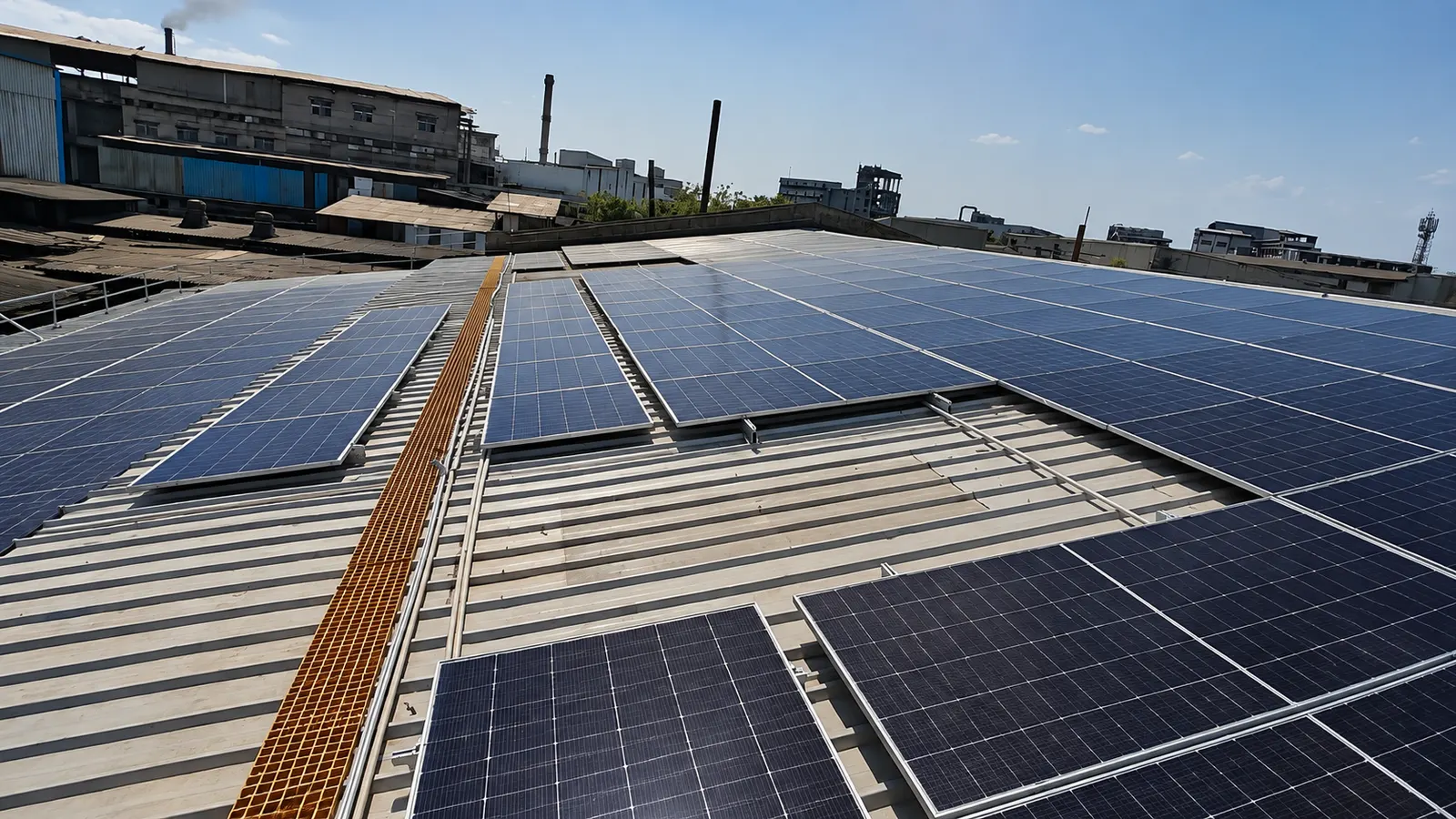
A pharmaceutical plant cannot treat rooftop solar as a standard shed installation. HVAC and cleanroom support loads run on a different clock from packaging or administration. Roof work can affect controlled spaces and air intakes. A suitable proposal joins the energy case to the site’s quality, engineering and electrical approval processes.
Direct answer. Solar can offset a Gujarat pharma plant’s grid energy during daylight, but it should be sized against the actual HVAC and process load and installed through a site-approved GMP work plan. The revised Schedule M gazetted in December 2023 requires documented pharmaceutical premises and quality systems. The solar design should also document power quality, protection, HT connection and any open-access alternative before an EPC bid is accepted.
Which pharma loads can rooftop solar offset?
For a Gujarat net-metering proposal, also check the DRES instrument signed 30 October 2026. Its published non-residential rule caps exported-energy set-off at 30% of grid imports in the billing cycle, with applicable banking charges and lapse of exports beyond the cap. This can change the value of low-load-day surplus. Gazette commencement and the terms governing the account must be confirmed with the DISCOM; direct on-site use is a separate quantity.
The useful load is the power the plant draws while sunlight is available. Cleanroom air handling, chilled water, exhaust systems, process equipment, lighting and office loads may all contribute, but their timing and criticality differ. A continuous HVAC base load can create strong daytime self-consumption. A plant that shuts a production line for a campaign change may have the same building but a different load curve. Use the meter’s interval data and a process calendar instead of a nameplate total.
The site should separate three electrical groups. First are essential services that must remain within validated conditions, such as specified air handling and monitoring. Second are production loads that cycle by batch or shift. Third are noncritical loads whose timing can move. Rooftop solar reduces grid import while the grid is present; a standard on-grid inverter is not a continuity system for cleanrooms. A backup and transfer design must be assessed separately against the plant’s qualification requirements.
Ask for twelve months of bills, maximum-demand data and representative interval readings. Record planned shutdowns, monsoon operation, HVAC seasonal changes and major equipment additions. A one-day load study can miss a batch cycle or cleaning period. The industrial solar installation guide covers the general factory process; for pharma, the energy model should be reviewed by both the utility engineering team and the quality function.
Use a Quality, Load, Grid Gate. The project proceeds only when the quality team accepts the roof and contamination controls, the energy team has a defensible daytime profile, and the electrical team has an approved connection and protection route. A failure at any gate changes the design, not just the project schedule. This makes the business decision more reliable than choosing capacity from annual consumption alone.
| Load group | Solar value question | Qualification question |
|---|---|---|
| Cleanroom and HVAC support | How much daytime import is continuous? | Can work and electrical changes preserve validated conditions? |
| Batch production | How do campaigns change the load curve? | Which equipment needs stable supply or controlled shutdown? |
| Offices and utilities | Can use move into solar hours? | Does the change affect approved operating procedures? |
The table is a planning tool, not a claim that every pharma site has the same load mix. Confirm the actual circuits and the site’s quality requirements before sizing.
How should GMP controls shape roof access and construction?
The revised Schedule M gazette published by the Ministry of Health and Family Welfare in December 2023 sets Good Manufacturing Practices and requirements for premises, plant and equipment for pharmaceutical products. It requires documented systems and responsibilities. It does not contain a generic solar-panel approval form. The plant must apply its own quality risk management to construction near controlled spaces, air intakes and product routes.
Map the roof from below as well as above. Mark cleanrooms, air-handling intakes, exhaust outlets, pressure boundaries, roof penetrations, drainage and maintenance routes. A solar crew may work over a controlled room without entering it, yet a dropped fastener, dust release, leaking penetration or temporary interruption can still affect operations. The plant’s engineering and quality teams should agree the work method, containment, monitoring and acceptance checks before installation begins.
The CDSCO GMP inspection checklist shows the importance of maintained premises, equipment and records in an inspection. That reinforces a practical rule: treat the rooftop work as a documented change with approved drawings, contractor access, deviation handling and closure evidence. The plant’s quality team must approve the change and decide what qualification or requalification is needed.
The roof may need hot work, drilling, lifting or material staging. Each activity should have a plant permit, exclusion zone and agreed cleaning method. If a cable crosses a validated area, route and seal it according to the site engineering standard. If a roof penetration is unavoidable, document waterproofing and the effect on cleanroom envelope integrity. The factory installation without shutdown guide explains how roof work can be phased; a pharma site must add its quality controls to that phasing.
Watch out
A roof work permit does not replace the plant's GMP change-control decision. Get quality approval for work near air intakes and controlled spaces.
Ask the EPC for a construction method that identifies the site zones, access times, lifting path, dust controls, temporary weather protection and post-work inspection. The quality team should know which records will remain available for future audits.
What power-quality checks belong in the solar design?
The solar interface should be studied at the plant’s point of common coupling. Identify the HT or LT transformer, switchgear, existing APFC equipment, UPS, generator, drives and sensitive process controls. The inverter’s grid-following operation can reduce active import while the site’s reactive demand persists. That can change the power factor recorded at the utility meter. The power-factor penalty guide explains this effect; the site should measure it rather than assume it will occur or disappear.
The CEA compendium of grid connectivity regulations published in 2024 sets technical expectations for connecting generation to the grid, including safe operation and power quality. It states that grid standards are not a substitute for protecting the user’s own equipment. That distinction matters for pharma: regulatory interconnection compliance and internal process-equipment suitability are separate tests. The EPC should provide inverter data, protection settings and a commissioning plan, while the plant determines any qualification of its critical circuits.
Request a baseline power-quality survey if the site has existing harmonic or voltage complaints. Record voltage, frequency, harmonics, power factor, demand and important machine events before solar is connected. After commissioning, repeat the measurements under comparable production conditions. If an issue appears, the data helps distinguish inverter settings, APFC interaction, grid variation and a pre-existing plant problem. Avoid a contract that treats every future disturbance as either automatically caused by solar or automatically unrelated to it.
The electrical single-line diagram should show anti-islanding protection, isolation points, earthing, transformer and meter connections, and any generator or UPS interface. The CEA safety regulations notified in 2023 apply to electrical safety. State inspector and DISCOM approval requirements may also apply to the actual capacity and voltage. The CEIG approval guide explains Gujarat’s rooftop inspector workflow.
Technical note
Grid-interconnection compliance protects the connection. The plant must separately assess its validated process equipment and backup requirements.
Acceptance should require documented settings and tests. A verbal assurance of “clean power” does not define a measurable standard for a regulated manufacturing site.
Does an HT connection make open access a better option?
An HT connection can make off-site renewable procurement worth evaluating, but it does not automatically make it cheaper than rooftop. The GERC FY 2026-27 DGVCL tariff order, Case 2581/2025 dated 25 March 2026 sets the relevant HT energy, demand and open-access charges for a DGVCL plant. A site in another licensee area must use its own bill and order. The HT versus LT connection guide explains the supply-route differences.
The national Ministry of Power parliamentary answer dated 3 February 2025 describes the 100 kW eligibility threshold for non-captive green open access and the exception for captive consumers. Gujarat’s current GERC regulation and approval process determine the local route. A pharma factory with a suitable roof can compare on-site self-use with off-site power delivered through GETCO and the DISCOM. The off-site option needs a full landed-cost ledger, not just a generator price.
Off-site procurement may suit a plant with limited roof or a high continuous load. It brings transmission and wheeling charges, losses, surcharges where applicable, banking, scheduling and contract risk. The Gujarat open-access landed-cost guide works through those lines with dated orders. A rooftop plant behind the same meter avoids much of that network path for directly used energy but may be limited by roof area and site works.
The choice should use the same interval load profile and a clearly defined delivered unit. Include any effect on contract demand and power factor separately. A plant that runs around the clock may use rooftop solar well in daytime yet still need grid import every night. Open access can cover more annual energy, but its delivered value depends on the approved path and commercial terms.
Compare the physical and grid routes. Send the plant bill, load profile and roof plan through industrial solar so a proposal can compare rooftop with a documented off-site option.
Which approvals and records should a pharma project retain?
Keep a project approvals matrix with quality, structural, electrical, DISCOM and inspector columns. The quality column should name the change-control number, risk assessment, work zones and acceptance conditions. The structural column should contain the roof survey, mounting calculations and as-built records. The electrical column should contain the single-line diagram, protection settings, test results and commissioning data. The DISCOM and inspector columns should contain application references, approved drawings and meter records.
The GERC rooftop regulation and amendments govern the Gujarat grid-connected rooftop route, including the applicable capacity and process conditions. The CEA 2023 safety regulations govern national electrical safety duties. The revised Schedule M governs the pharmaceutical quality-system context. The owner should not use an electrical approval as evidence that GMP change control is complete, or a GMP release as evidence that the DISCOM has approved grid connection.
The project team can follow a simple record sequence:
- Baseline the site. Archive bills, interval load, roof drawings and power-quality measurements.
- Approve the change. Obtain quality, EHS and engineering acceptance of the work plan.
- Approve the connection. Submit drawings and protection details to the relevant DISCOM and inspector.
- Test and commission. Record electrical tests, meter readings and process-condition checks.
- Close and retain. Store as-built drawings, training records, deviations and maintenance instructions.
These are project controls, not a universal statutory checklist for every formulation, bulk-drug or packaging facility. The site’s licence and internal procedures may require additional evidence. Ask the EPC to identify what it will produce and what the plant must produce. The solar permits Gujarat guide gives the wider permit context.
During construction, log deviations. A new cable route, moved inverter or changed roof penetration can affect both approved electrical drawings and quality-risk controls. The project should have a process for stopping work, assessing the change and updating records. This is especially important around validated HVAC systems, where a seemingly minor opening can affect pressure control or water ingress.
At handover, retain an accessible register of roof zones, equipment, isolation points and safe maintenance routes. Future service workers may not have been present during installation. The documentation should let them work without disturbing controlled spaces or losing traceability.
How do Ahmedabad, Vapi and Ankleshwar sites differ?
The same national Schedule M and CEA frameworks apply, but the local roof, utility and industrial setting are not identical. A plant in Ahmedabad may be on a different licensee and tariff than a plant in Vapi or Ankleshwar. Read the bill before selecting the order. The GERC tariff-order list for FY 2026-27 includes separate orders for the state DISCOMs and private licensees. A location name alone is not enough to establish the applicable tariff or open-access charge.
Vapi and Ankleshwar can involve chemical and coastal exposure issues at particular sites. That is a site condition to inspect, not a claim about every plant in either area. Check roof corrosion, air-intake position, chemical deposits and equipment enclosure ratings. The Vapi chemical-cluster guide and Ankleshwar chemical-cluster guide cover the broader industrial setting. A pharma proposal should also account for the site’s controlled areas and quality procedures.
Roof ownership and expansion plans can differ. Some plants own large sheds; others occupy leased buildings or have roofs reserved for new HVAC equipment. A good layout leaves access to air handling and future plant. Do not fill a roof that the engineering team may need for an expansion. A small usable roof may still support worthwhile direct-use solar, while a larger annual renewable target may require an off-site route.
| Site question | Why it changes the proposal | Document to request |
|---|---|---|
| Licensee and HT category | Tariff and approval route differ | Complete recent bill |
| Air intake and controlled areas | Roof work may affect GMP conditions | Roof and HVAC drawings |
| Corrosion or deposits | Equipment and mounting specification change | Site survey and maintenance record |
| Expansion plan | Roof area and future load can change | Approved plant master plan |
The table should be completed with site evidence. It is not a ranking of cities. The best configuration for one plant may be inappropriate at another plant in the same district.
When is the proposed solar route ready for procurement?
It is ready when the quality, load and grid gates each have evidence. The quality team should have accepted the construction method and defined any qualification needed after work. The energy team should have a bill and interval model that separates self-consumption from export. The electrical team should have an approved connection concept and a plan for protection and power-quality tests. A panel quotation alone does not close those decisions.
The EPC bid should include the equipment list, roof design, cable and switchgear layout, protection scheme, proposed commissioning tests and operation and maintenance scope. Ask for clear exclusions. If temporary HVAC isolation, roof reinforcement or additional switchgear is outside the price, it should be visible before comparing bids. The industrial EPC bid checklist helps normalise these items.
- ✓ Quality work plan and roof survey are accepted.
- ✓ Load, protection and export assumptions are documented.
- ✗ Roof access crosses an uncontrolled GMP area.
- ✗ “Clean power” is promised without tests.
The proposal should state what it does not prove. A generation forecast cannot certify product quality. An inverter data sheet cannot prove that a validated machine will ride through a grid outage. A grid approval cannot replace a roof survey. Naming those boundaries makes it easier for the plant’s engineering, quality and finance teams to make one coordinated decision.
Use the quality, load and grid gate again at contract signing. If one gate is still open, make the next study a named deliverable with an owner and decision date. Do not hide it in a generic “subject to site survey” line after the plant has already committed to a capacity.
The procurement review should also assign the owner of deviations discovered during construction. If a cable route crosses a controlled room or a roof penetration differs from the accepted drawing, the plant should know who can stop that work, who proposes the revised method and which quality record is updated. This is a practical approval gate, not an assumption to leave for the installation crew.
How Heaven Green Energy helps plan a Pharma Solar Proposal
Start with the documents the site already uses: the complete electricity bill, interval load if available, roof and HVAC plans, electrical single-line diagram, quality change-control procedure and production calendar. These let a proposal identify the real daytime offset, roof and process constraints, and approval route. Any missing evidence should be listed as an assumption to verify in the site survey.
The service routes are:
- Industrial solar for a factory rooftop and electrical proposal.
- Commercial solar for a smaller business or non-manufacturing premises.
- Ground-mount solar park for a separately assessed land or off-site route.
Heaven Green Energy files DISCOM paperwork for its customers. The plant remains responsible for its own accurate site information and internal quality approvals. A proposal should assign who prepares each drawing, who approves roof work near controlled areas, who submits the grid application and who records commissioning tests. It should also name the quality and engineering representatives who can accept a change to the installed design.
Ask for two commercial views where both are feasible: rooftop direct use and a documented off-site option. Apply the actual GERC tariff and open-access orders to the plant’s licensee. Keep the energy model separate from backup and validated power-quality requirements. The buyer can then see which part of its electricity use solar can affect and which obligations remain.
Use the industrial solar page to begin a factory proposal discussion with those documents. The first useful output is a clear scope and assumptions register. That register is as important as the proposed kW because the site must be able to build, qualify, operate and maintain the array without compromising its manufacturing controls.
Before signing, ask the plant’s quality lead and electrical lead to review the same version of the proposal. Their comments should be resolved in the drawing and scope register, so a later contractor change does not reopen a closed GMP or protection decision without review.
Set a document handover point before the final electrical tie-in. The file should contain the approved cable route, inverter and protection settings, roof access method, test results, updated single-line diagram and the version of the quality change record that permitted the work. Record who can isolate the solar circuit during a plant deviation and who can authorise restart. If the installed equipment or route differs from the accepted drawing, resolve that difference through the plant’s change-control process before treating commissioning as complete. This gives maintenance and quality teams a usable record after the EPC leaves the site.
Frequently asked questions
Can a pharmaceutical plant use rooftop solar without disrupting GMP operations?
It may be possible with a site-approved change-control and work plan. The plant must assess roof access, air intakes, controlled spaces, dust, penetrations and post-work acceptance under its own quality system. The revised Schedule M gazetted in December 2023 makes documented premises and procedures central to GMP; it does not provide a blanket solar waiver.
Does rooftop solar make a pharma factory’s electricity “clean power” for equipment?
It can reduce grid energy imported while the grid is present, but that does not certify voltage quality or outage continuity at a machine. The plant should test power quality and keep separately designed UPS or backup arrangements for critical equipment.
Should HVAC load determine the solar size?
It is an important input, especially when it runs during daylight, but the size also depends on the full interval load, roof area, shade, sanctioned connection and export rules. Model campaign and shutdown days separately.
Does an HT pharma plant automatically qualify for open access?
The national MoP rule describes eligibility based on contracted demand or sanctioned load, with a captive exception. Gujarat’s GERC process and the specific grid path still apply. HT status alone does not prove every approval or landed cost.
Which documents should be kept for a GMP audit after solar installation?
Keep the quality change record, risk assessment, roof and HVAC drawings, contractor work method, approved electrical drawings, deviations, commissioning tests, as-built plans and maintenance instructions. The site’s own quality procedures determine any additional qualification evidence.
What should a Gujarat pharma plant send for a proposal?
Send bills, interval demand, production calendar, roof and HVAC plans, electrical single-line drawing, roof ownership details and the site’s change-control requirements. These inputs support a proposal that distinguishes energy savings from quality, power and approval duties.