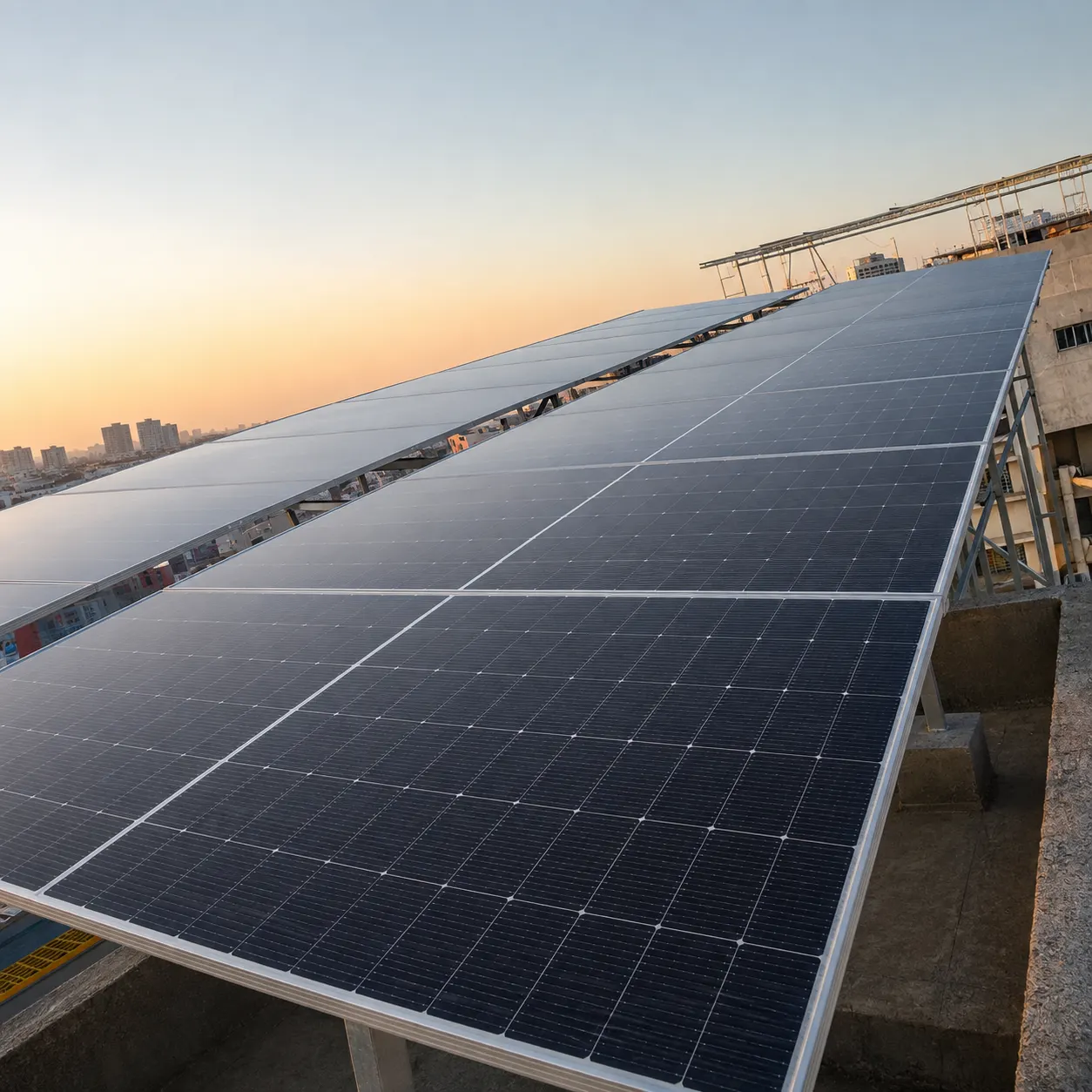
Schools and colleges use power through the day, which can make rooftop solar a practical option. Their calendars create a second problem: generation continues during holidays, examination breaks and low-occupancy weekends. The meter, trust structure and approved export rule decide whether a larger system remains useful outside term time.
Direct answer. Solar for schools should be sized from the common campus meter’s term-time and holiday interval demand, not only a busy-month bill. A trust or college should confirm its consumer category and the current rooftop rule in its state before valuing exports. MPERC’s rooftop regulation was amended on 18 June 2026, and Gujarat and Maharashtra have separate frameworks; there is no single national credit rate for an educational campus.
How does the academic calendar change the solar load match?
Classrooms, labs, computers, administration, pumps, lighting and cooling often use power during solar hours. Yet demand can fall during summer holidays, semester breaks, Sundays and examination periods. A residential hostel may remain occupied when classrooms close. A college with laboratories can have a different schedule from a primary school. A roof can be large while the meter’s daytime minimum is small for several weeks of the year.
Collect a full year of bills and, where possible, interval meter readings. Mark teaching days, holiday periods, hostel occupancy, special events and any evening classes. Separate buildings and meters. A campus may have one account for teaching blocks, another for a hostel or staff housing, and a third for common services. The solar design must identify which meter receives generation and where the roof rights sit. The sanctioned-load glossary helps decode the account before a capacity is proposed.
Build at least two representative operating days. A term-time day might have cooling and classroom demand from morning to afternoon. A holiday day may have only security, server, pumping and maintenance load. Match expected solar output with each interval. If the array produces more than the holiday load, the surplus depends on the approved metering and settlement rule. Do not assume it will offset the following term’s retail bill one-for-one. The business net-billing versus net-metering guide explains why direct use and export can have different values.
Use a checklist. First label all operating periods, including the low-load month. Next identify the proposed meter and tariff category. Finally survey the roof and compare generation with the selected meter’s interval load. This prevents a board from accepting a proposal based on annual energy alone. A school can consume many units in a year but still export heavily through a long break.
| Calendar period | Load evidence | Sizing question |
|---|---|---|
| Teaching term | Classroom, lab and cooling intervals | How much solar is used directly? |
| Examination period | Altered room and equipment schedule | Does daytime demand remain steady? |
| Holiday or weekend | Pumps, IT, hostel and security | What share becomes surplus? |
| New academic block | Approved expansion and meter plan | Is future load on the same connection? |
This table is a planning framework. A campus should replace each row with its own calendar and utility records.
Which tariff and rooftop rule applies to the campus meter?
The electricity bill establishes the distribution licensee, consumer category, sanctioned load or contract demand, voltage and tax treatment. An institution may be owned by a charitable trust, a private company, a government body or another entity; the ownership label does not by itself determine the utility tariff. Ask the EPC to quote the category and rate from the applicable order for each campus meter, not a blended “school tariff.”
For Gujarat, the GERC state DISCOM tariff schedule effective 1 April 2026 is one official reference where a state DISCOM supplies the site; Torrent licensee accounts need the relevant Torrent schedule. Gujarat’s rooftop net-metering regulation and amendments index should be used for the proposed meter and capacity. For Maharashtra, MERC publishes the 2019 Grid Interactive Rooftop Renewable Energy Generating Systems Regulations and later amendments. For Madhya Pradesh, MPERC’s FY 2026-27 retail tariff order, Petition 140/2025 dated 26 March 2026 and 2024 rooftop regulation with the first amendment dated 18 June 2026 provide the official framework. Each is a separate state route.
Read the bill in components: imported energy, fixed or demand charge, ToD slots where relevant, power-factor terms, duties and taxes. A solar unit used directly can reduce matching grid energy. It may not remove demand and fixed charges. A high-load event after school hours or a cloudy interval can still set demand. The maximum-demand guide is useful for a campus with large AC or lab peaks.
The school’s proposal should identify the current rule’s capacity cap and export mechanism for that consumer category. Do not assume a residential subsidy or residential net-metering clause applies because students and teachers use the building. The institution’s utility account and legal status are the inputs. The commercial solar route is the appropriate enquiry path for an institution.
Those dates help the board check that a proposal uses a current rule. The actual bill and approval determine the campus case.
How should a school size solar when holidays produce surplus?
Start with the minimum recurring daytime load, then test larger capacities against the approved export value. The roof is an upper physical limit, not the recommended system size. A school may have enough roof to cover a busy teaching day but little use during a summer break. A hostel, library or research lab can raise the holiday baseload, so the decision must use the actual campus calendar rather than a generic assumption.
Illustrative example, not an actual campus generation or bill forecast: assume an array produces 1,000 kWh on a representative clear day. A teaching day has 850 kWh of demand in matching solar intervals, leaving 150 kWh of possible surplus. A holiday day has 200 kWh of matching demand, leaving 800 kWh of possible surplus. The same array and weather produce different economics because the campus uses less power during the break. The value of the 800 kWh depends on the approved state’s meter and settlement rule; it should not be priced automatically at the retail tariff.
Ask the EPC for month-by-month generation and use. It should show expected direct consumption, export, remaining grid import and fixed or demand charges in both the academic and holiday calendars. A model that divides an annual bill by twelve can conceal the months with the largest export share. If the school operates multiple shifts or a summer programme, include those actual activities. If a proposed new block is not yet approved, show it as a separate future scenario.
Capacity also depends on sanctioned load or contract demand and the applicable state limit. The solar capacity and sanctioned-load guide explains why a system cannot be sized from roof area alone. If a load extension is needed, the utility’s feasibility and cost drivers should be resolved before the board approves a larger array. The school should also compare a smaller self-use design with a larger export-heavy design under the same generation inputs.
| Design case | Strength | Risk to test |
|---|---|---|
| Smaller daytime-baseload system | More output matches recurring load | May leave busy-term consumption untouched |
| Larger term-time system | More direct use when classes run | Holiday export and settlement value |
| Staged expansion | Preserves option for a future building | Later approval and equipment compatibility |
The table is a decision screen. The board should ask for the actual unit split and the cited export clause before choosing a case.
Holiday sizing check
Request a separate holiday bill model. Annual consumption can look large while the campus exports much of its solar output during the longest break.
The goal is a system that remains sensible across the school year, not one that looks attractive only in the highest-load month.
What should a trust board know about depreciation and funding?
Tax treatment depends on the institution’s legal status, asset ownership, year and accounts. Do not add a business accelerated-depreciation benefit to every school proposal or assume the asset’s cost and depreciation can both be counted as a trust benefit. The Income Tax Department’s transition guidance distinguishes the Income-tax Act, 2025, effective from 1 April 2026, from earlier-year matters continuing under the 1961 Act. The accountant should identify the applicable current provision and confirm the treatment in writing before any tax benefit enters the model.
Some educational operators are taxable companies or other entities rather than institutions using charitable-trust tax treatment. Their tax analysis may differ. The board should provide its registration, tax status, ownership of the proposed roof and accounting policy to its adviser. The EPC should present a base electricity case without an assumed tax benefit, then add an adviser-approved scenario if applicable. This avoids a false choice between an otherwise sound energy project and a tax line that the institution cannot use.
Funding can come from the institution’s own capital, a loan, a third-party operating model or donations where the board’s rules permit. The OPEX versus CAPEX solar guide explains the ownership difference. A third-party structure needs clear roof rights, meter relationship, payment obligations, insurance, equipment access and end-of-term removal terms. A donation-funded project still needs someone responsible for operations, repair and meter compliance after handover. Donor intent and trust deed restrictions should be checked by the institution’s legal and finance advisers.
The purchase decision should record total project scope, roof work, approvals, maintenance and replacement responsibilities without assuming a return percentage. A school board can compare bids using expected direct-use units and the actual tariff components they avoid. It should also see how holiday exports are valued. Funding source does not alter the physical fact that a solar array produces during a school break.
Trust tax note
Do not put an automatic accelerated-depreciation credit into a trust's solar proposal. Ask its tax adviser to confirm the entity and asset treatment first.
This is a governance check, not a substitute for tax advice on the institution’s own accounts.
Which approvals should the school committee settle first?
A school or college can have several decision makers: a trust board, managing committee, landlord, principal, facilities team and utility account holder. The proposal should name who can approve the roof, who signs the electricity application and who can commit funds. A committee resolution may be required by the institution’s own rules. If the campus is leased, the roof owner may need to consent separately. The meter holder and roof owner need not be the same person, so the EPC should identify the required document chain before filing.
The first approval is an internal scope: which buildings, meter and budget are in the project. The second is a structural and safety review of the proposed roof. The third is the utility interconnection or rooftop application under the applicable GERC, MERC or MPERC rule. Electrical inspection can also apply depending on voltage and capacity. The CEA Measures Relating to Safety and Electric Supply Regulations, 2023 are the national safety reference; state authorities and the utility specify the local process.
The board should ask for a document checklist: latest bill, sanctioned load or contract demand, title or lease, roof consent, site drawing, structural conclusion, single-line diagram, equipment details, protection scheme and committee authorization. Some documents are only needed for particular capacities or arrangements, so the EPC should identify the actual form instead of giving the board a generic home-subsidy list. The solar permits guide gives a Gujarat-wide overview, but a school should confirm the utility and legal entity on its own application.
Plan the calendar. Roof work near classrooms should consider examinations, student movement, access to toilets and emergency routes. The electrical tie-in may need a planned isolation that affects labs, servers or hostel services. A school can often choose a holiday window for construction, but that is a site scheduling decision rather than a promised duration. The campus facilities lead should approve lifting, hot work, work at height and restricted areas before contractors mobilise.
Keep records after approval. The institution should retain the board resolution, utility agreement, drawings, inspection results, commissioning data and O&M instructions. Committee membership changes, but the solar plant remains on the roof. A complete file helps future trustees understand who owns it and how it is billed.
What safety and maintenance rules matter on a live campus?
Solar modules and electrical routes must be placed so students cannot reach live equipment or enter work zones. The roof layout should preserve fire access, drainage, water tanks, HVAC service areas and safe movement for maintenance workers. A structural engineer should review roof capacity, anchoring and wind loads. The roof-strength guide covers the physical survey; a campus with older buildings may need a more detailed review of waterproofing and additions made over time.
Construction should separate lifting and roof work from student routes. A site plan should mark temporary barriers, delivery areas, crane or hoist locations and safe hours for noisy or hot work. Labs, server rooms and medical facilities may need continuity during the electrical tie-in. The committee should approve an isolation plan and emergency contacts. These steps follow ordinary campus safety management and the CEA electrical-safety framework, not an assumption that daytime classes can simply continue under any roof work.
After commissioning, the school should define who checks inverter alarms, generation, cleaning needs and roof leaks. Holidays can be a convenient maintenance period, but generation also continues then. If the site is closed, remote monitoring and a named response owner become important. No response-time promise is needed; the contract should state the process and contact. The solar monitoring guide explains the records that help distinguish a fault from a low-load export period.
The O&M contract should state inspection scope, cleaning method, safety access, equipment warranties and who handles a utility meter issue. A school should not assume that a donated plant arrives with funded long-term maintenance. Nor should a third-party owner be allowed roof access without campus procedures. Each model needs a practical access and responsibility plan.
- ✓ Student and worker zones separated
- ✓ Roof and fire routes reviewed
- ✓ Tie-in scheduled with critical loads
- ✓ Named O&M and record owner
- ✗ No holiday export case
- ✗ Roof ownership unclear
- ✗ Maintenance funding omitted
- ✗ Campus access plan absent
The board can use this checklist to compare bids with the same operational duties, not just the same module capacity.
How do multiple campus meters and roof rights affect the choice?
A college can have several electricity connections because its teaching block, hostel, sports complex and staff quarters were built at different times. One array on a convenient roof does not automatically reduce every account. The rooftop application identifies a consumer number and approved electrical arrangement. If the institution wants to share output across meters, it must establish that a group, virtual or other permitted mechanism applies to those accounts under the current state rule. The business metering comparison explains why the words “net metering” alone do not answer this question.
Make a meter-and-roof map before selecting capacity. For each building, record the roof owner, electricity account holder, tariff category, sanctioned load, daytime consumption and distance to the proposed interconnection point. A teaching block may have the strongest term-time load but a weak roof. A hostel may have a strong year-round load but be separately metered. A carport may have a safe mounting opportunity yet sit far from the intended electrical panel. Each pairing has a different design and consent question.
Where a trust owns the property but a different entity holds the electricity account, confirm who signs the utility forms and who receives the bill credit. A lease or operating agreement may allocate electricity costs to a school operator. Solar ownership and electricity savings should be addressed in that contract before installation. If the campus has tenants, such as a canteen or training partner, do not imply they will share a solar benefit without a documented meter and payment arrangement.
The owner should also consider future meter consolidation or expansion. A new hostel or academic block may change the best interconnection point. If such work is only proposed, keep it as a future scenario. The base case should work under today’s approved meter and roof rights. This is particularly important for an OPEX model, where a third party may need long-term roof access and a clear bill or payment counterparty.
The practical output is a one-page schedule of roofs, meters, rights and responsible signatories. That schedule can travel with the board resolution and utility application. It lets bidders price the same electrical route and prevents a low quote from silently assuming a credit transfer that has not been approved.
Plan a campus proposal: Bring the calendar, bills, roof documents and committee requirements to the commercial solar enquiry. Ask for term-time and holiday cases under the current state rule.
How Heaven Green Energy helps scope a Campus Proposal
For an institution enquiry, assemble a full year of bills, interval data if available, the academic and hostel calendar, roof plans, ownership or lease records, and the trust or management approval process. Heaven Green Energy files DISCOM paperwork for its customers. The institution should provide accurate entity and consumer documents and agree which committee can authorize the application.
The relevant routes are:
- Commercial solar for the school or college’s primary proposal.
- Industrial solar only if a separately operated industrial training or manufacturing unit has its own factory connection.
- OPEX versus CAPEX guide for the ownership and funding comparison.
The initial review should identify the meter and tariff category, then compare load during classes and breaks. A roof survey and safety plan should follow. Finally, the proposal should show the selected metering mechanism, export treatment and any remaining bill charges. The board should receive the source and date of each regulatory assumption, so a future committee can review the same decision.
Use this sequence:
- Map the calendar. Separate term, holiday, weekend and hostel loads.
- Identify the account. Confirm licensee, category, meter and sanctioned load.
- Set governance. Record roof rights, committee resolution and signatory.
- Survey the roof. Check structure, access, drainage and student safety.
- Compare sizes. Value direct use and surplus under the approved rule.
- Plan operation. Assign meter records, cleaning and maintenance responsibility.
The proposal should be reviewable by both the facilities team and the finance committee. After commissioning, compare generated, directly used and exported units against the academic calendar. A low import bill in a holiday month can coexist with a large export credit, and the two should be recorded separately. That ongoing record helps the institution understand whether the chosen size still fits as enrolment and buildings change.
Use the commercial solar route for the main enquiry. A useful result is a system size and approval plan that remains sensible when the campus is quiet.
Frequently asked questions
Should a school size solar from the highest summer bill?
No. A summer bill can include cooling or hostel use, while other holidays may have little load. Use the full academic calendar and interval readings. Model direct use and exports in term and holiday months under the approved metering mechanism.
Is PM Surya Ghar a subsidy for a school campus?
Do not assume a residential household subsidy applies to an institutional meter. The proposal should use the institution’s actual consumer category and the official scheme’s eligibility terms. Any claimed incentive needs its own named, dated source and an eligibility check.
Can a charitable school trust claim accelerated depreciation?
Do not add accelerated depreciation to a trust’s solar model automatically. The adviser must check the institution’s legal and tax status, the tax year and whether the asset cost was treated as application of income. Use the applicable Income-tax Act and rules for that year; do not carry a business depreciation assumption into an exempt trust’s proposal.
What happens to solar output during long holidays?
Output continues in sunlight. If the campus uses little at the same time, more generation can be exported or curtailed depending on the approved meter and network arrangement. Its value follows the applicable state and consumer-category rule, not an assumed retail credit.
Does a committee resolution replace DISCOM approval?
No. A resolution can authorize the institution’s purchase and signatory, but the utility must still approve the grid connection under the applicable rule. Roof ownership, structural and electrical-safety checks may also require separate documents.
What should a school send for a first solar proposal?
Send a year of bills, academic and hostel calendar, interval data if available, roof drawings, meter and sanctioned-load details, ownership or lease papers, and the committee’s approval process. Those inputs make the holiday, roof and paperwork checks possible.