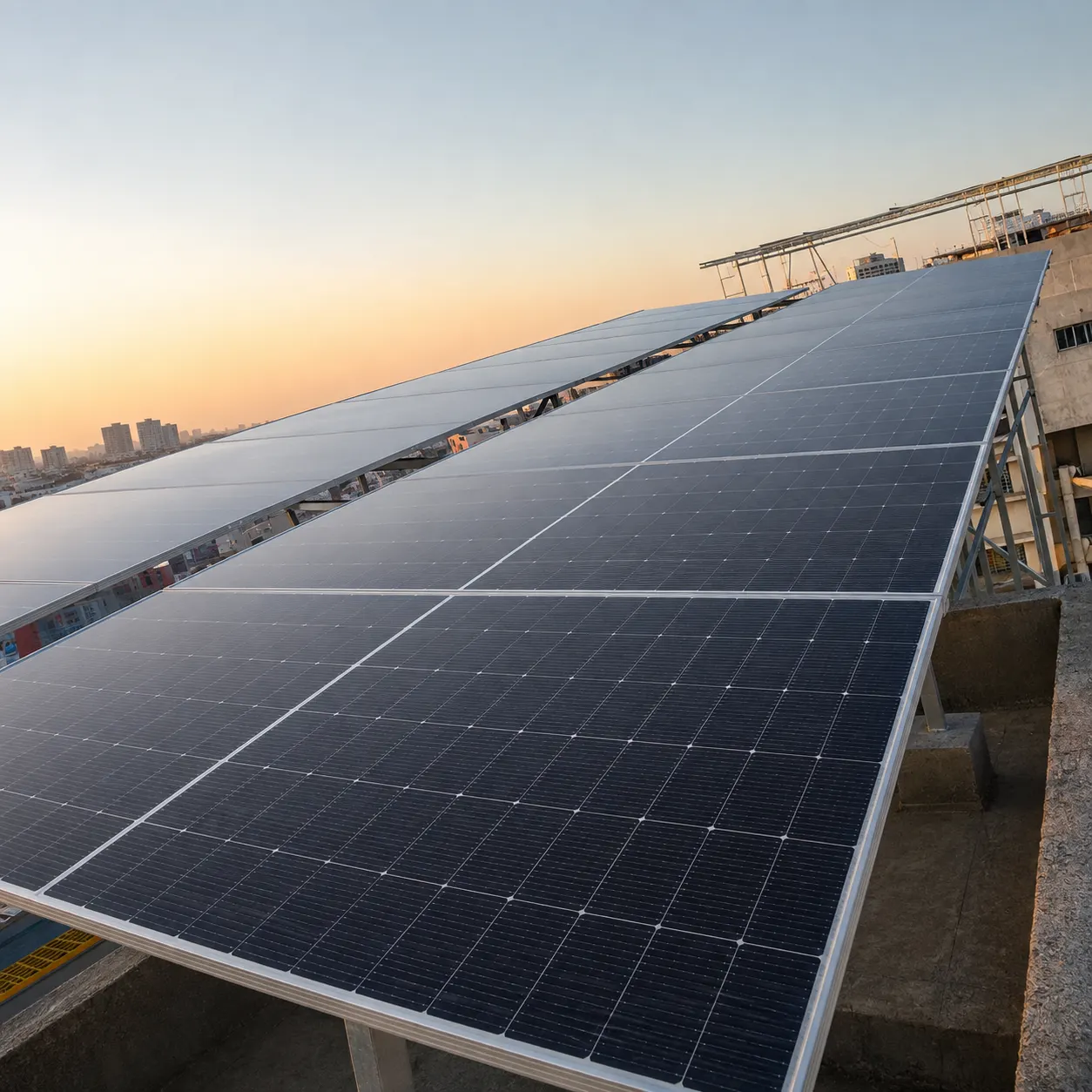
A temple, gaushala or charitable trust may have a roof and supporters ready to fund solar. The energy case still begins with the electricity meter and the daily load. Lighting, pumps, kitchens, ventilation and animal-care equipment can run at different times, while donations and committee approvals bring their own responsibilities.
Direct answer. Solar for a temple trust should be sized from the trust’s actual utility category, daytime use and approved rooftop export rule. A donation or CSR contribution can fund a project only through the institution’s and donor’s applicable rules; neither changes how its meter settles solar units. Gujarat’s state DISCOM tariff schedule is effective 1 April 2026, and the trust should use the tariff for its own account.
What loads can a temple or gaushala use directly from solar?
For a Gujarat net-metering proposal, also check the DRES instrument signed 30 October 2026. Its published non-residential rule caps exported-energy set-off at 30% of grid imports in the billing cycle, with applicable banking charges and lapse of exports beyond the cap. This can change the value of low-load-day surplus. Gazette commencement and the terms governing the account must be confirmed with the DISCOM; direct on-site use is a separate quantity.
Temples may use electricity for lighting, fans, kitchens, sound systems, pumps and office services. Demand can rise at dawn, dusk, festivals or weekly gatherings, which may not coincide with the strongest solar hours. A gaushala may run water pumps, ventilation, fodder equipment, cooling and lighting. Some of those loads operate through the day; others occur in early morning or evening. A charitable clinic, dining hall or training centre on the same property may have still another schedule. The institution’s name does not establish its load profile.
Collect a full year of electricity bills and, where available, interval meter readings. Mark ordinary days, festival days, seasonal changes and periods when the premises are closed or lightly used. Make an equipment list, but verify actual operation with the meter. A large pump rating does not mean it runs through every sunny hour. Conversely, a modest recurring daytime load can make a smaller array useful even if the overall bill is not large. The commercial solar route is the appropriate proposal path for this institutional account.
List the services that must stay powered, record when they operate and match them to the proposed solar meter. First identify each service that must stay powered: animal water, ventilation, medical refrigeration or kitchen operations may be more critical than decorative lighting. Then map when those services run. Finally compare their interval demand with expected solar output. Standard grid-connected rooftop solar offsets matching grid consumption but does not by itself provide backup during an outage. Critical loads need a separately designed backup plan if continuity is required.
The proposal should show direct use, export and remaining grid import separately. A temple with evening-heavy gatherings may have more surplus in the afternoon than its monthly bill suggests. A gaushala with daytime water pumping can have a different match. The solar bill still high guide explains why a bill can retain charges after installation; the trust should not budget for a zero bill.
| Site load | Timing question | Solar design implication |
|---|---|---|
| Temple lighting and sound | Does the peak occur after sunset? | Rooftop may not offset the peak directly |
| Kitchen and dining | Are meals prepared in daylight? | Check direct-use intervals |
| Gaushala water and ventilation | Which hours and seasons run equipment? | Stable daytime load may support self-use |
| Festival or event demand | How often does it occur? | Do not size from rare peaks alone |
These rows are a survey template. The trust’s bills and operating calendar decide the real quantities.
Which tariff and meter arrangement should the trustees verify?
The first document is the current utility bill. Record the distribution licensee, consumer name, tariff category, sanctioned load or contract demand, voltage and consumer number. A temple or gaushala can be billed under different categories depending on its activities and the utility’s approved classification. Do not assume a domestic rate because people stay on site, or a universal charity concession because the owner is a trust. The sanctioned-load glossary helps the committee read the account.
For a Gujarat state DISCOM account, use the GERC tariff schedule effective 1 April 2026. If the site is supplied by Torrent Power, use its applicable licensee schedule instead. The GERC rooftop net-metering regulations and amendments establish the state grid-interconnection framework. The trust must check its consumer category and the current clause for capacity, metering and settlement. A separate meter for staff housing or a guesthouse may follow a different route from the main institution account.
Ask the EPC to map every proposed roof to an electricity meter. A campus may have a temple meter, a kitchen meter and a gaushala meter. Ownership of all buildings by the same trust does not automatically combine their solar credits. If a group or virtual mechanism is proposed, the bidder should cite the current rule and obtain the relevant utility approval. The business net-metering comparison explains why export value and settlement depend on the selected arrangement.
Separate the bill into avoidable energy and remaining fixed, demand, duty or tax components. A directly used solar unit can reduce matching imports. An exported unit follows the approved credit or payment rule; it should not be valued automatically at the full retail rate. A high evening event may also leave a demand charge. The contract-demand glossary helps the committee distinguish a capacity commitment from monthly units.
The useful output is a meter schedule: licensee, category, consumer number, proposed roof, available load data and authorized signatory. It allows trustees to approve one clear application rather than an ambiguous “solar for the whole trust” concept.
The dates identify official documents, not a tariff quote for every charitable site.
How should the solar size be chosen for irregular attendance?
Size from recurring daytime consumption and test surplus during quiet periods. A temple may have large festival crowds but ordinary days with modest load. A gaushala may have a steady animal-care baseline but seasonal cooling demand. An array designed from the largest festival bill can export much of its output through the rest of the year. The roof may allow it physically, yet its commercial value depends on export settlement.
Illustrative example, not a real trust bill or generation forecast: assume a proposed array produces 500 kWh on a representative sunny day. On a normal day, the trust uses 350 kWh in matching solar intervals, leaving 150 kWh of potential surplus. On a festival day, matching daytime use rises to 450 kWh. On a closed or low-activity day, it falls to 100 kWh, leaving 400 kWh of potential surplus. A model based only on the festival day would miss the export-heavy case. The approved GERC arrangement determines what happens to the surplus.
Compare at least a smaller direct-use design and a larger design. For each, show monthly generation, self-use, exports, remaining imports and fixed or demand charges. Include the actual event calendar and any future services the trust has approved. If a new kitchen or shelter is merely proposed, keep it as a separate expansion case. The solar capacity and sanctioned-load guide explains why a roof and bill are not enough to establish the regulatory capacity ceiling.
The roof itself needs a survey. Many charitable buildings have additions built in stages. Check ownership, structural drawings, roof age, waterproofing, shade from domes or nearby buildings, water tanks and public access. A safe, smaller array on a sound roof can be a better first phase than a larger layout on a fragile extension. The roof-strength guide gives the survey questions. If the trust has spare land, an on-site ground structure may be another physical option, but land use and electrical routing need separate review.
| Candidate size | Direct-use case | Main risk to test |
|---|---|---|
| Modest baseline array | Matches regular daytime services | Leaves some event-day imports |
| Larger event-oriented array | Covers more busy-day load | Quiet-day surplus and export value |
| Staged expansion | Adds capacity after new services open | Later approval and compatibility |
This is a comparison method, not a recommended size. The committee should ask for the actual unit split under the site’s tariff and approval.
Sizing principle
Test ordinary days before festival peaks. The roof can hold an array that the trust cannot use directly most of the year.
The committee should approve a size after seeing both the physical roof conclusion and the quiet-day export case.
Can donations or CSR fund a trust’s solar plant?
Donations may be possible if the trust deed, donor terms and applicable tax rules permit the proposed capital asset. The trustees should document whether the money is restricted to construction, equipment, maintenance or a broader purpose. A gift that funds modules but not roof repair, insurance or operations leaves a recurring cost for the institution. The board should assign an owner for each part of the project and keep a clear asset register after handover.
For corporate social responsibility, the Ministry of Corporate Affairs General Circular 21/2014 places renewable-energy projects under Schedule VII’s environmental-sustainability heading. The MCA CSR FAQ, General Circular 14/2021 says a company’s CSR activity must be relatable to Schedule VII and describes permitted implementation routes. These statements support considering a properly structured renewable-energy project, not an automatic right for every temple or gaushala to receive CSR money. The donor company’s board, implementing-agency eligibility, beneficiary structure and compliance records must be reviewed for the specific project.
Asset ownership also needs a written check. Rule 7(4) of the MCA CSR Amendment Rules, 2021 sets who may hold a capital asset created or acquired using CSR funds. The permitted routes include specified charitable entities with the required CSR registration, project beneficiaries in the stated forms, or a public authority. The donor and trust should check the proposed owner and implementing agency against the current rules before treating the solar asset as eligible CSR expenditure.
The trust should not write “CSR approved” in a proposal unless the contributing company and legal advisers have accepted the structure. A pledge or conversation is not a signed funding agreement. If the plant will be owned by a third party under an OPEX arrangement, the donor and trust should also consider whether they are funding an asset, a service or an operating payment. The OPEX versus CAPEX guide explains those models. The contract should identify roof rights, who receives the utility benefit and who maintains the equipment.
Tax treatment is separate from funding. Do not assume a business accelerated-depreciation benefit or count both the asset cost and depreciation without advice. The Income Tax Department’s transition guidance distinguishes the Income-tax Act, 2025, effective from 1 April 2026, from earlier-year matters under the 1961 Act. The trust’s adviser should confirm the current applicable provision, entity status, donor conditions and accounting treatment before a tax line is added.
Funding check
A CSR category can make a project worth reviewing, but funding, implementing-agency eligibility and ownership need project-specific confirmation.
The energy model should stand on its own without a guessed donation, tax benefit or subsidy. Confirmed funding can then be applied transparently.
What committee and property approvals are needed?
The trust deed and governing rules determine who can commit funds, allow use of a roof and sign a utility application. A temple committee may operate the building while another trust owns it. A gaushala may use leased land or have a donor-funded shed. The electricity account can be in a third name. Before an EPC fixes the layout, the trustees should establish the legal owner, utility consumer, authorized signatory and the committee resolution required for the project.
Create a document pack with the latest bill, property or lease record, trust registration, roof consent, site drawing, structural conclusion and a resolution naming the signatory. The utility will require its own interconnection documents, equipment and protection details. The GERC rooftop regulation index is the official starting point for a Gujarat site. If the building is in a different state, the applicable regulator and licensee change. A local electrical-safety approval may also be required depending on the connection and capacity.
Ownership and public access deserve special attention. A roof over a prayer hall, animal shelter or dining space may be occupied while work occurs above it. The committee should approve lifting zones, restricted routes, work-at-height controls and a planned electrical isolation. The CEA Measures Relating to Safety and Electric Supply Regulations, 2023 provide the national safety reference. The site manager should identify event dates and animal-care services that cannot be interrupted without a separate plan.
The committee should also clarify whether any donor branding, equipment access or maintenance right is proposed. A funding agreement should not silently grant unrestricted access to a worship or animal-care site. The trust needs a practical process for service visits and emergency isolation. If the roof later needs repair, the agreement should state who removes and reinstalls modules and who bears the cost. These clauses matter long after the initial donation is spent.
Keep the approval file with the trust’s permanent records. Committee members may change; the meter agreement, structural drawings and equipment ownership should remain discoverable. A project that depends on one volunteer’s memory is difficult to maintain and audit.
What should the O&M plan say for public and animal-care sites?
Cleaning, inspection and fault response need an assigned owner. A temple roof may collect dust, leaves or bird deposits. A gaushala roof can face dust and ammonia exposure depending on ventilation and site layout. The EPC should identify likely deposition and corrosion zones, choose suitable mounting and cable protection, and provide safe cleaning access. Do not apply a generic soiling percentage or cleaning interval without observing the site. The solar panel cleaning guide describes basic methods, but the trust’s roof and water supply determine the work plan.
The O&M agreement should state who reads inverter alarms, checks generation, tests protection, arranges cleaning and calls the utility when a meter issue appears. It should distinguish equipment warranties from labour, consumables and roof repairs. A donated plant is not self-maintaining, and a third-party-owned plant still needs site access rules. The solar monitoring guide explains how routine records can help locate a fault before it affects many billing periods.
For a gaushala, identify essential services before electrical work. Water pumping, ventilation or a medical area may require continuity. Standard on-grid rooftop solar does not supply backup when the grid is down. If the institution needs backup for critical loads, that is a separate design and operating question, with its own controls and maintenance. The solar and power-cuts guide explains the distinction. Do not imply that a normal rooftop array replaces a generator.
The handover pack should include approved drawings, a site map of isolators, meter agreement, equipment serial records, warranties, inspection results and a simple responsibilities sheet. The trust can keep a monthly log of generation, import, export and cleaning. That log helps a new committee understand whether the solar plant is performing and how it affects the actual utility bill.
- ✓ Meter and roof rights documented
- ✓ Ordinary-day load and export modelled
- ✓ Funding and maintenance assigned
- ✓ Public or animal-care access protected
- ✗ Festival peak used as everyday load
- ✗ CSR eligibility assumed
- ✗ Donor funds equipment only
- ✗ No future committee handover
The committee should compare bids with the same operating responsibilities, not just the same panel count.
How should trustees compare two solar proposals fairly?
Two bids can quote the same capacity but include different roof work, equipment, utility approvals and maintenance. The trust should compare them against one written scope. Start with the actual consumer account and the same load data. Give each bidder the ordinary-day and festival calendar, roof drawings and expected future services. Ask each to show the forecast generation method, usable roof area, direct-use units, exported units and remaining bill charges. The industrial EPC bid checklist offers a wider comparison framework that a trust can adapt without treating its site as a factory.
Check the boundaries of the price. One bid may include structural strengthening and waterproofing while another assumes the roof is ready. One may include the meter application and protection equipment, while another leaves them to the trust. A third-party operating proposal may have a lower initial payment but a long-term roof and electricity purchase obligation. These are different commercial structures, so a single headline price does not make them comparable. Ask for all exclusions and who owns each approval and later repair.
The energy model should be conservative about exports. A temple’s largest events may occur after dark, and a gaushala’s daytime water or ventilation load may change with seasons. Each bidder should use the same calendar assumptions so the committee can see whether different forecasts come from design or from a more optimistic load profile. If one bidder claims a benefit from CSR, tax, donation or subsidy, remove that line from the base comparison until the named party confirms eligibility and funding.
Ask for a handover plan as well as equipment specifications. Who will hold the meter agreement, inverter credentials, drawings and warranties? Who checks monthly generation and arranges cleaning? If an operating committee changes, who keeps the records? A proposal that answers these questions may be more useful than one that simply promises the highest generation. The trust should also review safety access for worshippers, staff, volunteers and animals during installation and maintenance.
The decision record can be a one-page table of scope, assumptions, exclusions and responsible people, signed by the approving committee. That makes the purchase understandable to future trustees and donors. It also helps the EPC price the same project that the institution has actually authorized.
Plan a trust proposal: Share the bills, roof documents, daily schedule and committee requirements through the commercial solar enquiry. Request a model that separates ordinary use, event peaks and exports.
How Heaven Green Energy helps scope a Trust Proposal
For an enquiry, collect a year of bills, interval data if available, the trust deed or authorization process, roof ownership documents, daily operating schedule, site drawings and a list of critical services. Heaven Green Energy files DISCOM paperwork for its customers. The trust should provide accurate consumer and property records and identify the authorized signatory.
The relevant routes are:
- Commercial solar for the temple, gaushala or charitable-institution proposal.
- Industrial solar only for a separately operated industrial unit with its own factory account.
- OPEX versus CAPEX guide for ownership and long-term payment choices.
The first review should confirm tariff category and the meter receiving generation. Next, compare ordinary-day and event-day load with forecast solar output. A roof survey should establish safe mounting and public access. Then the trustees can review funding and maintenance responsibilities. This sequence keeps a donor’s preferred capacity from overruling the site and bill facts.
Use this buying sequence:
- Identify the account. Record licensee, category, consumer name and load limit.
- Map the services. Separate daylight, evening and critical loads.
- Set authority. Approve roof rights, resolution and signatory.
- Survey the site. Check structure, public access and equipment location.
- Compare sizes. Value self-use and surplus under the approved rule.
- Fund operation. Assign cleaning, monitoring, repairs and records.
After commissioning, keep the meter agreement and production records with the trust’s permanent documents. Compare generation with imports and exports each month. If the institution adds a kitchen, shelter or new hall, update the load model before considering more modules. A clear file makes it easier for future trustees to manage the asset rather than rediscover the original assumptions.
Use the commercial solar route for the primary enquiry. The useful result is a safe, funded and maintainable project tied to the institution’s own meter.
Frequently asked questions
Can a temple trust get the same residential solar subsidy as a home?
Do not assume so. An institutional meter must be assessed under the scheme’s actual eligibility and its own utility consumer category. A proposal should not include a household subsidy unless an official scheme source and the site’s status support it.
Can CSR money pay for a gaushala solar plant?
The Ministry of Corporate Affairs has identified renewable-energy projects within Schedule VII’s environmental-sustainability heading. A specific project still needs the donor company’s CSR approval, compliant implementation structure and clear asset ownership. Eligibility is not automatic for every recipient or proposal.
Should a temple size solar from a festival bill?
No. A festival peak may be rare and often occurs after sunset. Model ordinary days and event days separately, then value any surplus under the approved rooftop arrangement.
Does a charitable trust automatically receive accelerated depreciation?
No automatic business tax benefit should be assumed. The trust’s adviser must review its legal and accounting status. For 2026 matters, the adviser must identify the applicable current provision and avoid double counting asset cost and depreciation.
Will rooftop solar run gaushala equipment during an outage?
Standard grid-connected rooftop solar disconnects during a grid outage. Essential animal-care loads need a separately designed backup arrangement if continuity is required. The proposal should state that scope and maintenance responsibility.
What documents should trustees prepare first?
Prepare the latest bills, property or lease records, trust authorization, roof plans, daily load schedule and list of critical services. The utility application will also need technical drawings and equipment details for the selected system.
Keep a written record of any donor restriction or proposed third-party ownership. That helps the committee assign maintenance and roof access after commissioning, when the original proposal team may no longer be involved.