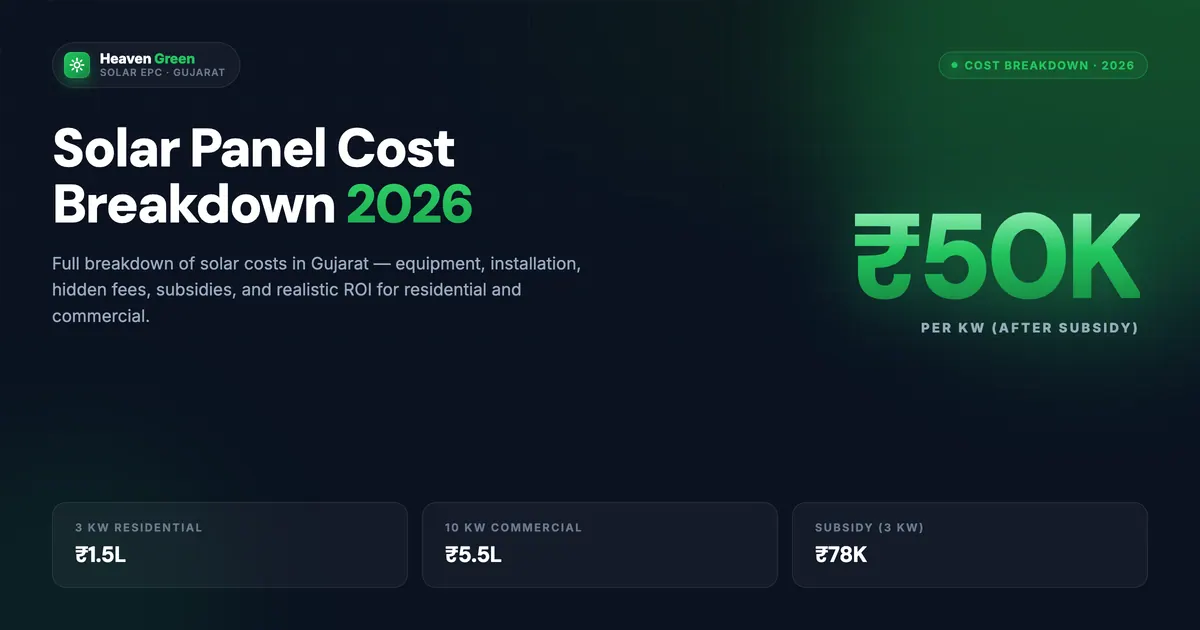
If you are pricing rooftop solar in Pune, the three sizes that matter are 3 kW, 5 kW, and 10 kW. Together they cover nearly every home in the MSEDCL (Maharashtra State Electricity Distribution Company Limited) zone, from a 2 BHK in Kothrud to a bungalow in Baner. In 2026, after the PM Suryaghar subsidy of up to ₹78,000 from MNRE (Ministry of New and Renewable Energy), a 3 kW system costs ₹1,20,000 to ₹1,50,000, a 5 kW system costs ₹1,80,000 to ₹2,20,000, and a 10 kW system costs ₹3,20,000 to ₹4,00,000 fully installed.
Direct answer. Solar cost in Pune after the PM Suryaghar subsidy is ₹1,20,000 to ₹1,50,000 for 3 kW, ₹1,80,000 to ₹2,20,000 for 5 kW, and ₹3,20,000 to ₹4,00,000 for 10 kW in 2026. With MSEDCL’s slab tariff crossing ₹10.00/kWh above 300 units, payback runs 3.5 to 5 years. Heaven Green Energy handles the subsidy application, MSEDCL net metering, and 25-year support.
This post goes size by size with full price tables, the exact subsidy math, MSEDCL’s current tariff slabs, monthly savings, and payback per size. It is the detailed companion to our broader solar installation cost guide for Pune, which covers vendor selection and the approval process in more depth.
What Does Rooftop Solar Cost in Pune in 2026?
The honest answer is that the headline price depends on three things: system size, component tier, and whether your vendor quotes gross or net cost. Across the quotes we see in Pune, a turnkey on-grid system with Tier-1 mono PERC panels and a BIS-certified string inverter lands between ₹66,000 and ₹76,000 per kW before subsidy for small systems, dropping to ₹40,000 to ₹48,000 per kW at 10 kW because fixed costs spread out.
A few Pune-specific factors shape these numbers. Pune enjoys 5.2 to 5.5 peak sun hours daily, among the best for any metro in India, so each kW installed generates 1,450 to 1,650 kWh per year. The city also has fewer dust-storm days than Rajasthan or north Gujarat, so annual cleaning costs stay modest at ₹1,500 to ₹2,500 for a residential rooftop. That lifts effective yield over the 25-year panel life.
One pricing trap deserves mention upfront. Homeowners on X (formerly Twitter) regularly share quotes where ₹1.8 lakh is labelled the “final price” for a 3 kW system, without clarifying whether the ₹78,000 subsidy is already deducted. In our experience across 10,000+ installations, roughly one in three first quotes a Pune homeowner receives mixes gross and net figures. Always ask the vendor to show both columns separately, and cross-check against the PM Suryaghar complete guide before signing anything.
3 kW Solar System Price in Pune After Subsidy
A 3 kW system is the subsidy sweet spot for Pune homes. It captures the full ₹78,000 central subsidy, fits the most common sanctioned load, and covers the majority of a 2-3 BHK’s consumption. Here is the full cost breakdown.
| Component | Cost Range | Notes |
|---|---|---|
| Solar panels (540 Wp mono PERC, 6 nos) | ₹72,000-₹84,000 | Tier-1, ALMM-listed, BIS-certified |
| Grid-tie inverter (3 kW string) | ₹28,000-₹36,000 | BIS-certified with anti-islanding |
| Mounting structure + hardware | ₹18,000-₹24,000 | Hot-dip galvanised, wind-rated |
| Wiring, BOS, earthing, lightning protection | ₹22,000-₹28,000 | DCDB/ACDB included |
| Installation, commissioning, DISCOM liaison | ₹25,000-₹32,000 | Includes MSEDCL documentation |
| Gross system cost | ₹1,98,000-₹2,28,000 | Before subsidy |
| PM Suryaghar subsidy | -₹78,000 | DBT to your bank account |
| Net cost to you | ₹1,20,000-₹1,50,000 | MSEDCL meter charges extra (₹5,000-₹13,000) |
The table reflects turnkey quotes from MNRE-empanelled vendors in Pune in 2026. One change worth knowing: since the DCR (Domestic Content Requirement) window tightened in mid-2026, systems using DCR-compliant panels cost ₹20,000 to ₹30,000 more than older quotes circulating online. Any 2025 price thread you find on social media likely understates today’s cost by that amount.
Generation-wise, a 3 kW system in Pune produces 360 to 450 kWh per month, or about 12 to 15 units per day. That offsets a monthly bill of ₹2,000 to ₹4,000 almost entirely. Payback at current MSEDCL tariffs runs 3.5 to 4.5 years, the fastest of the three sizes because the subsidy covers a larger share of the project cost. For a national perspective on the same size, our 3 kW solar system guide for India breaks down state-by-state pricing, and the team at Qbits Energy maintains a detailed 3 kW system price breakdown with component-level math.
5 kW Solar System Price in Pune After Subsidy
A 5 kW system is the standard choice for a 3-4 BHK Pune home running one or two air conditioners, an inverter fridge, and a water pump. It generates 600 to 750 kWh per month, which maps neatly onto MSEDCL bills of ₹4,000 to ₹8,000.
| Component | Cost Range | Notes |
|---|---|---|
| Solar panels (540 Wp mono PERC, 9-10 nos) | ₹1,20,000-₹1,38,000 | Tier-1, ALMM-listed |
| Grid-tie inverter (5 kW string) | ₹38,000-₹48,000 | Dual MPPT preferred for split roofs |
| Mounting structure + hardware | ₹28,000-₹36,000 | Approx 45-55 sq m roof area needed |
| Wiring, BOS, earthing, lightning protection | ₹30,000-₹38,000 | Includes DCDB/ACDB |
| Installation, commissioning, DISCOM liaison | ₹42,000-₹48,000 | Includes MSEDCL documentation |
| Gross system cost | ₹2,58,000-₹2,98,000 | Before subsidy |
| PM Suryaghar subsidy | -₹78,000 | Same cap as 3 kW |
| Net cost to you | ₹1,80,000-₹2,20,000 | Meter charges extra |
The key economics point: the subsidy does not scale. A 5 kW system gets the same ₹78,000 as a 3 kW system, so the subsidy covers only 26 to 30% of the project cost here versus 34 to 39% at 3 kW. That is why per-kW returns are strongest at exactly 3 kW.
That said, 5 kW often wins on absolute savings. A real example from homeowner reports on X: a Maharashtra homeowner shared a 5 kW install at ₹3.6 lakh gross, ₹2.82 lakh net, with the subsidy landing about a month after commissioning and full payback projected around four years. Our Pune installs track the same curve. At a blended savings rate of ₹6.00 to ₹7.00/kWh, a 5 kW system saves ₹42,000 to ₹52,000 per year, putting payback at 3.8 to 4.8 years. Our 3 kW vs 5 kW vs 10 kW comparison has the national head-to-head if you are torn between sizes.
💰 Real numbers
On a 5 kW Pune system with net cost ₹2,00,000 and annual savings of ₹45,000, payback is 4.4 years. The remaining 20+ years of panel life return roughly ₹10 lakh in bill savings.
10 kW Solar System Price in Pune After Subsidy
A 10 kW system is the residential net metering ceiling in Maharashtra and the right fit for large bungalows, villas, home offices, and small commercial premises. It generates 1,200 to 1,500 kWh per month, enough to erase bills of ₹10,000 to ₹15,000.
| Component | Cost Range | Notes |
|---|---|---|
| Solar panels (540 Wp mono PERC, 18-19 nos) | ₹2,16,000-₹2,47,000 | Tier-1, ALMM-listed |
| Grid-tie inverter (10 kW, three-phase) | ₹62,000-₹78,000 | Three-phase connection required |
| Mounting structure + hardware | ₹52,000-₹65,000 | Approx 90-110 sq m shadow-free area |
| Wiring, BOS, earthing, lightning protection | ₹48,000-₹60,000 | Higher-gauge DC cabling |
| Installation, commissioning, DISCOM liaison | ₹58,000-₹68,000 | CEIG inspection may apply |
| Gross system cost | ₹3,98,000-₹4,78,000 | Before subsidy |
| PM Suryaghar subsidy | -₹78,000 | Cap unchanged |
| Net cost to you | ₹3,20,000-₹4,00,000 | Meter + load enhancement extra |
Two 10 kW realities need attention. First, the subsidy covers only 16 to 20% of the project at this size, so payback stretches to 4.5 to 6 years unless your self-consumption is high. Second, most Pune homes with a 10 kW plan need a three-phase connection and a sanctioned load of 8 kW or more. If your sanctioned load is lower, MSEDCL will require a load enhancement application (₹10,000 to ₹25,000 extra) before approving net metering.
Where 10 kW shines is absolute savings. At full self-consumption against MSEDCL’s upper slabs, annual savings reach ₹75,000 to ₹95,000, and 25-year lifetime savings cross ₹18 to ₹24 lakh. For engineering-grade detail on this size, Qbits Energy’s 10 kW system price guide covers inverter sizing and three-phase wiring in depth. Commercial users should also note that systems above 10 kW move to net billing (gross metering), where exports earn a lower feed-in rate, which changes the ROI math entirely.
How Do MSEDCL Tariff Slabs Decide Your Savings?
Your solar savings in Pune are set by which MSEDCL slab your consumption lands in, not by a single average rate. MSEDCL bills residential consumers telescopically: the first 0-100 units per month are charged at about ₹3.06/kWh, the middle slabs step up sharply, and consumption above 300 units per month crosses ₹10.00/kWh, per MSEDCL’s tariff schedule for 2026.
Solar offsets your most expensive units first. A household using 500 kWh per month pays the top slab rate on roughly 200 of those units. Every solar unit you self-consume displaces a ₹10.00/kWh unit before it touches the ₹3.06/kWh units. This is why two Pune homes with identical monthly bills can see different payback periods: the one with more consumption in the upper slabs saves more per kWh generated.
Here is how the slabs translate into savings per solar unit:
| Monthly Consumption | Marginal Slab Rate | Savings per Solar kWh (self-consumed) | Export Credit if Surplus |
|---|---|---|---|
| Under 100 kWh | ₹3.06/kWh | ₹3.06 | ₹3.00-₹3.50 |
| 100-300 kWh | ₹5.50-₹7.00/kWh | ₹5.50-₹7.00 | ₹3.00-₹3.50 |
| 300-500 kWh | ₹8.50-₹10.00/kWh | ₹8.50-₹10.00 | ₹3.00-₹3.50 |
| Above 500 kWh | ₹10.00+/kWh | ₹10.00+ | ₹3.00-₹3.50 |
The gap between the last two columns is the single most important number in this article. Surplus units exported to MSEDCL earn only ₹3.00 to ₹3.50/kWh under net metering, while self-consumed units save up to ₹10.00/kWh. Sizing your system to your own consumption, not to your roof size, is what protects your payback. For the full mechanics of how credits are settled, see our net metering guide for India.
Curious what your exact slab math looks like? Feed your latest MSEDCL bill into our free solar calculator and see size-wise savings in 60 seconds.
The Pune Size-to-Slab Match Method
The Pune Size-to-Slab Match Method is the sizing framework Heaven Green Energy uses on every residential site visit in Maharashtra. The idea is simple: your system size should be decided by your slab exposure first, then validated against sanctioned load and roof area. Most sizing guides start with roof area; we start with the bill, because that is where the money is.
- Find your slab exposure. Pull your last 12 MSEDCL bills. Note what share of monthly units sits above 300 kWh (the ₹10.00/kWh zone). If that share is under 15%, your blended savings rate will be modest; above 30%, it is excellent.
- Apply the bill-to-kW rule. Divide your average monthly bill by ₹1,800. That gives the kW size that offsets 90-95% of consumption. A ₹5,400 bill points to 3 kW; a ₹9,000 bill points to 5 kW.
- Check sanctioned load. MSEDCL typically caps approved system size near your sanctioned load, sometimes at 90% of it. A 5 kW plan on a 3 kW sanctioned load needs load enhancement first.
- Check shadow-free roof area. You need roughly 9-11 sq m per kW. A 5 kW system needs 45-55 sq m free of water-tank and parapet shadows, which is not guaranteed in Pune’s dense layouts.
- Take the most constrained input. If the bill says 5 kW but sanctioned load says 3 kW, install 3 kW now or file the load enhancement. The most constrained input always wins.
This method avoids the two classic Pune sizing failures: oversizing into export territory (where credits earn ₹3.00-₹3.50/kWh) and undersizing against a ₹10.00/kWh bill (where you leave the cheapest savings on the table). Our home solar system size guide has the Gujarat-calibrated version of the same rule if you own property in both states.
Savings and Payback by System Size
Here is the complete financial picture for all three sizes at Pune’s 2026 prices and MSEDCL tariffs. All figures assume on-grid systems, Tier-1 panels, and self-consumption of 70-90% of generation.
| Metric | 3 kW | 5 kW | 10 kW |
|---|---|---|---|
| Net cost after subsidy | ₹1,20,000-₹1,50,000 | ₹1,80,000-₹2,20,000 | ₹3,20,000-₹4,00,000 |
| Monthly generation | 360-450 kWh | 600-750 kWh | 1,200-1,500 kWh |
| Annual savings | ₹27,000-₹37,000 | ₹42,000-₹52,000 | ₹75,000-₹95,000 |
| Payback period | 3.5-4.5 years | 3.8-4.8 years | 4.5-6 years |
| 25-year net savings | ₹6.5-8.5 lakh | ₹10-12 lakh | ₹18-24 lakh |
| Best fit | Bill ₹2,000-₹4,000 | Bill ₹4,000-₹8,000 | Bill ₹10,000+, villa/office |
Annual savings assume a blended rate of ₹6.00 to ₹7.00/kWh for 3 kW and 5 kW systems (typical when 40-60% of your units sit above ₹6/kWh) and higher self-consumption against upper slabs for 10 kW. Electricity duty at 16% and periodic tariff revisions push real savings slightly higher over time, since MSEDCL rates have historically risen 3-5% per year, as tracked by industry coverage on Mercom India.
Verdict. If your bill is under ₹4,000, take 3 kW and bank the fastest payback. Between ₹4,000 and ₹8,000, take 5 kW. Above ₹10,000 with roof and sanctioned load to match, 10 kW delivers the largest lifetime savings even with the weakest subsidy coverage.
One nuance worth admitting: these payback figures assume your subsidy actually arrives on schedule. Homeowners on X report MSEDCL-zone cases where the DBT (Direct Benefit Transfer) took over a month past commissioning, and a few where inspection queues stalled for two months. A delayed subsidy does not change lifetime economics, but it does stretch the cash-flow payback by the delay period. Working with an empanelled vendor who files cleanly is the single best protection, a point we detail in the PM Suryaghar MSEDCL process guide.
MSEDCL Net Metering and the PM Suryaghar Subsidy Process
The subsidy and net metering journey is the same for all three sizes and takes 60 to 90 days end to end in Pune. PM Suryaghar (PM Surya Ghar Muft Bijli Yojana), launched in February 2024, pays the subsidy directly to your bank account after MSEDCL commissions the bidirectional meter.
- Register on the National Portal. Create an account at pmsuryaghar.gov.in with your MSEDCL consumer number and mobile OTP.
- Submit your application. Upload the latest bill, Aadhaar, property proof, and load sanction letter.
- Get feasibility approval. MSEDCL’s Pune circles complete the technical feasibility check in 12 to 20 days.
- Install through an MNRE-empanelled vendor. Only empanelled vendors qualify you for the subsidy. Heaven Green Energy is empanelled across MSEDCL zones.
- Pass inspection and get the net meter. MSEDCL inspects in 10 to 18 days and installs the bidirectional meter (₹3,000-₹8,000 plus ₹2,000-₹5,000 application charges).
- Receive the subsidy via DBT. ₹78,000 lands in your bank account within 30 days of successful commissioning, per the scheme rules on mnre.gov.in.
📘 Regulation note
MSEDCL allows net metering for residential systems up to 10 kW and only up to your sanctioned load. Panels must be BIS-certified (IS 14286/IEC 61215) and the inverter BIS-certified with anti-islanding protection (IS 16221/IEC 62109), per BIS and MNRE empanelment rules. Maharashtra adds no state subsidy on top of PM Suryaghar as of 2026; check MAHAURJA for updates.
For the engineering paperwork behind a smooth approval, the Heaven Designs team’s MSEDCL net metering guide documents the drawing and single-line-diagram requirements inspectors check. Our own Maharashtra solar policy overview covers the state-level context, including why Maharashtra does not stack an additional subsidy the way Uttar Pradesh does.
Which Size Should You Pick? Pros and Cons
Each size has a clear winner profile. Here is the honest tradeoff view.
- ✓ Upper-slab MSEDCL rates make every extra self-consumed kWh worth up to ₹10
- ✓ Per-kW installation cost drops at 5 kW and 10 kW
- ✓ Headroom for an EV, second AC, or home office later
- ✓ Larger absolute savings, ₹18-24 lakh over 25 years at 10 kW
- ✗ Subsidy caps at ₹78,000, so bigger systems get weaker per-kW support
- ✗ Exports earn only ₹3.00-₹3.50/kWh, a third of upper-slab value
- ✗ Sanctioned load and three-phase requirements add cost and delay
- ✗ 10 kW needs 90-110 sq m of shadow-free roof, rare in dense Pune layouts
The decision rule we give every Pune homeowner: size to your bill, not your roof. A 3 kW system at 90% self-consumption beats a 5 kW system at 55% self-consumption on every financial metric that matters. The exception is a confirmed near-term load increase, like an EV purchase within 12 months, where sizing up once is cheaper than upgrading later.
Get a free site assessment. Our engineer checks your slab exposure, sanctioned load, and roof shadows in one visit, and sends a size-wise savings proposal in 48 hours, no cost, no obligation. Get your free quote →
Common Sizing and Pricing Mistakes Pune Homeowners Make
Across our Pune installs and the complaint threads we track on X, four mistakes account for most of the money homeowners lose.
-
1
Comparing quotes on gross price only. A ₹20,000 cheaper quote from a non-empanelled vendor forfeits the ₹78,000 subsidy. Always compare net cost after subsidy, and verify the vendor's MNRE empanelment on the National Portal.
-
2
Sizing for export instead of self-consumption. Every unit exported earns ₹3.00-₹3.50 instead of saving up to ₹10.00. A 10 kW system on a ₹6,000 bill is a savings destroyer, not a savings machine.
-
3
Ignoring sanctioned load before ordering. MSEDCL will reject or downsize applications that exceed sanctioned load, and load enhancement adds ₹10,000-₹25,000 plus weeks of delay. Check your bill's [contract demand](/glossary/contract-demand) line first.
-
4
Trusting outdated price threads. Pre-2026 quotes ignore the DCR panel requirement that added ₹20,000-₹30,000 to 3 kW systems from mid-2026. Also beware "free 300 units" marketing; the subsidy is installation support, not free electricity forever.
⚠️ Watch out
A missing BIS certificate number for the inverter is the most common reason MSEDCL rejects net metering files in Pune, delaying subsidy by 2-3 months. Ask every vendor for the exact model number and verify it before paying an advance.
The solar contractor selection checklist walks through every document to demand from a vendor, in any Indian city.
How Heaven Green Energy Helps
Heaven Green Energy has completed 10,000+ installations across India, with hundreds of residential and commercial projects in MSEDCL territory covering Pune, Pimpri-Chinchwad, Nashik, and Nagpur. Our Pune teams run the Pune Size-to-Slab Match Method on every site visit, so the size we quote is the size your bill actually justifies. We file the PM Suryaghar application, handle MSEDCL feasibility and inspection coordination, and stay accountable through the 25-year panel life.
- Residential Solar: 1-10 kW rooftop systems with the PM Suryaghar subsidy handled end to end, BIS-certified components, and a 25-year performance warranty.
- Commercial Solar: 10-100 kW systems for Pune offices, shops, and institutions with custom ROI modelling.
- Solar EPC: turnkey delivery covering civil work, electrical, DISCOM liaison, and annual maintenance.
- Solar Calculator: enter your MSEDCL bill and see size-wise subsidy, savings, and payback in 60 seconds.
Our MNRE empanelment across MSEDCL zones means your subsidy application goes through the right channel the first time. Call +91 63904 05060 or request a callback; site visit within 24 hours, proposal in 48 hours.
Frequently Asked Questions
How much does a 3 kW solar system cost in Pune after subsidy in 2026?
A 3 kW rooftop solar system in Pune costs ₹1,20,000 to ₹1,50,000 after the ₹78,000 PM Suryaghar subsidy. The gross cost before subsidy is ₹1,98,000 to ₹2,28,000, covering panels, inverter, mounting structure, wiring, and MSEDCL documentation. Meter and application charges of ₹5,000 to ₹13,000 are extra. Payback at current MSEDCL tariffs is 3.5 to 4.5 years.
Is the ₹78,000 subsidy the same for 3 kW, 5 kW, and 10 kW systems?
Yes. PM Suryaghar pays ₹30,000 for 1 kW, ₹60,000 for 2 kW, and ₹78,000 for any system of 3 kW or more, capped there. A 10 kW system receives the same ₹78,000 as a 3 kW system. This is why per-kW economics are strongest at exactly 3 kW, and why sizing to your actual bill matters more than sizing to your roof.
What is the payback period for a 5 kW solar system in Pune?
A 5 kW system in Pune pays back in 3.8 to 4.8 years. With net cost of ₹1,80,000 to ₹2,20,000 after subsidy and annual savings of ₹42,000 to ₹52,000 at a blended rate of ₹6.00 to ₹7.00/kWh, most households recover the investment in about 4.4 years. The system then generates roughly ₹10 lakh in savings over its remaining 20-plus year life.
How much electricity does a 10 kW solar system generate in Pune?
A 10 kW system in Pune generates 1,200 to 1,500 kWh per month, or about 40 to 50 units per day, given the city’s 5.2 to 5.5 peak sun hours. That is enough to offset MSEDCL bills of ₹10,000 to ₹15,000 per month. Generation dips 25 to 35% during the June to September monsoon but recovers fully in the October to May dry season.
Does MSEDCL allow net metering for a 10 kW residential system?
Yes. MSEDCL permits net metering for residential systems up to 10 kW, subject to your sanctioned load. Systems above 10 kW move to net billing, where exports earn a lower feed-in tariff. Most 10 kW installations need a three-phase connection and a sanctioned load of 8 kW or more; otherwise a load enhancement application is required first.
Can I install a 5 kW system if my sanctioned load is 3 kW?
Not directly. MSEDCL typically caps the approved solar system size at or near your sanctioned load, sometimes at 90% of it. You would need to file a load enhancement application with MSEDCL, which costs ₹10,000 to ₹25,000 and adds several weeks. The cleaner path is to apply for load enhancement first, then submit the PM Suryaghar application for the 5 kW system.
Which is better for a Pune 3 BHK, 3 kW or 5 kW?
For a 3 BHK with a monthly bill of ₹2,000 to ₹4,000, 3 kW is better: it captures the full ₹78,000 subsidy, fits the common sanctioned load, and pays back fastest. If your bill is ₹4,000 to ₹8,000, usually because of one or two air conditioners, 5 kW is the right call. Use the bill-to-kW rule: divide your average monthly bill by ₹1,800 to get your size.
Are there any Maharashtra state subsidies on top of PM Suryaghar in Pune?
No. As of 2026, Maharashtra does not stack an additional state-level rooftop solar subsidy on top of the PM Suryaghar central subsidy for residential consumers. Pune homeowners receive the central benefit of up to ₹78,000 only. States like Uttar Pradesh do offer stacking, which is why prices quoted in other states’ social media threads look lower. Check MAHAURJA for any new state announcements.