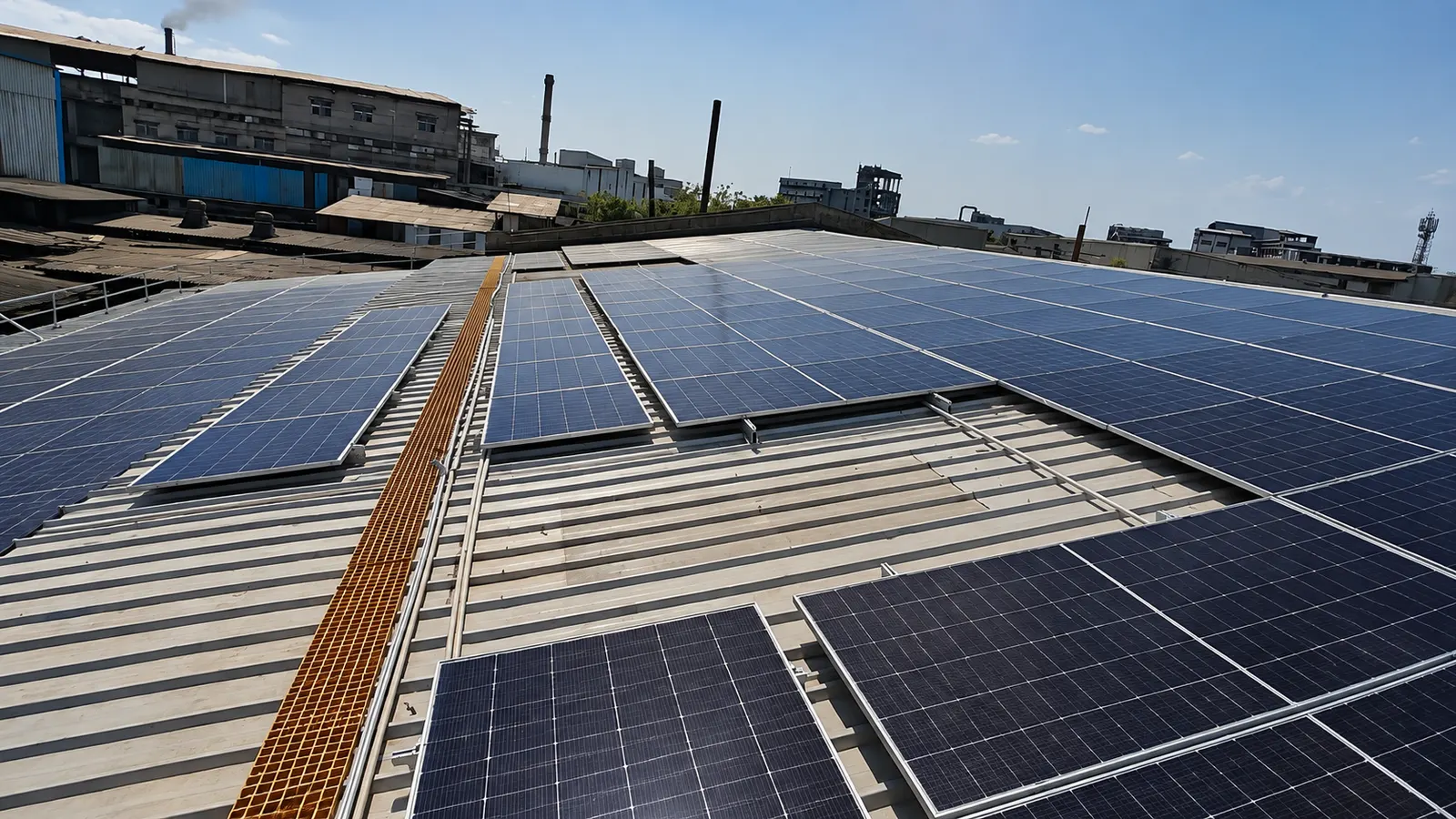
Injection moulding, extrusion and packaging plants can use substantial power while the sun is out. They can also run at night, stop presses between orders and have electrical peaks that rooftop solar does not reliably remove. The useful buying question is how much generation matches the plant’s real interval load, after roof, tariff and power-quality checks.
Direct answer. For a plastics factory, size solar from interval data for production machines and utilities, alongside the annual bills. Match predicted daylight output with moulding, cooling and air-system demand, then check the connection’s export arrangement and roof. GERC’s state DISCOM tariff schedule effective 1 April 2026 includes separate HTP demand, energy and power-factor provisions; the actual consumer category controls the calculation.
Which plastic-industry loads can rooftop solar actually offset?
For a Gujarat net-metering proposal, also check the DRES instrument signed 30 October 2026. Its published non-residential rule caps exported-energy set-off at 30% of grid imports in the billing cycle, with applicable banking charges and lapse of exports beyond the cap. This can change the value of low-load-day surplus. Gazette commencement and the terms governing the account must be confirmed with the DISCOM; direct on-site use is a separate quantity.
The main loads may include injection moulding machines, extruders, dryers, chilled-water systems, air compressors, conveyors, granulators, printing, lamination and lighting. Their schedules can differ. A moulding plant can run a steady day shift with repeated machine cycles, while another runs three shifts and changes moulds for short batches. A packaging line may stop on weekends even when its HVAC and air compressors remain on. The bill needs to be read alongside the production calendar.
Start by collecting twelve months of bills and interval import data where available. Map active machines, standby loads, mould-change periods, weekend production and seasonal demand. For a proposal, separate the lowest typical daytime load from the highest short peak. A solar array can displace energy used while it generates, but its output will not necessarily coincide with the instant a compressor or press sets maximum demand. The maximum-demand guide explains why that bill component needs its own test.
The most useful number is not the factory’s connected motor capacity. It is the kW actually drawn in intervals when the proposed array produces. An equipment list can identify where the demand comes from, but a meter profile shows how much of it is simultaneous. A machine may have a high nameplate rating yet cycle at part load. Another may draw a stable base load through the whole day. An EPC should use the meter data to model both cases, then compare them with production plans for the next few years.
Use a checklist. First assign each production line to its actual operating hours. Second identify process and utility loads that remain on during changeovers. Third compare the resulting interval demand with a site-specific solar output profile. This separates directly used generation from possible exports or curtailment. The industrial solar installation guide covers the wider factory project; this load match is the sizing step that determines whether a proposed array is appropriate.
| Load group | Data to request | Solar design consequence |
|---|---|---|
| Moulding and extrusion | Run hours, idle cycles, interval kW | Daytime direct-use ceiling |
| Chillers and compressors | Baseline and peak kW | Stable daytime use and possible demand peak |
| Dryers and printing | Schedule and process restrictions | Shift-dependent use |
| Weekend services | Minimum import | Export or curtailment exposure |
These rows are a survey template. The actual production and meter readings, not a generic industry profile, should drive the bid.
How should an LT or HT plastic-factory bill be modelled?
Read the utility name, tariff category, sanctioned load or contract demand and billing voltage from the latest account. A small packaging unit can be on an LT business or industrial category; a larger moulding plant may be on HT. The label “plastic factory” does not decide the tariff. The HT versus LT solar guide explains why the connection type affects capacity, metering, approvals and demand charges. The sanctioned-load glossary helps decode the account.
For Gujarat state DISCOM consumers, the GERC tariff schedule effective 1 April 2026 is the current published reference for the relevant LT and HTP categories. The DGVCL FY 2026-27 tariff order, Case 2581/2025 dated 25 March 2026 supports a DGVCL account. A factory elsewhere must use its own licensee’s effective order. For Madhya Pradesh, the MPERC FY 2026-27 retail supply order, Petition 140/2025 dated 26 March 2026 is a separate tariff framework. Do not transfer a Gujarat per-unit rate or PF clause to an MP bill.
Separate the pre-solar bill into imported energy, demand or fixed charge, power-factor adjustment, time-of-day items, fuel adjustment, duties and taxes. Solar used directly can reduce matching grid energy. It may leave demand and fixed charges substantially in place. Power-factor effects can change, too, because grid-side active power falls while reactive demand from motors and transformers may remain. The kVAh billing after solar guide describes that bill effect for applicable accounts.
Any calculation of savings should value direct-use units at the avoidable energy components actually charged in those intervals. Exported units should be valued under the approved rooftop mechanism, not automatically at the retail tariff. An EPC should show the order date, clause and utility for every rate. If the unit is currently on LT but expects to add production capacity, assess a load extension or HT transition before freezing the solar design. A change in supply voltage can alter both electrical scope and the bill baseline.
Those dated references are not a quote for a particular plant. The bill identifies the applicable category and remaining charges.
Why can power factor change after moulding-plant solar?
Motors, chillers, transformers and drives can draw reactive power. A rooftop inverter supplies active power behind the meter during daylight, reducing the active power imported from the grid. If the plant’s reactive exchange with the grid remains similar, the ratio seen by the utility meter can worsen even though imported kWh falls. The effect is site-specific, and inverter reactive-power settings or automatic power-factor correction equipment can change it. The power-factor glossary explains the ratio, while the PF penalty after solar guide gives the diagnosis sequence.
The GERC state DISCOM tariff schedule effective 1 April 2026 sets HTP power-factor adjustment clauses. For the cited HTP-I schedule, the published penalty begins below 90% average PF, with an additional rate below 85%, and a rebate above 95%; other categories have their own text. These thresholds are dated tariff terms, not an estimate of any factory’s actual penalty. Check the consumer’s category and bill before applying them. If the site uses kVAh billing, verify how the utility calculates the energy quantity and whether separate PF adjustment also applies.
Before installation, ask for a power-quality review at the proposed point of connection. Record grid-side PF over representative production intervals, capacitor bank steps, APFC controller settings, inverter reactive-power capabilities, transformer magnetising demand and known harmonics. A capacitor bank sized for a pre-solar load profile can over-correct in some solar hours or under-correct in others. Failed capacitors, contactors or detuned reactors can also affect performance. The EPC and plant electrical team should agree who diagnoses and remedies a post-commissioning change.
Inverter settings must be coordinated with the utility approval and the plant’s correction system. A bidder should not promise that a default unity-PF setting will resolve every site. Equally, switching on a reactive-power mode without checking the grid code, inverter capacity and APFC response can introduce new issues. The proposal should specify a commissioning test at representative machine loads and record the settings and measurements handed to the owner.
PF design check
Request a pre-solar PF baseline and a post-commissioning test plan. A lower kWh import does not prove the PF adjustment will improve.
This is an electrical integration task, not a reason to assume rooftop solar is unsuitable. It is easier to scope before signing than to debate responsibility after a penalty appears.
What roof and electrical checks matter for sheds and packaging halls?
Industrial sheds vary widely. A metal roof may have adequate purlins but corrosion at fasteners. A fibre-cement or old sheet roof may be fragile and require replacement or an independent support. A packaging hall may have skylights, vents, ducts and future equipment penetrations. The roof-strength guide and old-roof decision guide help the owner screen these conditions. A qualified structural review should account for module, mounting, maintenance and wind loads on the actual building.
Do not let a panel layout close off access to chillers, exhaust outlets or roof drains. A moulding plant may need future duct or utility modifications when a machine is replaced. Leave a maintainable route for that work. Corrosion, dust and process emissions should be considered when choosing fasteners and cable pathways. The bifacial tin-shed guide explains the special design question for reflective metal roofs; an attractive module type cannot compensate for a weak roof.
Electrical integration begins with the current single-line diagram and a survey of transformers, main switchboards, existing APFC, generators and any earlier rooftop plant. The EPC should identify the interconnection point, cable route, isolators, protection and earthing. If the factory uses a diesel generator during outages, standard grid-connected solar does not automatically continue operating; the generator and PV interface requires a designed control scheme. The CEA Measures Relating to Safety and Electric Supply Regulations, 2023 provide the national electrical-safety reference.
The roof and electrical work also need a production plan. Agree crane access, material movement, hot-work permits, isolation windows and restricted areas before mobilising. The factory installation without shutdown guide describes phased roof work and a planned tie-in. That method can reduce disruption, but the actual switchgear connection may still need an approved outage window. Avoid a promise of uninterrupted production until the plant’s electrical team has reviewed the tie-in.
The handover should include structural sign-off, as-built drawings, protection settings, inspection records, warranties and a cleaning-access plan. Those documents are practical controls for a factory that changes machine layouts and roof equipment over time.
When should an old factory roof be repaired before solar?
A roof can be big enough for the required array and still be the wrong surface for immediate installation. Check the condition of sheets, purlins, fasteners, waterproofing and gutters before assuming the structure can carry modules for the intended operating life. A plastic or packaging plant may also have roof-mounted chillers, exhaust ducts and skylights that need access or future replacement. The owner should compare the condition of each bay, not classify the entire site from a single photograph.
Ask the structural reviewer to record corrosion, deflection, prior leaks, roof-covering type, wind load path and the available anchoring method. The review should include maintenance access and any concentration of load at mounting points. If the roof is fragile or near replacement, mounting directly on it may make the later roofing work harder and more expensive. The roof inspection guide gives the owner a practical inspection sequence. The decision is site-specific; a sound independent support may be possible in some cases, while other sheds need reroofing first.
There is also a production-sequencing choice. Reroofing a packaging hall can affect weather protection for stored products and machines. Solar work can sometimes be coordinated with a planned roof renewal, but the plant should approve temporary protection, lifting routes and the electrical tie-in separately. The project schedule should state who owns roof repairs, who warrants the waterproofing after mounting and who restores access if a future chiller replacement requires module removal. These details belong in the scope before a purchase order.
Compare at least three options: use structurally approved bays now, reinforce selected bays, or replace the roof covering and then install solar. A fourth option may be a different building or on-site ground space if the roof is unsuitable. The cheapest-looking initial array is not necessarily the lowest-risk choice when the roof needs major work soon. Keep roof construction cost separate from solar equipment cost so the owner can see why the scope changes.
Roof decision
Obtain a bay-by-bay structural conclusion and a waterproofing responsibility before treating every square metre as buildable solar area.
The final roof decision should preserve the plant’s process equipment and maintenance routes. This is a prerequisite for a usable energy project, not merely a construction detail.
How should a plant choose rooftop capacity and export treatment?
Use the lowest realistic daytime load and a measured production calendar, not only a peak summer bill. The proposed PV capacity must also fit the usable roof and the applicable connection rule. The solar capacity versus sanctioned-load guide covers the regulatory ceiling in Gujarat, Maharashtra and MP. A theoretical connection cap can be higher than the capacity a plant can use directly or mount safely.
Illustrative example, not an actual generation forecast: suppose a proposed array produces 1,500 kWh on a representative day. A full production day has 1,300 kWh of matching daytime demand; a weekend with only chillers and security has 350 kWh. Possible direct use changes from 1,300 to 350 kWh, while potential surplus rises from 200 to 1,150 kWh. The array’s nameplate size is the same in both cases. The economic difference comes from the timing of plant use and the approved treatment of exported units.
The business net-billing versus net-metering guide explains why export valuation varies by state and consumer category. The EPC should identify whether the plant’s approved route is net metering, net billing, gross metering or another permitted arrangement, and cite the effective regulator order. Do not assume that a surplus unit earns the full retail energy rate. An export cap or network constraint may make a larger array less useful than a smaller self-use design.
Compare at least two array sizes under the same weather, production and tariff assumptions. One can target high direct use on normal working days. The other can use more roof but export more on low-production days. Show monthly direct use, exports, grid imports, fixed and demand charges, PF adjustment assumptions and any seasonal downtime. If the factory plans a new line, show that as a separate future case rather than burying it in the current baseline.
| Candidate | Direct-use strength | Export exposure | Best evidence needed |
|---|---|---|---|
| Smaller self-use array | Matches stable day load | Lower on quiet days | Interval baseline and safe roof |
| Larger roof-fill array | More generation in busy shifts | Higher on weekends and shutdowns | Approved export rule and production forecast |
| Deferred expansion | Preserves roof and capital options | Depends on later capacity | Load-growth plan and approval pathway |
The table is a decision framework, not a recommendation for a particular factory. The current bill and approved meter arrangement decide the relative value.
What should the EPC contract and commissioning test say?
A factory quote should identify the bill and load data used to size the array, the proposed DC and AC capacity, the roof bays, equipment schedule, expected generation method and the treatment of direct-use and export units. It should name the distribution licensee and tariff order used in the commercial calculation. The industrial EPC bid checklist gives the wider ten-point review; a plastic plant should add explicit PF, harmonic and APFC coordination checks.
The contract should allocate responsibility for obtaining the site survey, structural sign-off, DISCOM interconnection, electrical inspection where required, meter changes and plant shutdown approval. It should state exclusions such as roof replacement, switchgear upgrades, transformer changes and cable route work. If an existing generator or rooftop plant is present, include how the systems will interact. A statement that a project is “turnkey” without a detailed scope can still leave critical electrical work unpriced or unassigned.
The commissioning plan should measure inverter operation, protection trips, energy meter readings, APFC response and grid-side PF at representative machine loads. The plant may not be able to run every production line during a single test, so the contract should identify a post-commissioning review when normal operations resume. Record the inverter Q-settings, APFC changes and baseline PF data. If the utility bill later shows a penalty, those records make diagnosis possible.
- ✓ Load and roof assumptions attached
- ✓ Export mechanism and tariff cited
- ✓ PF test and settings recorded
- ✓ Shutdown and handover duties assigned
- ✗ All generated units valued equally
- ✗ No APFC responsibility
- ✗ No roof structural conclusion
- ✗ Generator interface left unspecified
The owner should retain the final assumptions and as-built documents. Machine additions, new shifts or a roof change can alter the load match and may require a utility approval for a solar capacity change. A clear baseline makes future decisions easier and keeps bill performance separate from changes in production.
Ask for a factory-specific review: Send bills, interval readings, roof drawings and the machine schedule through the industrial solar enquiry. Request separate direct-use, export, demand and PF lines in the proposal.
How Heaven Green Energy helps scope Plastic-Industry Solar
For a proposal enquiry, gather twelve months of bills, any interval meter data, the machine and shift calendar, roof drawings, single-line diagram, APFC details and planned equipment additions. Heaven Green Energy files DISCOM paperwork for its customers. The owner should provide accurate connection and property documents and approve the plant’s electrical and safety work windows.
The relevant routes are:
- Industrial solar for a larger moulding, extrusion or packaging factory.
- Commercial solar for a smaller business or separately metered warehouse.
- Ground-mount solar park if an off-site land route needs separate assessment.
The first review should classify the consumer account and identify the applicable tariff and rooftop rule. Next, compare predicted daylight output with measured plant demand and survey the usable roof. Then assess power quality, APFC and protection at the interconnection point. If the plant expects a new production line, run the current and expansion cases separately. This sequence prevents a roof-only quote from missing the bill or electrical integration question.
Use this buying sequence:
- Map the machines. Identify active, idle and maintenance shifts.
- Read the account. Confirm LT or HT category, demand and PF terms.
- Survey the roof. Check structure, drainage, access and process deposits.
- Compare capacities. Show direct use and export by interval.
- Agree the electrical design. Coordinate inverter, APFC and protection.
- Document handover. Keep approvals, settings, test results and drawings.
Ask the EPC to show which bill lines remain after solar, not just the gross generation estimate. The factory’s production team should sign off the tie-in window and access routes before equipment arrives. After commissioning, monitor the first bills alongside generation and machine utilisation. That comparison can identify a metering or PF issue without mistaking normal production changes for a solar fault.
Use the industrial solar route for the primary factory proposal. A useful result is a safe layout and a bill model that the plant engineer and finance team can both audit.
Frequently asked questions
Is injection moulding a good daytime load for rooftop solar?
It can be, if the machines, chillers and compressors actually run while the array generates. Use interval readings and a production calendar. A factory that stops frequently or runs mostly at night may have a lower direct-use share than its annual kWh suggests.
Will solar remove a plastic factory’s power-factor penalty?
Not automatically. Solar can lower active power imported from the grid while reactive demand remains, changing the meter’s PF. Review the existing APFC, capacitor health and inverter reactive-power settings before and after commissioning. Apply the actual utility tariff clause to the bill.
Can a small LT packaging unit install the same capacity as an HT moulding plant?
No universal size follows from the business type. Rooftop capacity depends on the applicable state and connection rule, sanctioned load or contract demand, roof and network feasibility. Both sites should be sized from measured daytime use and the approved export arrangement.
Does rooftop solar run a factory during a grid outage?
Standard grid-connected solar disconnects during an outage for safety. Backup requires separately designed equipment and controls, especially if a diesel generator is present. The EPC should show the generator interface rather than imply backup from PV nameplate capacity.
Should a plant use its full shed roof for panels?
Only after structural, fire-access, drainage and maintenance checks. A larger array can export more when production stops. Compare a smaller direct-use design with a larger roof-fill design using the same tariff and production assumptions.
What should be written into the EPC scope?
Include the load baseline, roof and electrical drawings, utility approval, export mechanism, APFC and PF testing, generator interface if relevant, shutdown plan, exclusions and handover records. These terms make bid comparison and later diagnosis possible.