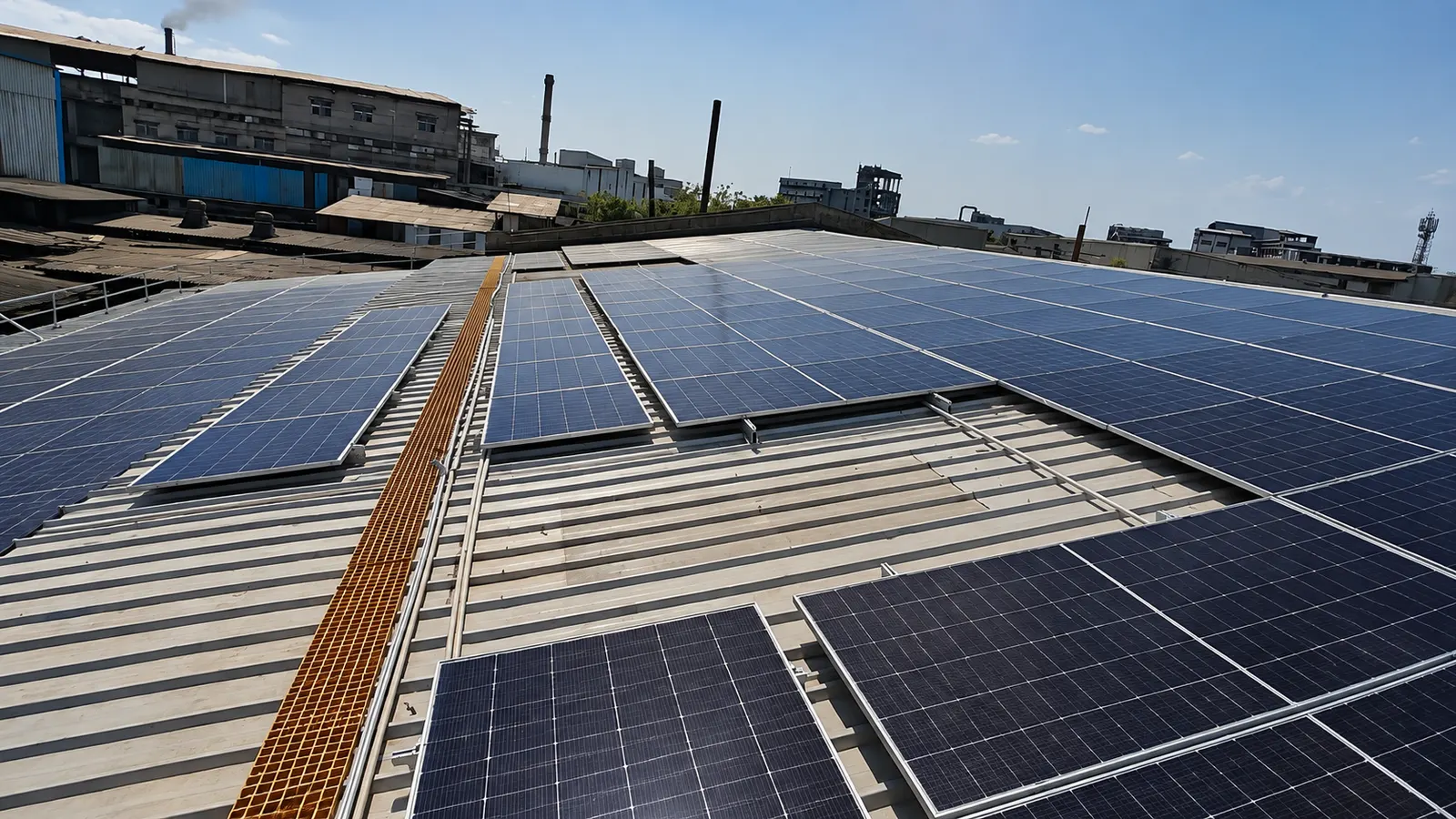
Auto component factories often have a useful daytime electrical load from machining, pressing, air compressors, chillers and inspection. The plant’s utility account, operating shifts and roof rights decide how much rooftop solar can offset. A Pithampur proposal cannot reuse a Waluj approval or tariff assumption, even if the production lines look similar.
Direct answer. Solar for auto component plants is best sized from actual interval consumption and surveyed roof space. In Pithampur, first identify whether the meter is with a state DISCOM or the MPIDC SEZ licensee; in Waluj, check MSEDCL and the MIDC plot documents. MPERC’s FY 2026-27 tariff order is dated 26 March 2026, while the applicable Maharashtra rooftop framework is MERC’s 2019 regulation with later amendments.
Which machine loads actually align with rooftop generation?
Machining centres, presses, welding equipment, compressed air, cooling and quality-control systems can produce a strong load during the day. Yet the sector label does not tell an EPC the load shape. A plant with two production shifts may have a steady daytime baseload. Another plant may run its largest press at night, stop on weekends, or idle a line between customer orders. Solar produces by sunlight, not the vehicle-maker’s delivery schedule.
Collect a year of bills and, where possible, 15-minute meter data. Add the production calendar, planned line expansions and known shutdowns. Mark which loads are continuous: compressors, chilled water, air handling, lighting and IT systems may still draw power when a particular machine is off. Then identify the lowest normal daytime demand, since that often limits how much solar can be used directly without export. The industrial solar installation guide describes the overall process; this plant-specific load map comes before final array sizing.
Separate energy from demand. A large motor start or short press cycle can set a maximum-demand event even if monthly kWh is moderate. Rooftop solar may reduce grid imports during that event if the sun and machine coincide, but a cloud or an evening cycle can leave recorded maximum demand unchanged. The maximum-demand glossary explains the bill term. Any promise to lower contracted demand should be backed by interval evidence and a utility approval plan.
The first design question is where solar generation goes on an ordinary working day, a low-volume day and a scheduled shutdown. A plant that uses all output during normal shifts may still export heavily on weekends. An OEM order change can alter that balance. Ask the EPC to calculate direct use and export in each case. A model that multiplies the entire forecast generation by a flat retail tariff cannot show whether the proposed size survives a production schedule change.
| Load group | Typical measurement | Solar design question |
|---|---|---|
| Machining and presses | Interval kW and run hours | Does the peak occur in daylight? |
| Air and cooling | Baseline kW by shift | How much solar can be used on quiet days? |
| Welding and test equipment | Short peaks and quality load | Will demand or power quality need separate work? |
| Shutdown and weekend services | Minimum import | What happens to surplus output? |
The table is a survey template. Actual meter and production records should replace assumptions before a bid is accepted.
What changes between a Pithampur and a Waluj electricity account?
Pithampur is not one universal tariff account. A factory may be supplied by an MP distribution company or, in a specific area, by MP Industrial Development Corporation’s SEZ distribution licensee. The MPERC state DISCOM retail tariff order for FY 2026-27, Petition 140/2025 dated 26 March 2026 is the state DISCOM reference. MPERC also issued a separate MPIDC SEZ order for FY 2026-27, Petition 141/2025. Read the name printed on the current bill before selecting either schedule. The Indore service page provides local context, but the tariff order and account govern the calculation.
Waluj is in Maharashtra, so the plant needs its current MSEDCL tariff schedule and MERC rooftop rule. MERC publishes the 2019 Grid Interactive Rooftop Renewable Energy Generating Systems Regulations and the 2023 and 2024 amendments. The applicable mechanism, capacity limit and settlement should be checked against the approved application and the plant’s consumer category. A generic claim that every industrial connection receives the same net-metering treatment would be unsafe. The Sambhajinagar service page is a route to a local enquiry, not a substitute for the MSEDCL account.
For either location, split the bill into energy, demand, time-of-day, power-factor, fixed and statutory components. Identify which items a direct-use solar unit can avoid and which remain after installation. Confirm whether an existing captive, open-access or generator arrangement changes the utility paperwork. If the plant has multiple adjacent buildings under separate consumer numbers, document which meter owns each proposed array and which roof belongs to the application.
Use the tariff order’s effective date, not the date of the EPC quotation, as the source for each rate. A proposal can be reviewed only when the reader can trace every rate and rule to the right licensee. This is especially important when comparing Pithampur and Waluj: the same physical array could have a different financial result because the tariff, export arrangement and approvals differ.
The two MP order numbers are a reminder to verify the distribution licensee on the bill.
How should the roof, estate lease and approvals be screened?
An industrial roof is a structural and legal asset, not merely spare square metres. Survey trusses, purlins, sheet condition, wind exposure, drainage, skylights, fire access, cranes and equipment openings. Older sheds may need repair or replacement before panels. The roof-strength checklist and old-roof guide help frame the physical decision. A structural engineer should sign off the actual mounting loads and anchorage, including maintenance and wind loads.
The plot agreement matters too. In a Waluj MIDC plot, check the lease and approved building plan before altering a structure or adding a carport. MIDC’s official building-permission checklist includes lease or ownership documents, structural professionals and relevant approvals for building-plan applications. That does not mean every rooftop panel automatically requires a new building permit. It means the owner should ask the relevant MIDC office and qualified designer whether the proposed structural work changes an approved plan or triggers a formal application. The answer depends on the plot and design.
In Pithampur, confirm whether the plot is in an industrial estate or SEZ and who controls the building and electrical connection. The factory should review MPIDC lease terms or other land documents, obtain required owner consent and identify the authority for any structural change. Do not assume that a DISCOM rooftop approval also grants roof or estate permission. Conversely, an estate’s no-objection document does not replace electrical interconnection approval.
The solar approval package usually needs a proposed capacity, connection details, single-line diagram, protection scheme, equipment certificates and ownership or consent records. The exact form is set by the relevant utility and regulator. An HT connection may also need electrical-safety inspection or approval under the applicable rules. The CEA Measures Relating to Safety and Electric Supply Regulations, 2023 provide the national safety framework. Put the utility, estate, structural and electrical sign-offs on one schedule with named owners, so an unapproved roof change does not delay commissioning.
Approval check
A rooftop interconnection application and an estate or landlord consent answer different questions. Record both before finalising the mounting and meter design.
The plant team should also reserve access for future machine exhaust, cooling equipment and roof maintenance. A roof full of modules can become expensive to change when a new production line needs a duct or crane route.
How do MP and Maharashtra rooftop rules change export value?
Direct use is the cleanest part of the energy model: a solar unit consumed behind the same meter at the same time normally reduces grid imports. Export is different. Its credit, settlement period and allowed capacity depend on the state’s current rooftop framework and the approved connection. MPERC’s MPIDC SEZ FY 2026-27 tariff order says that net, group, gross and virtual metering accounting follows MPERC’s Grid Interactive Renewable Energy System and Related Matters Regulations, 2024, as amended. That is an instruction to read the current regulation and approval, not to assume all four mechanisms are available to every plant.
MERC’s rooftop regulations index lists the 2019 base regulation and subsequent amendments. A Waluj bidder should identify the applicable consumer category and metering arrangement, then show the exact clause used for any export credit. The commercial net-billing versus net-metering guide explains why exported units can be worth less or settle differently from directly used units. A factory with repeated weekend shutdowns should not be sized on a weekday-only self-use assumption.
Illustrative example, not a utility bill or project forecast: suppose an array produces 2,000 kWh over a working day and the plant can use 1,800 kWh in the same intervals. On a shutdown day, assume the same generation but only 300 kWh of matching site load. Potential surplus changes from 200 to 1,700 kWh. The actual credit for that surplus cannot be calculated without the applicable approved metering mechanism and tariff source. The example shows why an export-heavy design needs more evidence than a daytime-load claim.
The bill model should have separate rows for forecast generation, direct consumption, export, imported units by time slot, demand charges and taxes. For a leased roof, it should also identify who receives the bill credit and who bears future meter or account changes. If an EPC proposes a larger array on the strength of export income, ask for the order, date, settlement method and an example bill. An unsigned rate assumption is not a reliable basis for plant procurement.
The proposed capacity should be checked against sanctioned load or contract demand and the connection-specific cap before equipment is ordered. The solar capacity and sanctioned-load guide gives the wider state comparison. Where a load extension is needed, its time, cost drivers and network feasibility belong in the project plan.
What should a plant verify about power quality and production continuity?
Auto component plants can have variable-speed drives, welders, presses and test equipment. Those loads can affect power factor and harmonic performance. Solar inverters should be integrated with the existing electrical system, not treated as an isolated appliance. Before the bid is signed, obtain a current single-line diagram, transformer details, existing automatic power-factor correction settings, protection settings and, if available, a power-quality study. The power-factor guide explains why the grid-side factor can move after solar reduces active imports.
The EPC should state the point of connection and fault-isolation method. It should show how inverter protection coordinates with the plant’s switchgear and the utility’s interconnection requirements. If the plant uses a diesel generator for continuity, the design must show how the PV plant disconnects or synchronises during grid outages under the proposed controls. Standard grid-connected rooftop solar does not by itself keep production running during a power cut. Do not sell a backup claim from an ordinary on-grid design.
Installation planning should fit the manufacturing calendar. Roof work may proceed in phases, while the final electrical tie-in can need a planned shutdown or isolation window. Material movement, lifting, hot work and cable routing should be agreed with production, EHS and maintenance teams. The factory installation without shutdown guide sets out that sequence. Agree the roof-work phases and electrical isolation window with production before equipment arrives.
The plant’s quality team may need records for customer or internal audits. It can ask for approved drawings, material traceability, test reports, commissioning records, meter agreements, safety inspection documents and O&M instructions. These records support verification of the installation; they do not establish any automatic OEM sustainability credit. If a customer requests renewable-energy evidence, confirm the contract’s exact requirement and the accounting method before making a claim.
An EPC proposal should explain how production changes are handled after commissioning. A new machine or shift can change direct solar use, peak demand and power factor. The owner should retain baseline interval data so later bill changes can be investigated against actual operating changes. That makes both performance monitoring and future capacity additions more disciplined.
How should two factory bids be compared across these locations?
Normalize bids to the same load, site and tariff assumptions before comparing their quoted output or price. A Waluj factory and a Pithampur factory may have different roofs, meter arrangements and approvals. Even two bids for one roof can use different generation estimates and export valuations. The industrial EPC bid checklist sets out the broader procurement method; the location-specific checks below prevent the wrong utility rule from entering the comparison.
Ask each bidder for a year-by-year generation model with the software input file or enough inputs to reproduce it: module layout, shade, weather source, orientation, losses and degradation assumption. Require the same plant production calendar and import data in both cases. Compare directly consumed units and exported units separately. Keep demand charges, fuel adjustment, duties and fixed charges visible. A low quoted cost per generated unit is not automatically a low delivered cost to the factory if much of the output is exported under a different value.
Check scope. One bidder may include roof strengthening, cable tray, fire access, meter changes and approvals while another excludes them. The owner should mark every exclusion and identify who pays for it. For a leased industrial plot, the bidder must also say who obtains landlord or estate consent. A proposed panel layout that clashes with production exhaust, future crane access or drainage is a cost risk even if its generation forecast looks attractive.
- ✓ Correct licensee and tariff order
- ✓ Same interval-load baseline
- ✓ Direct use and export separated
- ✓ Structural and estate scope listed
- ✗ Pithampur and Waluj rates mixed
- ✗ All output priced at retail tariff
- ✗ Roof capacity before structural sign-off
- ✗ Backup promised without controls
The final comparison should state the expected unit cost and bill effect under a conservative production case, but should not convert that result into a guaranteed saving or return. The buyer should be able to change a shift schedule or export assumption and see the effect. That makes the decision robust enough for a factory purchase order.
Request a plant-specific comparison: Send the bill, production shifts and roof drawings through the industrial solar enquiry. Ask the bidder to name the exact utility, tariff order and approval route for your plot.
When should an auto component plant examine off-site solar?
An off-site option becomes relevant when the safe roof is small compared with the factory’s daytime load, when multiple sites need supply, or when a plant’s expansion will exceed the existing roof. It may also be considered where the factory is a tenant without sufficient roof rights. Off-site supply is not a simple extension of rooftop net metering. It uses a separate generator, network access and commercial agreement, with charges and losses between generation and the factory meter. The open-access glossary explains the delivery route.
The Ministry of Power parliamentary answer dated 3 February 2025 describes the Green Energy Open Access threshold of 100 kW contracted demand or sanctioned load for ordinary eligible consumers, with stated aggregation terms, and no load limit for captive consumers. State rules and the specific drawal licensee still govern the application and charges. A Pithampur MPIDC SEZ account may need a different operating process from a state DISCOM account. A Waluj MSEDCL plant must use Maharashtra’s current open-access and distribution rules. The threshold is an eligibility screen, not an approval or a delivered-price quotation.
Ask for a line-by-line delivered-cost comparison. It should show the generator payment, transmission and wheeling charges, network losses, applicable cross-subsidy or additional surcharge, scheduling and banking terms, taxes and the cost of any required metering. For a captive structure, add the ownership and annual consumption tests, governance obligations and exit rights. An off-site solar generator still produces mainly in daylight; it does not automatically cover a plant’s night production or serve as outage backup. Compare its hourly delivery with the same factory interval data used for rooftop sizing.
| Decision point | Rooftop self-use | Off-site solar |
|---|---|---|
| Site constraint | Requires safe roof and roof rights | Requires grid access and a generator contract |
| Energy value | Direct use can reduce matching grid imports | Delivered cost depends on all charges and losses |
| Export or mismatch | Governed by the rooftop approval | Governed by scheduling, banking and settlement rules |
| Operational risk | Roof maintenance and site access | Contract, network and regulation changes |
The table is a screening framework. A factory should request both cases with the same load, tariff year and production forecast before choosing one.
Off-site comparison
Compare energy delivered at the factory meter after losses and charges. A generator's quoted price is only one line of the landed-cost calculation.
The plant may ultimately use both routes: a roof array for direct daytime consumption and a separate off-site contract for remaining eligible load. The two should be modelled together to avoid double-counting the same grid imports. Any proposed combination should identify which project supplies each meter and how their scheduling and settlement interact. That is a procurement and compliance question for the actual factory, not a general sector rule.
How Heaven Green Energy helps scope an Auto Component Plant
The starting pack for a factory proposal is a full year of bills, interval readings where available, the current single-line diagram, site and roof drawings, plot or lease documents, production calendar and planned expansions. Heaven Green Energy files DISCOM paperwork for its customers. The plant owner should ensure the consumer name, property rights and proposed roof match the application documents.
The relevant routes are:
- Industrial solar for the primary Pithampur or Waluj factory enquiry.
- Commercial solar for a smaller separately metered office or showroom.
- Solar in Indore and solar in Sambhajinagar for local service context.
The first review should identify the utility and tariff category, not jump straight to a panel count. Then map sunlit load, roof bays, consent requirements and interconnection steps. For Pithampur, determine whether the account is with a state DISCOM or the MPIDC SEZ licensee. For Waluj, identify MSEDCL and the MIDC plot documents. These checks are small compared with the risk of modelling the wrong rule.
Use this sequence for a reviewable scope:
- Identify the meter. Record the distribution licensee, tariff category and contract demand.
- Map the production day. Collect interval load and schedule changes.
- Survey the roof. Confirm structure, shade, drainage and maintenance access.
- Confirm consent. Review the lease, estate and building-plan position.
- Model the bill. Separate direct use, export and unchanged charges.
- Plan the tie-in. Agree safety controls, production windows and handover records.
The proposal should include an assumptions register with a source and date for every rate or rule. The owner can then compare bids on the same basis and revise the model if a new machine changes the load before installation. After commissioning, retaining the baseline supports a useful comparison of generation and imports rather than a vague claim that the bill should fall by a fixed percentage.
Use the industrial solar route for the primary proposal. The decision should be supported by a utility-specific approval plan and a roof layout the production team can maintain.
Frequently asked questions
Is Pithampur always supplied by MPPKVVCL?
No. Check the name on the plant’s electricity bill. MPERC has a state DISCOM retail tariff order and a separate FY 2026-27 order for the MPIDC SEZ licensee. The applicable tariff and process depend on the actual account and location.
Can a Waluj MIDC factory install panels without any estate check?
Do not assume so. Review the plot lease, approved plan and proposed structural work. MIDC’s official building-permission materials show the relevant document and professional-sign-off framework. Ask the MIDC office or qualified designer whether the specific alteration needs a formal application, alongside MSEDCL rooftop approval.
Does solar reduce a press shop’s maximum-demand charge?
Solar can lower imports in matching daylight intervals, but a cloudy or night-time peak may still set recorded demand. The EPC should use interval data before claiming a demand-charge effect, and any contract-demand revision needs utility approval.
Can weekend export be valued at the normal retail tariff?
Only if the approved metering and settlement rule supports that treatment. A bidder must name the MPERC or MERC clause, date and consumer category used for export credit. Directly used solar and exported solar should be separate rows in the model.
Will on-grid solar keep machines running during a power cut?
No. A standard grid-connected system disconnects under an outage for safety. Backup requires a separately designed control and supply arrangement, with any generator interface clearly specified. The proposal should not treat rooftop solar capacity as backup capacity.
What documents should an auto component plant send first?
Send twelve months of bills, interval data if available, shift calendar, roof and site drawings, single-line diagram, lease or ownership records and planned machine additions. Those inputs establish the right utility, roof and load assumptions before a capacity is chosen.