Someone in your family, your neighbourhood WhatsApp group, or your local electrician has probably told you something about solar that isn’t quite true. Maybe it was “panels stop working in monsoon,” or “solar needs washing every week,” or “the subsidy is a government trick.” Rooftop solar in India crossed a real scale point in 2026, MNRE data shows over 1.5 crore homes registered under PM Suryaghar Muft Bijli Yojana, and with that scale comes a matching wave of half-truths repeated so often they sound like fact.
Direct answer. Most common solar myths in India don’t hold up against measured data. Heat cuts panel efficiency by only 0.3 to 0.5 percent per degree above 25°C, cloudy days still generate 15 to 35 percent of clear-day output, and properly installed systems need only quarterly cleaning plus an annual check, not weekly maintenance. Genuine risks exist, PM Suryaghar vendor fraud and monthly-billing DISCOM true-ups among them, but they are avoidable with verification, not reasons to skip solar altogether.
This guide walks through nine myths we hear most often from homeowners across our 10,000-plus installations, checks each one against real numbers, and tells you exactly what to verify before you sign a contract or believe a rumor.
Myth 1: “Solar Panels Stop Working in Heat, So Summer Is Bad for Solar”
False, and the confusion comes from mixing up sunlight and heat. Crystalline silicon cells lose roughly 0.3 to 0.5 percent of rated output for every degree above the 25°C Standard Test Condition, a spec printed on every panel datasheet. In a Rajasthan or Gujarat summer, cell temperatures can climb to 60-70°C, per field monitoring reported by pv magazine India, trimming 15 to 20 percent off theoretical peak output on the hottest afternoons.
But that efficiency loss is not the same as total generation. Summer brings longer daylight hours and stronger direct irradiance, and that extra sunlight more than compensates for the heat penalty in most of India. Our own generation logs across Gujarat and Rajasthan installs consistently show March-to-May as the single highest-output season of the year, not the lowest, even with the heat drag factored in. Our solar in Rajasthan dust and heat guide breaks down region-specific derating in more detail, and our TOPCon vs mono PERC in Indian heat comparison covers which panel technology handles high-temperature climates with the smallest efficiency drop.
💡 Fast tip
If your installer quotes performance figures only from a clear, cool day, ask for the panel's [temperature coefficient](/glossary/temperature-coefficient) (in %/°C) on the datasheet. A lower number, typically under -0.35%/°C for TOPCon panels, means less summer efficiency loss.
Myth 2: “Cloudy or Rainy Days Mean Zero Solar Generation”
Also false. Solar cells respond to photons, not to a clear blue sky. On an overcast day, sunlight scatters through cloud cover and reaches the panel as diffuse irradiance rather than a single direct beam, and crystalline silicon still converts that scattered light into current, just at a reduced intensity. We covered this myth in depth, including region-by-region monsoon generation drops, cleaning effects, and net-metering math, in our will solar work in monsoon guide; the short version is that even heavy monsoon cloud cover produces 15 to 35 percent of clear-day output, not zero, and a full monsoon month typically lands 20 to 35 percent below summer peak, a real dip but not a shutdown.
Homeowners usually pick up this myth from checking their generation app during the exact worst hour of a storm, when instantaneous output genuinely can fall to 10 to 15 percent of capacity, then assuming that number represents the whole day or month. Judge cloudy-weather performance by your monthly total on the bill or app, not a single glance mid-downpour.
Myth 3: “Rooftop Solar Needs Constant, Expensive Maintenance”
Overstated. Solar panels have no moving parts, so there is nothing mechanical to wear out the way an air conditioner compressor or a generator engine does. What panels actually need is periodic dust removal and an annual electrical health check, not the weekly attention some sales pitches (on both the pro-solar and anti-solar side) imply.
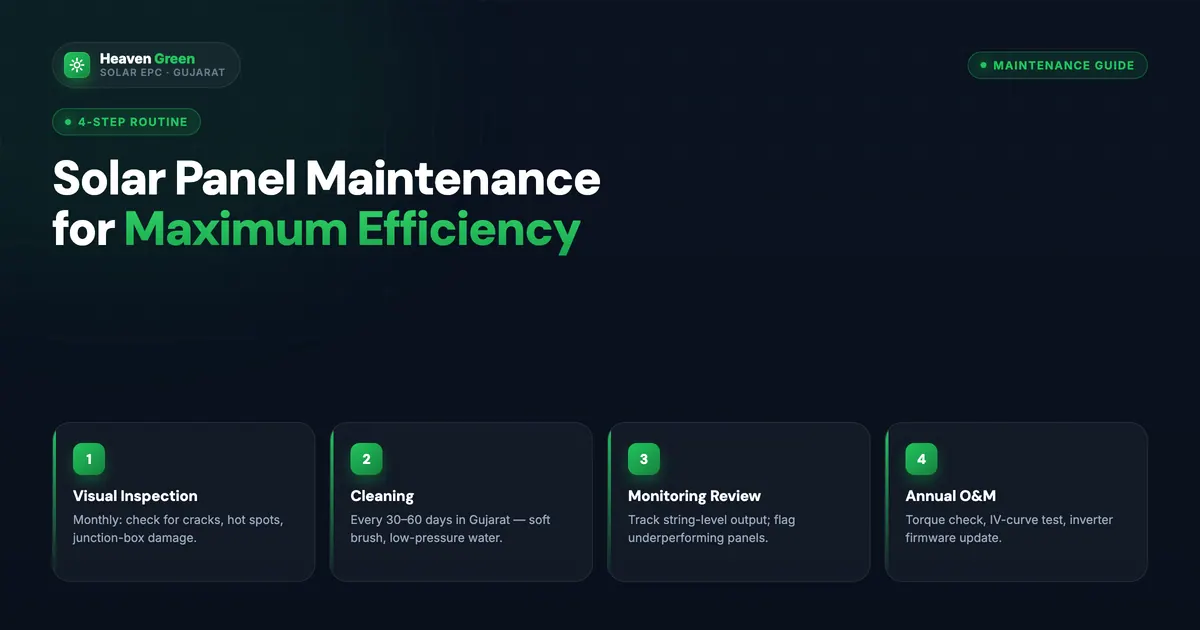
Our solar panel maintenance for maximum efficiency guide and quarterly maintenance checklist lay out the real cadence: a water rinse every 2 to 4 weeks in dusty regions, a soap-and-squeegee clean once a quarter, and a professional electrical inspection once a year, covering earthing resistance, inverter logs, and cable connections.
| Task | Myth-implied frequency | Actual recommended frequency | Approx. annual cost, 5 kW system |
|---|---|---|---|
| Panel cleaning | Weekly | Every 2 to 4 weeks (dusty regions), monthly elsewhere | ₹1,500 to ₹3,000 self-clean; ₹4,000 to ₹6,000 professional [AMC](/glossary/amc) |
| Inverter check | Monthly technician visit | Annual, plus app-based self-monitoring | Included in most AMC packages |
| Earthing/SPD test | Rarely mentioned | Once a year, pre-monsoon | ₹1,000 to ₹2,500 if not bundled |
The real maintenance risk isn’t over-servicing, it’s under-servicing parts homeowners don’t think about, like earthing and connector seals. Our solar system installation and maintenance mistakes guide lists the errors that actually cause generation loss, and none of them are “didn’t clean often enough.”
Myth 4: “The PM Suryaghar Subsidy Is a Government Trick or Never Actually Pays Out”
Partly true, partly false, and worth separating carefully. The subsidy itself is real and has paid out to over a crore households as of 2026 per MNRE and pmsuryaghar.gov.in, at rates of ₹30,000 per kW up to 2 kW and ₹18,000 per additional kW up to 3 kW, capped at ₹78,000 for a 3 kW-plus system. What is real is fraud around the scheme, not the payout itself. Enforcement in Maharashtra uncovered a pattern where consumers reverted commercial connections to residential status to claim the subsidy improperly, per Nagpur Today, and separately, installer-side fraud, vendors collecting large advances and disappearing, has been documented across multiple states.
⚠ Watch out
Never pay more than 10 to 20 percent advance to any solar vendor. Every legitimate PM Suryaghar-empanelled installer is listed on the National Portal with a verifiable registration number; treat that listing as your first non-negotiable check before any payment changes hands.
The nuance worth admitting: the program has genuine friction, portal errors, rejection loops, slow DISCOM inspections, that feels like a scam to a frustrated first-time applicant even when nothing fraudulent is happening. Our PM Suryaghar rejection reasons guide and PM Suryaghar portal error fix guide address the friction directly, so a slow application doesn’t get mistaken for a con.
Get a free site visit. Our engineer verifies your DISCOM’s current subsidy status and vendor empanelment before you commit to anyone. Get your free quote →
Myth 5: “Solar Doesn’t Actually Increase Your Home’s Resale Value”
False for owned systems, mostly true for leased ones, which is exactly why this myth persists in both directions. Market analysis cited across multiple Indian real-estate sources shows owned rooftop solar adds roughly 3 to 5 percent to resale value in metro markets where renewable-energy awareness is stronger, with realtors in cities like Pune and Bengaluru reporting solar-equipped homes commanding measurably higher offers than comparable non-solar homes. Homes with fully owned systems also tend to sell 15 to 20 percent faster, because a functioning solar system reads to a buyer as a lower future electricity bill baked into the property.
The catch is ownership structure. Leased or third-party-owned systems show little to no resale premium, because a buyer has to either take over unfamiliar lease obligations or negotiate a buyout, friction most buyers avoid. If you financed your system through a loan rather than a lease, and the loan is paid off or transferable, that distinction rarely dents resale value the way a lease does.
Myth 6: “Bigger Panels or More Panels Always Mean More Savings”
Not necessarily, and this myth drives oversized quotes. Solar savings scale with how closely your system’s output matches your consumption and your DISCOM’s net metering rules, not with raw panel count. A system sized well beyond your monthly usage exports excess units at whatever rate your state’s net metering policy allows, often lower than retail tariff, so the marginal panel past your consumption ceiling returns less than the first one did.
Our solar payback period explained guide walks through the sizing math in full. The short version: a system matched to your last 12 months of bills, ideally 80 to 100 percent of annual consumption, not your roof’s total available area, produces the fastest payback, typically 3 to 4 years post-subsidy.
Myth 7: “Solar Panels Damage Your Roof or Void Your Roof Warranty”
Mostly false when installed correctly. Rooftop mounting structures sit above the roof surface on brackets or ballasted frames, not embedded into the waterproofing layer, and a competent installer seals every penetration point with proper flashing. In most cases, a well-installed array actually shields the covered section of roof from direct UV exposure and rain impact, extending the life of that portion of the roofing material rather than shortening it.
The real risk isn’t solar itself, it’s a rushed or unlicensed installation crew skipping proper flashing and gasket sealing at mounting points, which is a workmanship failure, not a solar-technology failure. Ask any installer for their mounting structure warranty separately from the panel and inverter warranties; our solar warranty types explained guide breaks down which components carry which warranty period, and our how to file a solar warranty claim guide covers what to do if something does go wrong.
Myth 8: “Solar Panels Degrade Fast and Stop Working After 10-15 Years”
False. Modern crystalline silicon panels carry a 25 to 30 year performance warranty guaranteeing at least 80 to 87 percent of rated output at the end of that period, and annual degradation for reputable Tier-1 panels sits around 0.4 to 0.7 percent, not a sudden cliff. A panel at 100 percent output in year one is still around 88 to 92 percent in year 15, well within a useful, bill-reducing range.
- ✓ Output does drop gradually, roughly 0.4 to 0.7% a year
- ✓ Manufacturers guarantee minimum output, not zero decline
- ✓ Heat and poor installation can accelerate degradation slightly
- ✗ Panels do not "stop working" at any fixed age
- ✗ There is no sudden cliff-edge failure at year 10 or 15
- ✗ A degraded panel still generates usable, billable electricity
Our solar panel degradation and warranty truth guide documents the actual degradation curve reputable brands publish, and our Adani Solar warranty guide covers one specific manufacturer’s terms as a worked example. If you’re comparing design-side factors that influence long-term degradation, like shading analysis and layout optimization, the shadow analysis tooling from SurgePV shows how proper design work reduces hotspot-driven degradation before installation even begins.
Myth 9: “Net Metering Means You Get Free Electricity Forever”
False, and this is the myth that creates the most disappointed customers when their first bill arrives. Net metering banks the surplus electricity your system exports during high-generation months as a credit against your DISCOM bill; it does not zero out your bill permanently or pay you cash for excess generation in most residential tariff structures. A well-sized system typically covers 80 to 100 percent of annual consumption, not 150 percent, because oversizing past your usage just exports units at a lower settlement rate than what you’d otherwise pay for grid power.
Our net metering in India guide and what is net metering India guide explain the settlement mechanics DISCOM by DISCOM. “Near-zero bill” is achievable with correct sizing; “guaranteed free electricity regardless of usage” is not how any Indian net metering policy works.
Curious what solar would actually cost and save for your home? Use our free solar calculator, real subsidy and savings numbers in 60 seconds, not myths.
The Heaven Green Myth Verification Framework
We built this after fielding the same handful of myths on nearly every sales call, to give homeowners a fast way to test any solar claim before believing or repeating it.
- Ask “compared to what?” Most solar myths compare an extreme case (worst storm hour, hottest afternoon) to an unstated ideal, rather than to a realistic monthly or annual average.
- Ask “is there a published number behind this?” A real claim can point to a datasheet spec, an MNRE benchmark, or a DISCOM tariff order. A myth usually can’t.
- Ask “does this apply to owned systems or leased ones?” Several myths, resale value especially, flip true-to-false depending on ownership structure, and vague retellings drop that distinction.
Run any solar claim you hear through these three questions before it changes your decision. If a claim survives all three, it’s probably fact, not folklore.
How Heaven Green Energy Helps
Across our 10,000-plus rooftop installations in Gujarat, Rajasthan, Maharashtra, and Karnataka, we’ve heard nearly every myth on this list from a homeowner who almost didn’t go solar because of it. We build fact-checking into the sales process itself rather than leaving customers to sort rumor from reality alone.
- Residential solar: 1 to 10 kW rooftop systems sized against your real consumption, not a rule-of-thumb roof estimate.
- Solar calculator: see your actual subsidy, sizing, and payback numbers instead of relying on a neighbour’s secondhand figures.
- Solar panel warranty explained: the real coverage terms for panels, inverters, and mounting structures, in plain language.
- Contact us: call +91 63904 05060 to have an engineer verify any specific claim about your roof, your DISCOM, or a quote you’ve received.
For homeowners comparing detailed engineering quality across installers before committing, our design partner’s solar compliance resource center from Heaven Designs is a useful independent reference for what a properly engineered, myth-free rooftop system should actually include on paper.
Frequently Asked Questions
Do solar panels really work on cloudy or rainy days?
Yes. Solar cells use diffuse light scattered through cloud cover, not just direct sunbeams, so they keep generating on overcast and rainy days, typically 15 to 35 percent of clear-day output rather than zero. A complete stop in generation during weather, as opposed to a reduced output, usually points to a fault rather than normal cloudy-day behaviour.
Does hot weather really reduce solar panel output?
Yes, but only moderately. Panels lose about 0.3 to 0.5 percent of rated output per degree Celsius above 25°C, which can mean a 15 to 20 percent efficiency dip on the hottest Indian summer afternoons. Total monthly generation still tends to be highest in summer because longer daylight hours and stronger irradiance outweigh the heat penalty.
Is the PM Suryaghar subsidy actually real, or is it a scam?
The subsidy is real and has paid out to over a crore households as of 2026 according to MNRE and pmsuryaghar.gov.in. Fraud exists around the scheme, mainly installer-side advance-payment scams and isolated cases of consumers misrepresenting connection type, but the government payout itself is verifiable and legitimate when you go through an empanelled vendor listed on the National Portal.
Do solar panels actually need very little maintenance?
Yes, relative to most home appliances. Panels have no moving parts, so periodic cleaning every 2 to 4 weeks in dusty regions plus one professional inspection a year covers nearly all upkeep needs. The genuine risk area is earthing and connector maintenance, which homeowners tend to underestimate rather than over-clean.
Will solar panels increase my home’s resale value in India?
Yes, for owned systems. Market data from realtors in cities like Pune and Bengaluru shows a 3 to 5 percent resale premium for homes with owned rooftop solar, and these homes tend to sell 15 to 20 percent faster. Leased or third-party-owned systems show little to no resale benefit because buyers avoid taking over unfamiliar lease terms.
Does a bigger solar system always save more money?
No. Savings depend on how closely your system output matches your actual monthly consumption and your DISCOM’s net metering settlement rate, not on total panel count. Oversizing past your usage exports surplus units at a lower rate than you’d pay for grid electricity, weakening the return on the extra panels.
Do solar panels stop producing electricity after 10 to 15 years?
No. Reputable panels carry 25 to 30 year performance warranties guaranteeing at least 80 to 87 percent of original output at the end of that term, with annual degradation of roughly 0.4 to 0.7 percent. A panel is still producing meaningful, billable electricity at year 15 and typically well beyond it.
Does net metering mean my electricity bill becomes zero forever?
Not automatically. Net metering banks surplus generation as a bill credit; it doesn’t guarantee a permanently zero bill regardless of how much electricity you use. A correctly sized system typically covers 80 to 100 percent of annual consumption, producing a near-zero bill in practice, but usage spikes or an undersized system can still leave a balance due.