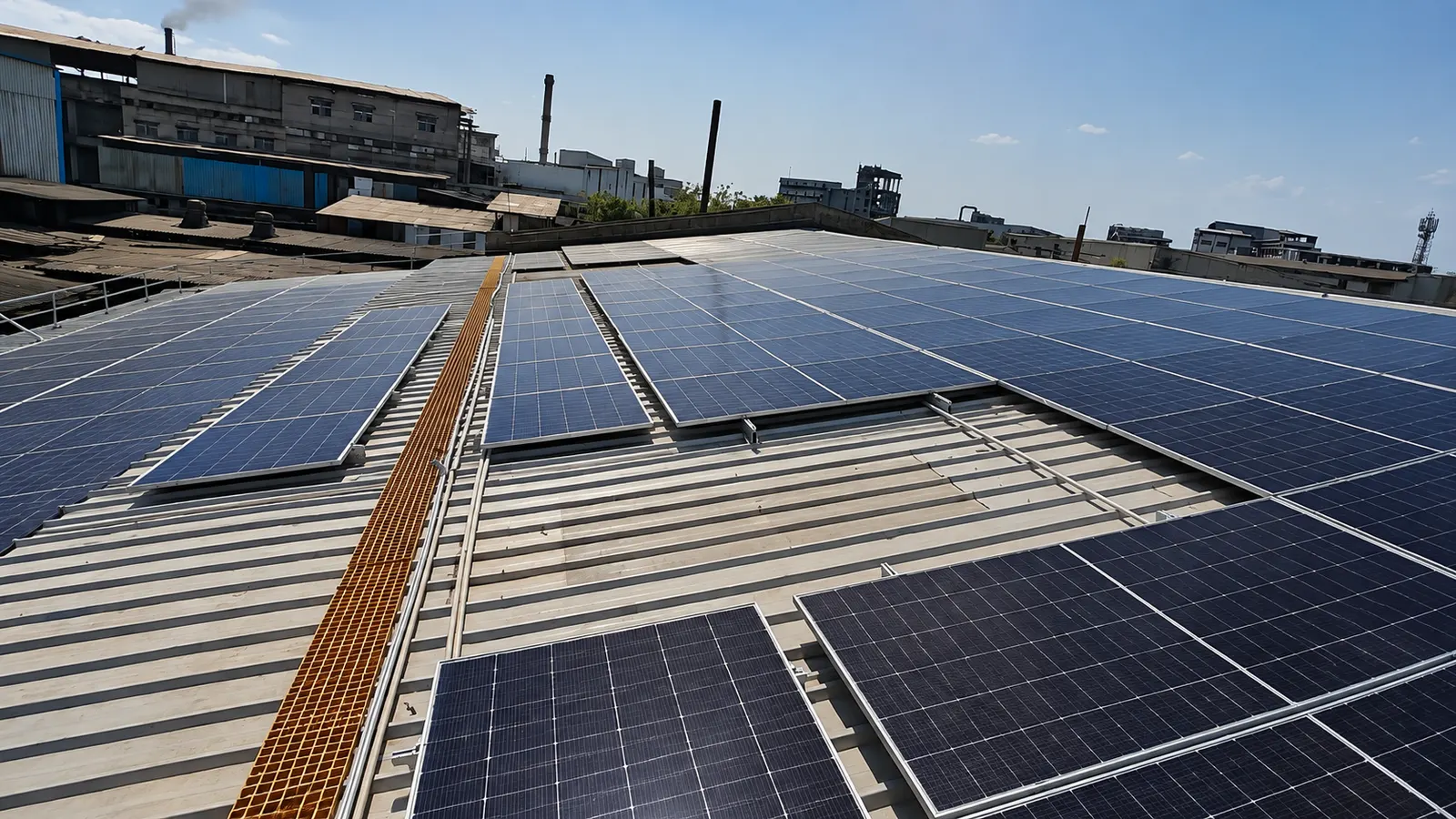
A dal mill can run graders, cleaners, dryers, polishers and packaging lines during daylight, making rooftop solar worth testing. The plant’s actual hours, dust, roof condition and utility account determine the design. A standard household solar estimate will miss both the industrial bill and the mill’s shutdown periods.
Direct answer. Solar for a dal mill in Indore should be sized by matching forecast daylight generation with measured process and auxiliary demand. The West DISCOM bill, MPERC retail tariff order dated 26 March 2026, and MPERC’s 2024 rooftop regulation with its 18 June 2026 amendment govern the commercial and approval checks. The mill should value self-used and exported units separately.
Which dal-mill loads align with sunlight and which do not?
Cleaning, grading, splitting, polishing, drying, conveying, air systems and packaging can all use electricity, but they do not necessarily operate at the same time. A mill might process in daylight and package later. Another might keep dryers or ventilation running beyond the main shift. A food-processing site can also have refrigeration or cold storage that continues through the night. The phrase “daytime industry” is a starting hypothesis, not a measured load profile.
Collect twelve months of complete bills and, if available, interval data from the electricity meter. Mark crop-arrival seasons, normal working days, partial shifts, weekly closures and maintenance shutdowns. Record each line’s operating hours, but use meter data to confirm the combined electrical draw. Machine nameplate ratings can overstate simultaneous use; they are useful for equipment design, not a substitute for measured imports. The industrial solar installation guide sets out the general process, while this mill needs a seasonal and interval load map before sizing.
The lowest realistic daytime load is especially important. A mill may have high demand on processing days but only office, security and a small air system during closures. A solar array sized for the highest day can export much of its output on the lowest day. That may still be a viable design under an approved export mechanism, but the exported units must be valued under the relevant MPERC rule. They cannot be assumed to remove the same amount of retail bill as directly used units.
Use a checklist. Map the crop and processing calendar first. Then split each typical day into production, partial-operation and shutdown intervals. Finally compare forecast solar output with the site’s import data in those same intervals. The result should show direct use, export and remaining grid imports by month. This method also helps a mill decide whether to include a future dryer or packaging line in the design, rather than treating an expansion as current load.
| Mill activity | What to measure | Solar modelling question |
|---|---|---|
| Cleaning and grading | Daytime run hours and kW | Is load stable enough for direct use? |
| Drying and polishing | Batch timing and peak kW | Does the load overlap the solar peak? |
| Packaging and storage | Evening and night use | How much grid energy remains? |
| Maintenance or crop gap | Minimum daytime import | How much output becomes surplus? |
The table is a data request for the owner, not a claim about every Indore mill. The actual crop calendar can change from year to year.
How should an Indore West DISCOM bill be read?
Identify the distribution licensee, consumer category, sanctioned load or contract demand and billing voltage on the account. Indore’s state distribution licensee is MP Paschim Kshetra Vidyut Vitran Company, commonly called West DISCOM or MPPKVVCL. A small mill may have an LV industrial account; a larger plant can be on HV. The tariff and demand treatment should be taken from the actual category printed on the bill, not from a generic per-unit estimate. The sanctioned-load glossary and HT versus LT guide explain those account fields.
The MPERC retail supply tariff order for FY 2026-27, Petition 140/2025 dated 26 March 2026 is the official state DISCOM source. It includes separate LV and HV categories, demand or fixed terms and applicable rebates. The MPERC order index confirms the order date. Do not use a proposal tariff from a previous financial year or a rate for a different licensee. If a site sits inside a special distribution area, the utility name on the bill decides which order to consult.
For a solar model, split the bill into energy charge, fixed or demand charge, time-of-day components if applicable, power-factor terms, taxes and other adjustments. Rooftop solar used instantly behind the meter can reduce matching grid energy. It does not automatically remove demand or fixed charges. A high load when solar output falls or after sunset may still set maximum demand. The maximum-demand penalty glossary explains why monthly units and peak demand are different quantities.
Ask the EPC to show a pre-solar and post-solar bill bridge using the same production data. A calculation that divides the total rupee bill by kWh and applies that blended rate to all forecast solar generation is unreliable. It can accidentally treat taxes and demand charges as avoidable energy, and treat exported units as if they were self-used. The proposal should name each tariff clause, its effective date and which component it applies to.
Those references give the regulatory year. The mill’s actual consumer number and tariff category supply the project-specific facts.
What do MPERC’s rooftop rules change for a mill?
The MPERC Grid Interactive Renewable Energy Systems and Related Matters Regulations, Revision-II, RG-39(II) of 2024, notified 15 March 2024 establish the state framework for rooftop arrangements. MPERC lists a first amendment, ARG-39(II)(i) of 2026, dated 18 June 2026. An EPC should read both and identify the exact clause for the mill’s consumer category, capacity and chosen metering option. A description of a household subsidy route does not establish commercial eligibility.
The regulation distinguishes the arrangements through which generation and exports are measured and settled. Direct consumption at the same meter has a different bill effect from surplus exported to the grid. Net metering, net billing, gross metering, group or virtual arrangements should be discussed only where the current rule and utility approval make them available to the particular site. The business net-billing versus net-metering guide describes the mechanisms, but the approved application is the decisive document for the mill.
Capacity also needs a connection check. Sanctioned load, contract demand, approved solar capacity and network feasibility can all constrain the proposed array. The solar capacity and sanctioned-load guide explains the state comparison. A mill should not buy modules on the assumption that a later load extension or export approval will be automatic. If the desired capacity exceeds the current connection limit, put the extension process and its cost drivers into the project plan first.
Illustrative example, not an MP bill or generation promise: assume a proposed system produces 800 kWh on a processing day. The mill consumes 700 kWh during the matching solar intervals, leaving 100 kWh of potential surplus. During a maintenance day, assume the same generation but only 150 kWh of matching use, leaving 650 kWh of potential surplus. The value of those two surplus quantities depends on the approved metering and settlement rule. The example shows why a crop-calendar model is needed even if the roof and array are unchanged.
The EPC should include a month-by-month table with direct use and export as separate columns, and cite the source of any export compensation rate. If the mill has multiple buildings under different meters, clarify which connection hosts the plant and whether any shared or group arrangement is permitted. A rooftop design cannot simply move credits between consumer numbers because the buildings have the same owner.
Rooftop rule check
Ask the EPC to name the RG-39(II) clause and 2026 amendment treatment used for the mill's capacity, meter and export calculation.
This is an approval and valuation question. It should be resolved before a large array is justified by idle-season exports.
How do grain dust and older roofs change the design?
Dal mills can release dust during cleaning, handling, conveying and processing. Dust may settle on modules and reduce light reaching them. It can also affect access and housekeeping around electrical equipment. The rate of soiling depends on process exhaust, prevailing wind, roof orientation, nearby roads and cleaning practice. Do not assign an invented annual loss percentage to the site. Instead, survey likely deposit zones and make the cleaning method part of the design.
The roof should be assessed bay by bay. Check purlins, trusses, fasteners, covering age, corrosion, prior leaks, skylights, ventilation ducts and safe walking routes. A lightweight sheet can be in poor condition even where the supporting frame is sound. The roof-strength guide and roof inspection guide set out questions for the plant engineer. A qualified structural reviewer must decide whether the actual roof can carry the mounting, modules, wind forces and maintenance access.
Place modules where cleaning can be done safely without stepping onto fragile sheets or blocking a dust-extraction duct. Keep roof drainage and fire access open. Cable routes should avoid grain-handling equipment and likely impact zones. Electrical enclosures should be located with the plant’s dust-control and maintenance practices in mind. The CEA Measures Relating to Safety and Electric Supply Regulations, 2023 are the national electrical-safety reference; the site design must also meet the utility’s interconnection conditions and applicable inspection requirements.
If the roof is due for replacement, compare reroofing before solar with reinforcement or a different structure. A quote that omits the roof work may look cheaper while shifting a near-term cost to the owner. The old-roof decision guide explains why fragile asbestos-cement or deteriorated sheets should not be treated as ordinary mounting surfaces. The owner should preserve room for future vents, conveyors and maintenance equipment instead of using every available square metre.
Dust affects operating cost as well as generation. The proposal should define how soiling will be checked, how often the plant will review performance and who can access the roof. The cleaning frequency should respond to measured deposition and generation trends, not a fixed promise copied from another factory. Water availability and safe isolation should be part of the plan.
Does seasonal production favour a smaller array or another route?
The answer depends on how often the mill operates during solar hours and how surplus is settled. A plant with long crop gaps may directly use less of a large array than a year-round packaging factory. A smaller array designed around stable auxiliary and normal processing demand can reduce export exposure. A larger array can be justified only if the approved export mechanism, future load or another lawful use supports the extra output. The cotton-ginning seasonal guide illustrates the same calendar problem in another crop-linked industry.
Model at least three calendars: a normal production year, a lower-throughput year and an expansion year if a new line is planned. For each, use the same solar weather and roof assumptions so the difference comes from load, not a changed generation model. Show direct-use units, exported units, peak demand and grid imports by month. A proposal that gives only an annual kWh total cannot show whether several low-load months dominate the export calculation.
There may be other options when the roof is small or unsuitable. On-site ground mounting can be considered if land use, setbacks and electrical routing allow it. An off-site open-access or captive arrangement has different eligibility, network charges, scheduling and banking rules, so it should be a separate model rather than a way to assume unlimited rooftop credits. The open-access glossary explains the route. For a smaller mill, the connection and administrative burden can make that route less attractive; only a site-specific delivered-cost comparison can establish it.
| Candidate route | What it solves | What must be verified |
|---|---|---|
| Smaller rooftop array | Matches regular daytime use | Low-load months and roof safety |
| Larger rooftop array | Uses more roof and busy-season demand | Export approval and settlement value |
| On-site ground array | Avoids a weak roof | Land rights, layout and connection |
| Off-site supply | Adds generation beyond the site | Eligibility, charges, losses and contracts |
This is a route screen, not a recommendation for an Indore mill without its bills and site survey. The owner should compare delivered energy at the factory meter under the same production scenarios.
The practical principle is to value energy where and when it is used. A busy-season bill can justify investigation, but it cannot on its own decide the array size for the whole year.
How should a mill plan for a new processing line?
An owner may expect to add a dryer, grader, packaging line or cold store after the solar plant is built. Future load can make a larger array useful, but it is not current demand. The proposal should show two separate cases: the plant as operated today and the plant after the new line is commissioned. Record the expected machine rating, running hours, start date and whether it shares the existing West DISCOM meter. Then test how much of the added demand falls in solar hours and how much remains after sunset.
The new line can also change sanctioned load or contract demand. A utility load extension, transformer upgrade or service change may be needed before the mill can operate the equipment. Solar capacity approval is a separate decision. Do not assume a planned industrial load automatically expands the permissible rooftop array or export limit. Ask the EPC to identify the current MPERC rule and the utility’s application steps for both changes. The contract-demand glossary helps distinguish the contracted capacity from actual monthly energy use.
Consider the roof plan at the same time. A new processing line may require exhaust ducts, product lifts or maintenance access through the very roof bay proposed for panels. Reserve those routes in the layout. If the mill intends to reroof, compare carrying out that work before mounting solar with the disruption of removing panels later. The factory engineer should approve both the future equipment route and the initial PV design, rather than treating the expansion drawing as a distant possibility.
Financially, a future-load case should not hide the risk of a delayed expansion. Ask for the current-load case to stand on its own, with direct-use and export quantities calculated under today’s operations. Then show how the new line changes those quantities and any demand-charge effect. If the larger array is attractive only after the expansion, the owner can evaluate a staged solar build, subject to later utility approval and equipment compatibility. The contract should state whether cabling, switchgear and mounting are designed for a possible second phase.
Expansion test
Show today's plant and the future line as separate scenarios. A possible machine purchase should not be treated as measured current solar consumption.
This approach keeps the first investment reviewable while leaving a route for growth. It also gives the owner a clear trigger to revisit the solar approval when the production plan becomes definite.
What should an EPC inspect before quoting the mill?
An EPC should inspect the electrical system and the plant operation as well as the roof. Obtain the meter category and sanctioned load, transformer and switchboard details, single-line diagram, existing generator or rooftop system, earthing, protection, power factor and any quality issue. The power-factor penalty guide explains why a factory’s grid-side PF may change after solar. A mill with motors and fans should not assume its existing correction equipment will behave the same way when active grid imports fall in daylight.
The EPC should walk the roof with the plant engineer and record each usable bay, dust source, structural concern, drainage and safe access route. It should identify a material-lifting path that does not pass above running process lines or stored product. The electrical tie-in must be coordinated with a planned isolation window. The factory installation without shutdown guide describes how roof work can be phased around production while the final connection receives its own approved work window.
Ask for an energy model that identifies its weather source, module orientation, shade, losses and monthly output. The load match should use interval data where available, not only monthly bills. If the EPC lacks interval data, it should state what has been assumed and show a conservative case. Demand-charge and export effects need separate calculations. Any proposed bill saving should be traceable to the effective tariff order and approved rooftop mechanism, with taxes and fixed charges left visible.
The quote should assign responsibility for structural sign-off, utility application, any electrical inspection, meter change, roof repairs, cable routing, shutdown coordination and handover documents. A short equipment list without those responsibilities is difficult to compare with a complete bid. The industrial EPC comparison checklist helps normalize the scope. In a food-processing site, include cleaning access and protection from dust deposits as explicit O&M items.
- ✓ Crop and shift calendar attached
- ✓ West DISCOM tariff category confirmed
- ✓ Roof and dust survey documented
- ✓ Direct use and export separated
- ✗ Peak-month bill used as annual load
- ✗ Every unit valued at retail rate
- ✗ Roof area quoted without structure check
- ✗ Cleaning and tie-in omitted
The best next step is a joint review by the owner, plant engineer and finance lead. It turns an attractive generation number into a scope that can be operated safely and checked against bills later.
Request an Indore factory proposal: Share the mill’s bills, production calendar and roof drawings through the industrial solar enquiry. Ask for separate normal-season and low-load cases under the current MPERC rules.
How Heaven Green Energy helps scope an Indore Mill
For a factory proposal, assemble a year of West DISCOM bills, interval readings if available, the crop and production calendar, roof plans, electrical single-line diagram, dust-extraction layout and any expansion plans. Heaven Green Energy files DISCOM paperwork for its customers. The owner should ensure the consumer and property documents match the proposed installation site.
The relevant routes are:
- Industrial solar for the primary dal-mill or food-processing factory enquiry.
- Commercial solar for a smaller separately metered business unit.
- Solar in Indore for the local service route.
The first review should confirm the tariff category and current MPERC rooftop rule, then map production intervals against the proposed generation profile. A roof survey should identify safe bays and dust exposure. The plant team should approve access, material movement and the final electrical tie-in. This order of work prevents a capacity chosen from bill amount alone from becoming the basis for an unreviewed roof and export design.
Follow this sequence:
- Confirm the account. Identify West DISCOM, LV or HV category and sanctioned load.
- Map the crop year. Separate processing, partial-operation and idle months.
- Survey the site. Check structural capacity, dust, water and access.
- Compare array sizes. Show direct use and exports in each calendar case.
- Plan approvals. Record utility, electrical and any property consent steps.
- Set handover checks. Retain meter, generation and maintenance records.
After commissioning, compare monthly generation and imports with the recorded production calendar. A lower bill in a quiet month does not prove the array performed well, and a higher bill in a busy month does not prove failure. The owner should check output, direct use, exports and grid imports separately. This baseline also supports a later decision if a new dryer or packaging line changes the solar load match.
Use the industrial solar route for the primary proposal. The useful outcome is a capacity, roof and approval plan grounded in the mill’s own operating year.
Frequently asked questions
Is a dal mill in Indore eligible for rooftop solar?
Eligibility and capacity depend on the actual West DISCOM account, sanctioned load or contract demand, roof and MPERC’s current rooftop regulation. The EPC should identify the applicable 2024 rule and 2026 amendment clause for the proposed installation before equipment is ordered.
Should a mill size solar from its busiest processing month?
No. Model normal and low-throughput months, maintenance days and weekend use. A large array may export much of its output during crop gaps. The approved export treatment decides the value of that surplus.
Does dal-mill dust make rooftop solar impossible?
No general rule says so. Survey the dust sources, roof structure and safe cleaning access. The design should include a maintenance method and monitor actual soiling rather than assume a universal loss percentage.
Will solar remove the factory’s demand charge?
Not automatically. A high-load interval after sunset or under cloud can still set maximum demand. Keep demand and energy charges separate in the model and seek utility approval before changing contract demand.
Can two buildings share one rooftop credit?
Only if the approved MPERC arrangement and utility application allow the specific configuration. The same owner or compound does not automatically move credits between consumer numbers. Document each meter, roof right and settlement mechanism.
What should a dal mill send for a first proposal?
Send twelve months of bills, interval data if available, the production calendar, roof and electrical drawings, sanctioned-load details, dust-extraction layout and planned line additions. Those inputs allow a realistic size and approval review.
The factory should also identify who controls the roof and electricity account if the site is leased. That avoids a proposal based on an unapproved building or meter arrangement. If a new processing line is planned, provide its expected operating hours separately from the existing load.